



Police officers and school resource officers from states across the region — including Utah, California, Idaho and Colorado — recently completed an intensive two-week, 80-hour D.A.R.E. training designed to prepare them to deliver updated drug prevention education and decision-making skills to students as young as kindergarten.
D.A.R.E., which stood for Drug Abuse Resistance Education when it was created in 1983, has significantly evolved. It now means Define, Assess, Respond and Evaluate, with a curriculum rooted in decision-making skills rather than drug awareness alone.
Kim Hawkes, the retired chief of the North Park Police Department who has worked with D.A.R.E. since 1989, serves as a training facilitator for the program's West Region.
"We want to have an impact on the lives of young people to be able to help them make good choices to keep their lives free from — not just drugs — but violence," Hawkes said.
The curriculum, which Hawkes describes as a preventive science, focuses on building decision-making skills through role-play scenarios and structured lessons. Trainers emphasize that while the curriculum itself does not change, the way officers deliver it is critical to its effectiveness.
Among the lessons covered during the two-week training were sessions specifically focused on vaping, drug abuse and fentanyl. One enhancement lesson on the synthetic opioid was led by Officer Victoria Esquivel of the Chino Police Department in California.
During the session, officers were instructed to make sure students understand that fentanyl can be fatal, that prescription drugs must be prescribed to the individual using them, and that fentanyl obtained outside of a pharmacy is frequently mixed with other drugs by drug cartels — a combination that increases the risk of death.
The enhancement lessons are age appropriate
“We don't have our middle schoolers using fentanyl, but they are becoming more aware. So I get questions about fentanyl often, especially from parents. So I think it's going to be beneficial going into the grade schools. That way they come into middle school with a basic foundation," Esquivel said.
Hawkes said the program reaches students who have already been personally affected by the drug crisis.
"We have kids in a classroom that have lost family members to drugs, so they know in a very real way the heartbreak," Hawkes said.
Esquivel added that student awareness of the issue runs deep.
"We'll have pretty educated kids asking more about how the drug caused that or how the drug affected that person," Esquivel said.
Building trust between officers and students is a central goal of the training. Hawkes said that relationship can make a lasting difference.
"I think that is a real plus as they start to see us as a friend, a resource, someone they can go to for help, someone they can ask questions to," Hawkes said.
He recalled one former student whose difficult home life made that relationship especially meaningful.
"His home life at the time was really challenging and it was the relationship that he had and the positive experience he had with us — with me in this circumstance — that really helped him keep a steady keel and making good choices and encouraging him to do positive things in his life," Hawkes said.
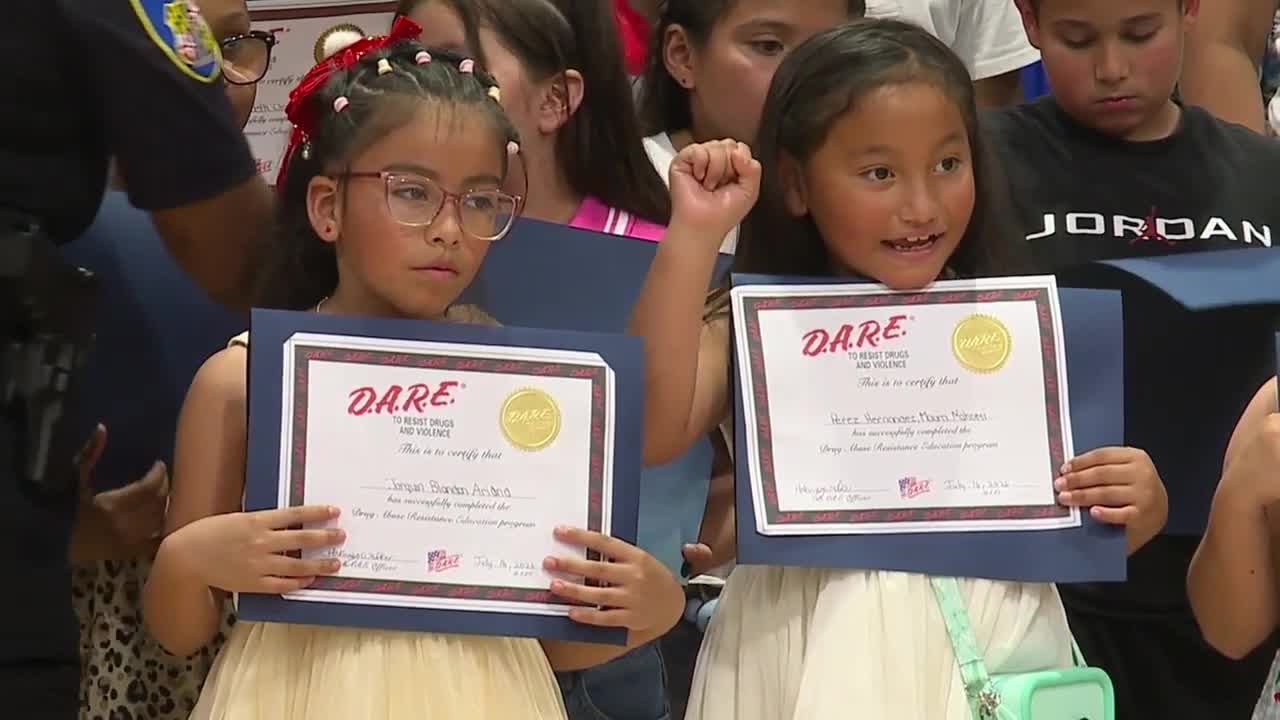
At the conclusion of their training, the officers worked directly with home-schooled students — putting their new skills into practice while reinforcing D.A.R.E.'s core message.
"When you are faced with some of the hard choices — because you are going to get that in life — that you guys have the tools you need to make a good choice when those hard choices come up. Like if someone does offer you drugs or if someone asks you to share an image on social media," one Wasatch County deputy said to the students.
Cyndi Simmons, a mother of 4 whose children participated, said she believes conversations about drugs should start at home — but that having another trusted adult reinforce the message adds value.
"They don't feel like tough conversations for us to have with our kids — we have lots of these conversations with our kids," Simmons said. "I know they focus a lot on just how to make good risk assessments and good choices in any situation and that's what we like to have them be exposed to.”
The officers graduated from D.A.R.E. training on Friday and received their diplomas. D.A.R.E. is taught in about a dozen school districts in Utah.
Parents who want to know how their child's school approaches drug education are encouraged to contact their school directly.
This story was reported on-air by a journalist and has been converted to this platform with the assistance of AI. Our editorial team verifies all reporting on all platforms for fairness and accuracy.
