

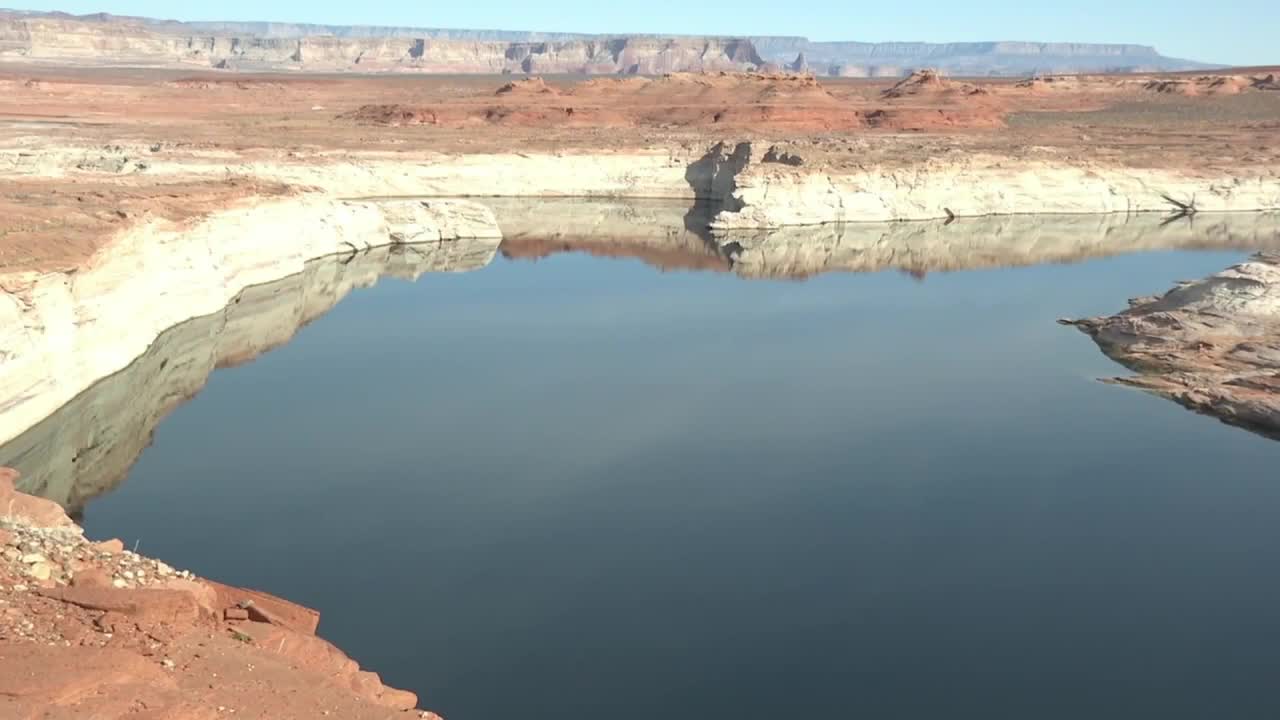


BOULDER, Colorado — If the Colorado River Basin experiences another dry winter, there will be an "outcome with devastating consequences," a new study warns.
It is likely that storage in Lake Powell and Lake Mead will be mostly depleted, with rural and urban communities being impacted.
"...in the event of another dry winter and with low projections of consumptive use, we would experience a gap of 2.59 million acre feet (MAF) between natural supply and Basin use. In such a situation, we risk a crash of the Basin's water storage system," the study warns. "We define a system crash as a situation in which the major reservoirs drop to elevations that risk damage to the dam infrastructure and are operated as 'run-of-the-river' facilities."
It does not mean taps run dry in cities. But agriculture would certainly be harmed. Western states like California are major agricultural producers for the entire United States.
"Many cities have developed diverse water portfolios and can fall back on replacement water supplies such as ground water, local rivers and reclaimed water," the study said. "A system crash would, however, have a significant impact on agricultural use of water."
The paper, released at a conference on the Colorado River at the University of Colorado Boulder on Thursday, is a sobering reminder of the crisis facing seven states and Mexico. The river provides life for more than 40 million people in the West.
"We have to be looking to the Basin as a whole and looking at how we use water in agriculture, for cities, for industry, for ecosystems and make some very difficult decisions about how to reduce use overall," Anne Castle, a former U.S. Commissioner for the Upper Colorado River Commission and one of the study's authors, told the Colorado River Collaborative (of which FOX 13 News is a member).
Current agreements between the states governing who gets what out of the river are due to expire in October, creating a high-stakes political situation. The states have so far not been able to reach a deal, and the Trump administration has prodded them to keep negotiating.
At Thursday's conference at the University of Colorado Boulder's Getches-Wilkinson Center, tribal and environmental groups said it was a call to make significant shifts.
"You have a situation where people die. And given that climate change is an existential threat, it’s lethal," said Daryl Vigil of the Water & Tribes Initiative.
Vigil said sovereign tribes, who are also impacted and have longstanding water rights, must be included in future negotiations about the river.
"What we need now is nothing in terms of incremental change, but complete transformation. And what that means is inclusion," he told the Colorado River Collaborative.
The study does offer another scenario if conditions improve.
"In contrast, if the next year is very wet, similar to Water Year 2023, the Basin's largest federal reservoirs would recover somewhat, but would provide only about two years of cushion before we find ourselves again in the same position we are in today, unless consumptive use decreases further," it said. "The recovery would be welcome but would provide only a brief reprieve from the crisis."
"Both scenarios demonstrate the need to adopt significant additional measures to permanently decrease consumptive uses across the entire Basin."
The study argues that the U.S. Bureau of Reclamation's projections on water levels are "too optimistic."
On Thursday, presentations on climate and hydrology show increasingly warm temperatures across the region and decreasing water flows into the river. All Colorado River states had the warmest March on record. All states were simultaneously very dry.
"These precipitation declines are clearly of concern," said Brad Udall, a water and climate research scientist at Colorado State University.
He spoke to the crowd about long-term trends, including the potential of a "Super El Niño" that could provide some moisture but also forecast models showing a warming climate and persistent drought in the American West.
"All kind of depressing, right?" Udall said to some grim chuckles from the crowd.
Udall said that with climate change, the world will be forced to redo more than 100 years of policy surrounding critical resources. He called on water managers to "pull straws out of this glass."
Katrina Grantz, the deputy director of the Colorado River for the U.S. Bureau of Reclamation, acknowledged the situation "doesn't look good."
"Not only is there less water, there's greater uncertainty looking ahead," she told the crowd, adding the agency is seeing increased frequency of "crisis-driven operations." She warned the crowd to prepare for another dry winter.
The U.S. Bureau of Reclamation ordered the release of a million acre-feet of water from Flaming Gorge to prop up Lake Powell and keep the Glen Canyon Dam generating electricity for millions. The agency has also reduced the amount of water it is releasing from Glen Canyon Dam to stabilize the reservoir levels. That will raise Lake Powell by 54 feet.
"That will hopefully keep Powell above 3,500," Grantz said, referencing the minimum level needed to generate power.
She assured the crowd that Glen Canyon Dam is in sound condition and can deliver water, even with the reduced releases. But she also warned, "We must plan to move forward with less."
John Berggren with Western Resource Advocates said everyone needs to conserve given the hydrologic shortages. His group has proposed some potential solutions for conservation that they believe could stretch resources further.
"If you change some of the policies around it, but take advantage of that conserved water that’s the way you protect critical infrastructure and you can also protect and help ecological conditions and other benefits throughout the Basin," he said.
The study is authored by a former U.S. Commissioner for the Upper Colorado Commission, now at the Getches-Wilkinson Center at the University of Colorado; Utah State University's Center for Colorado River Studies; a retired manager of the Colorado River Water Conservation District; a former director of the Phoenix Water Services now at Arizona State University; and the Utton Transboundary Resources Center at the University of New Mexico.
Read the study here:
This article is published through the Colorado River Collaborative, a solutions journalism initiative supported by the Janet Quinney Lawson Institute for Land, Water, and Air at Utah State University. See all of our stories about how Utahns are impacted by the Colorado River at greatsaltlakenews.org/coloradoriver