



In January 2023, a dementia patient wandered outside a door at her Sandy nursing home that “was supposed to be closed and locked at all times.”
She fell in the snow, “in temperatures close to freezing,” and couldn’t get up. By the time staff found her, she was hypothermic, according to a federal inspection of the facility.
Later that year, on a 99-degree day in July, a resident at a Murray facility left his nursing home and collapsed outside in the hot sun. A passerby found him on the ground, “partially unconscious” and gave him a glass of water before bringing him back, records show.
And 77-year-old James Buchanan, a Vietnam War veteran with dementia and a history of wandering away, died after he slipped out of the secured memory unit at his South Ogden nursing home without anyone noticing in September 2023. Police found him “floating face down in a canal” the next day, according to a complaint his family filed against the facility in state court.
His children “lost their father in such a traumatic way,” said Rachel Sykes, an attorney representing the family in the ongoing lawsuit. It was something, she argues, “that never should have happened.”
These are some of nearly 230 cases the FOX 13 Investigates team has identified of older adults – often with cognitive deficits, like dementia – wandering away from the assisted living centers and nursing homes entrusted with their care.
That number is likely an undercount but is based on a review of thousands of pages of federal nursing home inspection reports; police reports and call logs obtained through public records requests to more than a dozen departments; Silver Alerts; and news coverage of wandering events since 2019.
Eilon Caspi, a gerontologist and elder mistreatment researcher, said wandering from facilities is often a result of inadequate supervision even of residents deemed high risk of wandering away.
“A lot of these things can happen during the evening hours, at night, during weekends,” he said in an interview. “And guess what should happen during these time periods and often does not happen? Well, it has to do with lack of meaningful engagement. It has to do with less staffing.”
Some of the cases FOX 13 News identified involved residents described as “at-risk” due to health and medication needs or inappropriate clothing for the weather, as well as those previously deemed high risk for wandering or who lived in secured memory units.
Others were cognitively intact and able to come and go but were the subject of missing person reports after they failed to check out of a facility or return when they said they would. Among them was a Murray woman who police ultimately found buying a new phone at the mall.
“She appeared fine,” the officer who located her wrote in his report, adding that “she seemed very annoyed that I was there and that the care center called.”
Records reveal some residents left their facilities repeatedly, including one man whose nursing home reported him missing to police at least five times in 2021.
While some residents sustained injuries, many others who wandered away were returned safely home – incidents Caspi said can help “prevent the more serious ones and save lives.”
WATCH: Caspi explains why it’s important to pay attention to track all wandering events
The long-term care industry, he said, should "learn from those near misses, as well as from those situations where the person left and suffered there outside or suffered a physical injury or died.”
Allison Spangler, the president and CEO of the Utah Health Care Association – which represents the state’s long-term care industry – described wandering events as “rare.”
But she added in an email to FOX 13 News that “any incident where a resident was injured or worse is truly tragic” and that the safety and security of assisted living and nursing home residents is “our utmost priority."
She also wrote that there’s an important balance between “ensuring dementia care units are secure” and “adhering to what the resident and families want, what various regulations require, and the ability to maximize residents’ autonomy.”
“We encourage communities to have policies and procedures in place for when elopements” (the industry term for wandering events) “occur, which includes constantly assessing their system for improvements and regular training,” she continued. “We have to be vigilant and continue to look for solutions that ensure resident safety while still offering a home-like environment.”
‘SOMETHING HAS GONE WRONG’
Wandering is a common symptom of Alzheimer’s and other forms of dementia, according to Jeremy Cunningham, the director of public policy for the Alzheimer’s Association’s Utah chapter. The association estimates about 60% of those with dementia will wander at least once.
As the state’s population ages, “we’re seeing more and more people wander, more people get behind the wheel of an automobile,” he said in an interview. “And, you know, it’s really concerning.”
In 2019, the organization pushed for the creation of a Silver Alert program in Utah – a public notification system for missing adults 60 and older. Since that time, he said, the program has helped save more than 40 lives.
"Within the first five hours if they’re found, they have a 90% chance of coming home safe and sound,” Cunningham said. But he noted that life expectancy "decreases rapidly” the longer someone is missing.
“And it’s situational,” he added. “But that eight to 12 hours can determine if a person lives or dies.”
Though common, the Alzheimer’s Association says “wandering can be dangerous – even life-threatening" and that "the stress of this risk weighs heavily on caregivers and family.”
WATCH: Jeremy Cunningham discusses the importance of being prepared for a wandering event
To mitigate that threat, families sometimes turn to long-term care facilities – like assisted living centers and nursing homes – in hopes of finding safer supervision.
Buchanan’s children sought a higher level of care for their father after he began wandering away from his Ogden home in early 2022, according to his family’s lawsuit.
Their complaint contends that South Ogden Post Acute said it was “specifically equipped” to care for dementia patients with exit-seeking behaviors and had secure doors to prevent them from leaving, a claim the facility has denied in court filings.
“They trusted South Ogden Post Acute to keep him safe,” Sykes said of Buchanan’s family, “and to make sure that he didn’t wander, he didn’t escape the facility and didn’t get hurt.”
But shortly after he was admitted, Buchanan wandered away twice in March 2022. The second time, officers found him in Davis County, police records show.
Despite these events, the lawsuit alleges the nursing home did not increase monitoring, put Buchanan on one-to-one supervision or issue him a WanderGuard device, a wearable sensor that triggers an alarm when a resident steps outside a secure area. South Ogden Post Acute has also denied those allegations in its response to the complaint.
In September 2023, police records show Buchanan left the facility again without staff noticing.
As an officer from the South Ogden Police Department searched the facility’s grounds with a nursing home employee, he seemed to indicate that facilities working with so-called troubled teens treat exit-seeking behaviors more seriously.
“They normally put somebody within they call it ‘arm’s reach’ away from them,” he said, according to body camera footage obtained by FOX 13 News through an open records request. “So no matter where they go, there’s somebody that’s just dedicated [to be] their babysitter.”
“I wish we had staff for that,” the employee replied, noting that she already had one resident who required constant one-on-one supervision and “that’s killing us.”
The officer wrote later in his report that staff were aware of Buchanan's exit-seeking behaviors but had not made “any changes to prevent James or anyone else from escaping,” according to a copy of the police report.
Body camera footage shows the officer and staff making plans for a broader search that night.
But by the time they found Buchanan, it was too late. The medical examiner ultimately ruled his cause of death was “accidental drowning.”
Sykes, the family’s attorney, believes “this event was 100% preventable.”
“We’ve claimed that in the lawsuit and I think we’re going to be able to prove that,” she added. “That this never should have happened and that South Ogden was negligent in their monitoring and care of James Buchanan.”
Cascades Healthcare, the management company that operates South Ogden Post Acute (which is owned by Beaver Valley Hospital), issued a statement to FOX 13 News expressing condolences to Buchanan’s family and friends and its commitment to “providing safe, compassionate care to all residents.” It added that “state regulators conducted a thorough investigation and found no deficiencies in our care."
But Sykes argues that someone should never be able to wander away from a secure memory unit, as the lawsuit alleges Buchanan did.
“That means that something has gone wrong and there’s been, you know, a lack of oversight or safeguards or something that allowed that to happen,” she said.
‘THE HUMAN CONNECTION’
In many cases, Caspi said the circumstances behind an “unattended exit,” as he calls them, are “strikingly similar.”
Many incidents occur at times when facilities are commonly understaffed. And a lack of personally significant activities can contribute to wandering behaviors, he added.
“They’re starting to look to do something meaningful with their time,” he said. “And one of the scenarios is that they go to the door and try to get out.”
Newer residents to a facility are also more prone to wandering, Caspi said. The first few hours and weeks in a new nursing home or assisted living center are a “clear risk factor for a particular subgroup of individuals.”
Some facilities use assistive technologies that can alert them to exits, such as WanderGuards. But federal inspection records show they don’t always stop someone from wandering away.
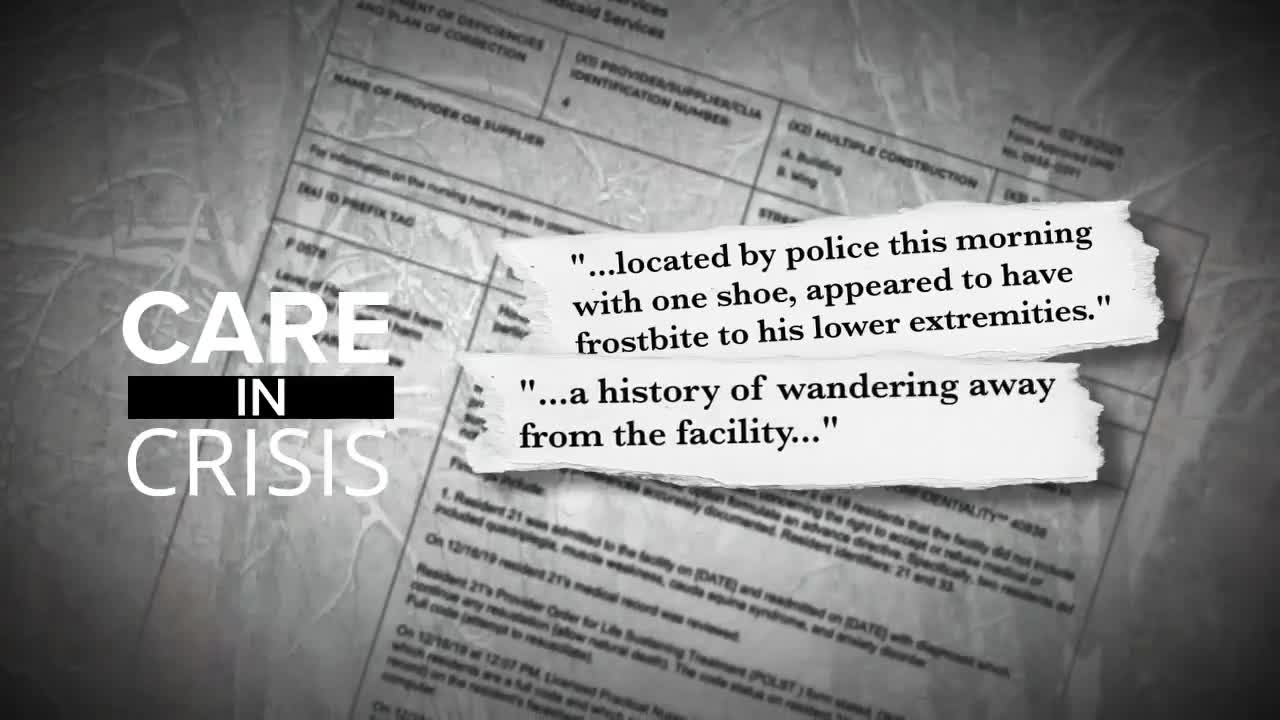
For example, one man who left his Salt Lake City nursing home on a snowy day in November 2019 and spent the night wandering the streets with one shoe off was wearing a working WanderGuard on his leg when he left the facility.
But it seems no one responded when the alarm sounded that he’d left the building, according to a federal inspection report. An administrator told regulators he would remind staff that when the WanderGuard alarm goes off, they need to “find the resident” that had deployed it.
Spangler, with the Utah Health Care Association, said in an email that the organization did not have data on the number of facilities in the state that use WanderGuards or similar devices.
Caspi, founder of the organization Dementia Behavior Consulting LLC – which provides guidance to facilities and families on how to prevent harmful behaviors among those with declining cognition – said these technologies can be helpful. But he added that "what we need is the low tech.”
“We can and we should think very seriously about investing in assistive technology,” he continued. “But it shouldn't be a substitute for the human connection.”
To prevent wandering events, he suggested that facilities also invest in staffing and in their recreation departments, to ensure residents are meaningfully engaged. Better training for staff and administrators can also help, Caspi said.
"What you want is to make sure that these leaders understand the risks involved and to demand that they will put upfront the resources needed” to reduce these incidents, he added.
If someone does wander, Cunningham, with the Alzheimer's Association’s Utah chapter, said the community has an important role to play. He encourages the public to keep an eye out for older adults who seem confused or out of place and to call for additional help if needed.
Ask, “Who are you looking for? What are you needing? You look really hot. Can I get you a drink?” he said. “I mean, you want to de-escalate and build trust. And then I think the individual’s more willing to talk to you and you can assess the situation.”
Two years after Buchanan’s death, Sykes said his children are still grieving their father, who they describe as a “jack of all trades” and a devoted parent.
She says they hope sharing his story will prevent other families from experiencing the same loss – and that their lawsuit will bring what they see as needed accountability for his death. “They don’t want this to happen to another family,” she said.