


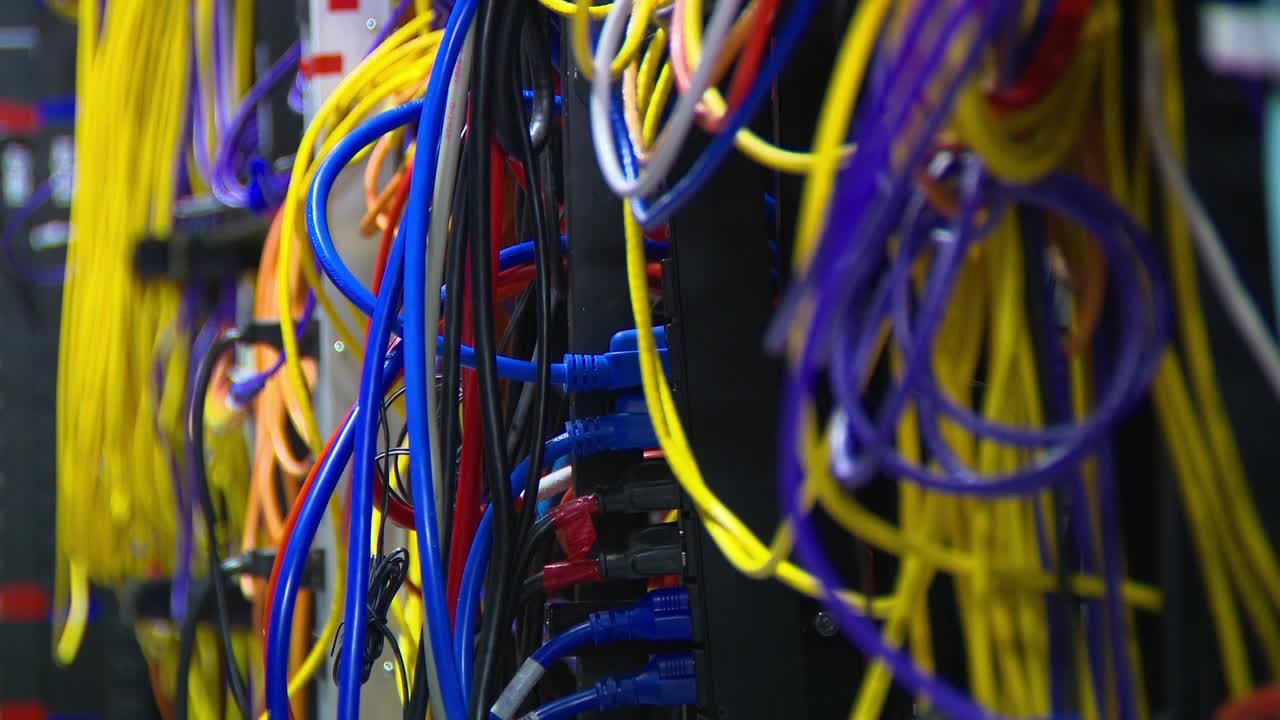


ST. GEORGE, Utah — For decades, small data centers have quietly served as the physical backbone of the internet.
But new, large-scale data centers meant to support artificial intelligence are sizing up significantly — and there’s been a corresponding increase in public scrutiny and concern about an industry long used to operating behind the scenes.
WATCH | Massive Utah data centers draw scrutiny, but smaller ones have existed for years
"There are quite a few already operating in Utah,” noted Shon Hiatt, a University of Southern California professor who has studied the state's data center landscape. But, he added, “the trend moving forward is bigger, larger data centers.”
Utah currently has at least 48 operational data centers, according to Hiatt’s recent report for the Kem C. Gardner Policy Institute. But another seven under construction will use more energy than all those that currently exist in the state combined, the report notes.
Pete Ashdown, president and founder of XMission, has operated a small data center in the heart of downtown Salt Lake City for more than 25 years. He stresses that there are “two different stories” when it comes to these facilities.
“It’s the traditional data centers that handles your email, handles your webpages, that have been around for decades,” Ashdown said. “And then there’s this new style of data center.”
The new hyperscale data centers have sprung up largely to support the recent boom in artificial intelligence and the corresponding surge in demand for computing and processing power.
“Around the time Chat GPT came out — 2022, 2023 — that was a game changer because then it started an AI race, basically,” said Bob West, the vice president of marketing for ValorC3, which operates a small data center in St. George.
“And with that, it caught the data center industry kind of off guard,” he added. “There wasn't enough capacity, and people started building data centers like crazy.”
That construction craze has sparked intense bipartisan blowback across the United States in recent months, with polls showing a majority of Utahns are now opposed to new data centers.
Nearly 76% of respondents in a Utah State University survey released last week said they oppose or strongly oppose building new data centers in the state. And 90% said they see the amount of water a project consumes as “very important” in determining whether they would support or oppose a particular project.
Hiatt said he believes the opposition also reflects broader fears about the future of artificial intelligence.
"What does it mean for society? What does it mean for my job?” he said, referencing the questions many people are asking as the technology rapidly advances. “And because of that, there's this anti, negative sentiment towards AI. And now it's being shifted to the data centers.”
'A lot of misconceptions’
While the phrase “data center” raises the specter of massive, power and energy-hungry campuses with thousands of servers, those in the industry stress that these facilities are not monolithic.
“I think there's just a lot of misconceptions about data centers and what we do here,” said West, with ValorC3. “Everybody thinks that, No. 1, there are these huge campuses and data centers are bad. They draw all this power; they take up all this water. And that's just not true.”
ValorC3 is a colocation data center, where other businesses rent space for their own servers and hardware. Chris Damrow, the director of facilities management there, describes it as “a hotel for companies’ or individuals’ very expensive computers.”
“Really what we do is provide power and cooling for other people’s computers,” he added, noting that the data center’s clients range from health care companies to financial institutions.
Colocation centers are different from what have been deemed “hyperscale” data centers. Those are predominantly owned and operated by major technology companies, like Facebook or Amazon, “and they need a very, very big footprint and a lot of power,” Damrow said.
WATCH | West, with ValorC3, explains the different types of data centers:
ValorC3’s St. George data center has a capacity of about 4 megawatts. That’s several thousand times smaller than the Stratos data center planned for Box Elder County that has dominated headlines in recent months.
In thirsty southern Utah, Damrow said ValorC3’s data center is cooled with a direct expansion system, which uses refrigerant rather than water. The trade-off of that system, though, is that it can be more energy-intensive — a resource Damrow said ValorC3 also tries to use judiciously.
“If we’re not,” he noted, “we’re losing money.”
About 300 miles north, XMission operates a colocation data center with an even smaller footprint than ValorC3's. The Salt Lake City facility has a capacity of just under 1 megawatt and uses a closed-loop cooling system that Ashdown compares to a car radiator.
“You’re not continually putting water into your car to cool your car,” he noted. “But the air that flows through the front of your car cools off the entire system of your car. It’s just a matter of moving heat around inside the engine and out to where it can be ejected.”
Asked to compare what he calls a “traditional data center” like XMission to the hyperscale ones coming online now, Ashdown argues that the latter have far more “intense” environmental impacts due to their scale.
"It’s doing one thing with one type of equipment that’s packed as dense as possible with as much power as possible and a whole lot of water,” he said. “And that’s not what happens here.”
FOX 13 News called or emailed all 48 operational data centers in the state requesting a tour, but only XMission and ValorC3 agreed to provide one.
‘I don’t trust them’
As the data center industry continues to scale up, Hiatt said Utah is in the middle of the pack nationally, both by the number of operational data centers and those under construction.
“Utah is getting close, but it’s not experiencing what I would say [is a] tremendous amount of growth” compared to some other states, he said. “It’s actually a sustained, manageable growth, what I see right now in Utah. And it’s something I think that Utahns should be happy about.”
There are currently more than 1,500 data centers under construction nationwide, according to April data from the Pew Research Center. Most are planned for the South and Midwest, while the West has 277 planned — a 34% increase.
And the building boom seems unlikely to die down anytime soon.
"I think anybody in this space right now would say that there's an overwhelming amount of demand,” West said. “And most of the time, a lot of the providers that I know — and even us — we just can't meet those levels of demand."
WATCH | Hiatt, with the University of Southern California, explains how Utah compares to the rest of the country in terms of data center growth:
Asked about the public backlash against data centers, West said he believes the industry could do a better job of being transparent with the public and communicating how "critical" they are to an economy that is increasingly dependent on digital infrastructure.
He also believes these facilities will get better at managing resources over time.
"The data center industry is really good at evolving, and technology is great at evolving,” he said. “So I think we'll find better ways to use power and water.”
Ashdown, however, is skeptical of the need for more scale and believes the demand is largely speculative.
He thinks computing and processing will require less space as they become more efficient over time, which will eventually render large-scale campuses unnecessary.
“I think that these AI data centers are probably going to be pickleball courts in 10 years,” he said. “They’re way too big for what we need.”
He's also skeptical of promises from technology companies that they can mitigate negative environmental impacts.
“They’re saying, ‘No, just trust us; it’s going to be fine,’” Ashdown said.“‘We’ve got plenty of water to do this and we’re not using that much water anyway. Just trust us.’”
The problem, he said, is that “I don’t trust them.”