

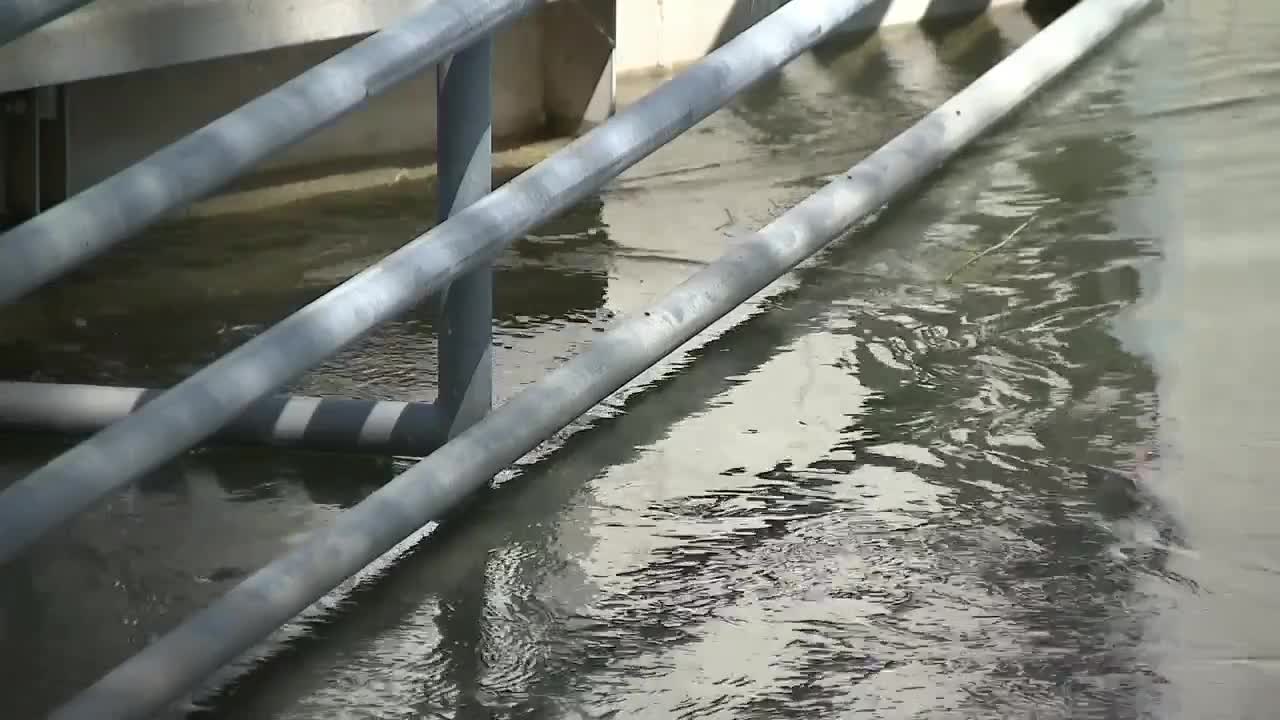


LOGAN, Utah — Just off the Logan River is a new diversion structure designed to help farmers in the Cache Valley use water more efficiently.
"The canal company spent almost $2 million over the last year putting in a new diversion structure here behind us with automated, real-time water measurement and piping the first mile or so of our canal company," said Nathan Daugs with the Cache Water District. "That gives us the option, or ability, to measure exactly what we’re diverting with our water right."
The Cache Water District is looking at other ways of stretching water resources further. Some of the small canal company's farmers are participating in a pilot project with the Great Salt Lake Commissioner's Office to test a new law allowing them to treat water like another crop and lease it to the lake.
"We’re getting a lot of good feedback. We’re building a lot of trust," said Hannah Freeze, the deputy Great Salt Lake Commissioner, among those tasked by Utah political leaders with reversing the lake's dramatic declines.
The idea of allowing farmers to treat water as a commodity and lease it to the state was allowed under a law that was passed by the Utah State Legislature this year and is starting to roll out. To ensure agriculture — Utah's top water user — supported it, farmers helped with drafting the legislation.
"The answer can’t be 'No,'" Freeze recalled in a recent interview with FOX 13 News.
Colorado River Basin sliding toward system-wide crash, new study warns:
The Great Salt Lake is once again shrinking. Impacted by water diversions from the rivers that flow into it, drought and a changing climate, the lake's declines present an ecological threat to public health, wildlife and economy. The lake generates snowpack, which supplies the majority of drinking water to the Wasatch Front; it acts as a refuge for millions of migratory birds; and numerous industries benefit from it.
So the program is starting off in the Cache Valley, a huge agriculture producer in the state. The pilot project allows a farmer to lease the water to the Great Salt Lake Commissioner's Office. They don't lose their water rights but are compensated for its use.
"We need to show that we are doing our part to help the environment. If the state is willing to help step up and pay for that leased water, maybe it’s worth the risk," Daugs told FOX 13 News.
The pilot project is starting small to ensure the state can make it as easy as possible for an agriculture producer to commit to it. The Utah State Engineer is handling the applications and helping to track where the water is going if it's not at the farm.
"We’re talking about a small amount of water. Maybe 5,000-acre feet. But that’s OK," Freeze said. "What we’re really focused on right now is trust, to say we have these tools in place, we have these mechanisms, we want to prove that they work and if they’re things that don’t work, we can adjust. If it doesn’t work for our producers, it’s not going to work for the lake."
Programs like this are a significant shift in how Utah has handled agriculture water for generations.
"It hasn’t been done in 150 years, right? So it’s brand new," Daugs said.
Trust is proving to be a big issue with agriculture producers.
"I will be honest, some of our farmers aren’t super excited about leasing," said Trevor Nelson, the general manager of the Bear River Canal Company, which is not participating in the pilot project. "There is that concern of, 'Once I start leasing to this, that, or the other environmental interest, am I going to get it back?' But when it was discussed at our annual shareholders meeting, I could see pencils and paper coming out and calculators running."
Freeze said the Great Salt Lake Commissioner's Office has gone to great lengths to assure farmers and ranchers that they don't lose water rights by participating in this program. A similar program is also playing out in the Colorado River system, where the state is paying some farmers to not grow crops and let the water go downstream to prop up Lake Powell.
But Daugs said the farmers who have volunteered also demand something else from the state: assurances and proof that the water they give isn't going to be diverted further downstream but will actually help the Great Salt Lake.
"Ag gets portrayed as the bad guy most of the time when it comes to water. This gives us a great opportunity to show ag is doing their part," he said. "But they want proof that them giving up a crop and taking the risk at the first of the year makes sense in the end and really got there."
This article is published through the Great Salt Lake Collaborative, a solutions journalism initiative that partners news, education and media organizations to help inform people about the plight of the Great Salt Lake—and what can be done to make a difference before it is too late. Read all of our stories at greatsaltlakenews.org.