

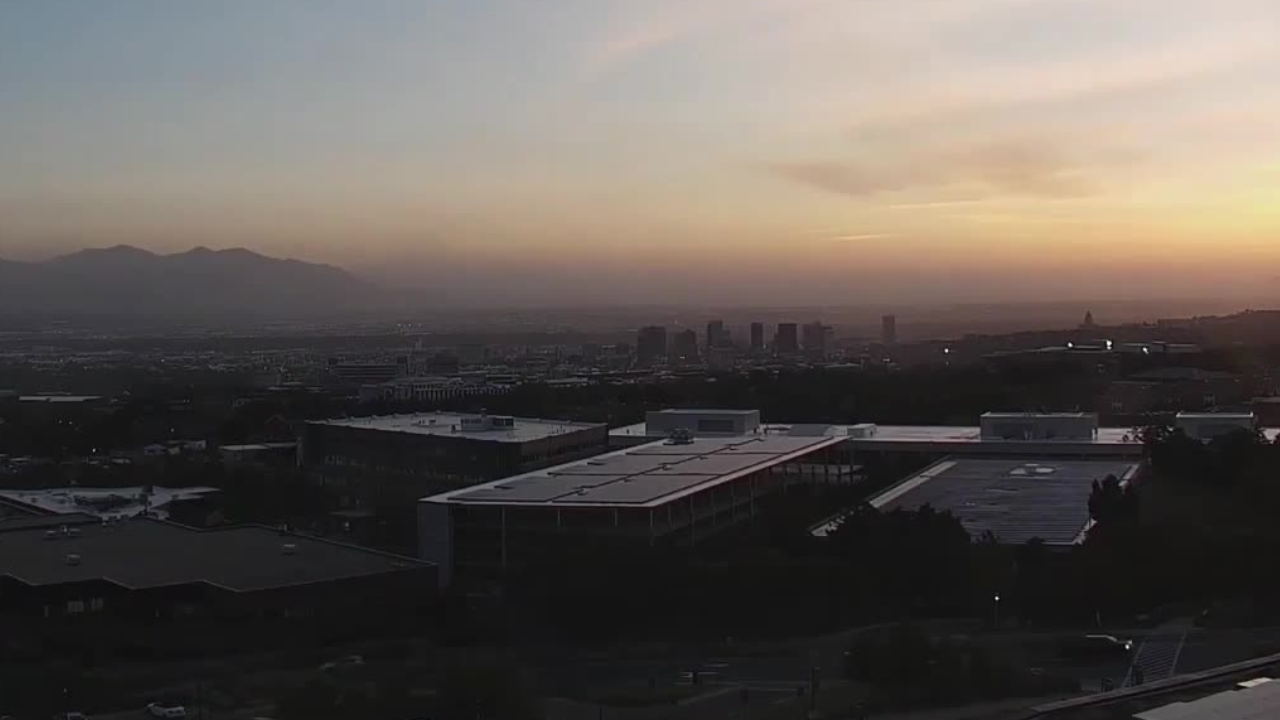


SALT LAKE CITY — A FOX 13 News camera on top of the Natural History Museum of Utah documented a Great Salt Lake dust event Wednesday night.
For hours, winds from 30 to 45 miles per hour pushed dust off the exposed lake bed into Salt Lake City and nearby communities. Through a time-lapse, you can see the dust event. A weather satellite also recorded dust blowing from the northwest across the lake and into communities.
Utah's Department of Environmental Quality told FOX 13 News that Wednesday night's dust event lasted about five hours. Areas around Farmington Bay were particularly impacted.
Time-lapse video below shows dust event off Great Salt Lake:
The dust storm underscores a growing concern for Salt Lake City and suburban communities around the Great Salt Lake.
"It’s like a ticking time bomb," said Daniel Tuutau, the chair of the Poplar Grove Community Council in Salt Lake City.
Tuutau and others in west-side communities closest to the lake have been pushing for dust monitors to be installed in their neighborhoods to give people an idea of how bad the dust situation is and what they can do about it.
Utah no longer to be held accountable for pollution coming from outside sources:
"That’s what we want to know," Tuutau told FOX 13 News. "That’s why we want dust monitors put in place, because you don’t have to have a question of what you’re breathing."
Dust alone is harmful to your lungs. But arsenic, lithium and numerous metals are naturally in the lake bed. Covered by water, it's not such an issue. But as the Great Salt Lake shrinks, winds pick up the exposed lake bed and blow it into nearby communities and people are put at risk. So far, more than 800 square miles of lake bed are exposed and roughly 70 square miles have been identified as "dust hot spots."
Currently, scientists are researching how much exposure people need for the chemicals to be harmful. Research has already shown that Great Salt Lake dust is impacting crops and soils.
After public pressure, the Utah State Legislature funded a series of dust monitors for communities around the Great Salt Lake. They are now being installed from as far north as Smithfield and Brigham City all the way down to Lindon and Herriman. The first 10 are expected to be in place by July.
Scientists showed FOX 13 News a dust monitoring station already operating near Saltair. It gathers data on PM10 and PM2.5 and collects dust samples pulled from the air to be sent to a lab for analysis.
"The goal is to provide the community with information," said Pierce Wratten, an environmental scientist with the Utah Division of Air Quality. "All this data will be publicly available."
State air quality director Bryce Bird said it will allow them to collect particles that are actually becoming airborne that could harm public health. It also will be shared with researchers who are studying Great Salt Lake dust.
The few monitors that are in place have provided some valuable data already, Bird told FOX 13 News.
"We know there have been dust impacts, but we’re not seeing violations of air quality standards that we could potentially see as the lake remains dry over time," he said.
Obviously, the easiest solution to fix the Great Salt Lake dust problem is to get water into the lake and cover the exposed playa. That is the subject of a massive effort by environmentalists and politicians who are purchasing water upstream to send to the lake and passing laws designed to prod more people to conserve.
Tuutau said dust monitors are critical infrastructure for neighborhoods like Poplar Grove.
"The not knowing is the biggest concern," he said. "Is this cloudy day going to bring some sort of toxins in or is this just more dust and dirt in the air?"
Utah's Department of Environmental Quality publishes air quality updates for people to decide whether it's good to be outside. You can check real-time air quality data here.
This article is published through the Great Salt Lake Collaborative, a solutions journalism initiative that partners news, education and media organizations to help inform people about the plight of the Great Salt Lake—and what can be done to make a difference before it is too late. Read all of our stories at greatsaltlakenews.org.
