

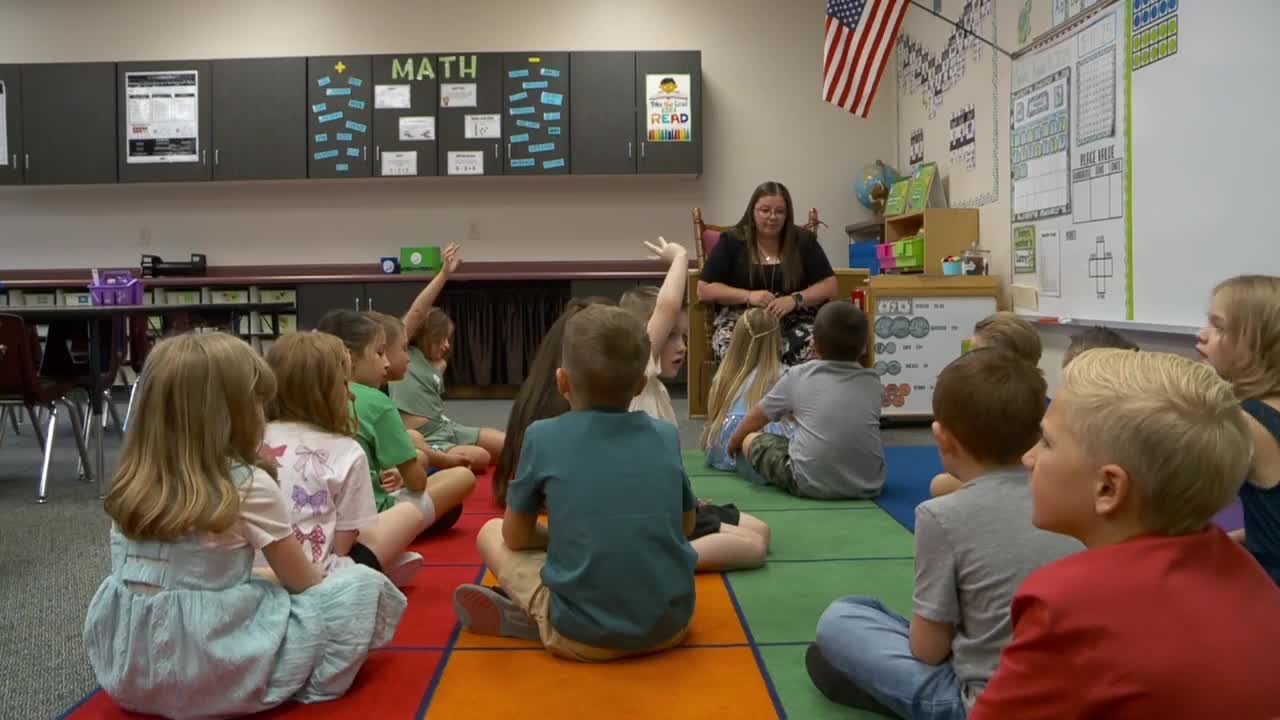


SALT LAKE CITY — An alarming report shows that nearly half of young children in Utah cannot read at their grade level, with deficiencies showing up across the state and not found in one or two areas.
The report issued Monday by the Kem C. Gardner Policy Institute at the University of Utah detailed how a large percentage of K-3 students in Utah have failed to meet grade-level expectations. By state definition, a student is reading on grade level if they meet or exceed a score of 405 on the end of year benchmark reading assessment.
Among the numbers released in the study is data showcasing how just 50.3 percent of third graders are achieving grade-level proficiency. The report said that students who have a command of reading by the third-grade "progress through coursework more effectively, graduate at higher rates, and experience stronger long-term employment and health outcomes."
As Utah students struggle to read, what's being done to help them?
"We look at third grade specifically as like a pivot point," explained Andrea Thomas Brandley, the lead author of the report. "Prior to third grade, students are spending a lot of their time learning to read, and then after third grade, they’re doing a lot of reading to learn."
The school districts that struggle with K-3 student reading proficiency include those in northern and southern areas of Utah, including the Salt Lake City School District, which is one of 17 districts that fail to reach 50 percent. Only the Park City School District, at 70.1%, met the goal of more than 70 percent proficiency in 2025.
More statistics from the study show that only 18% of third-grade students with limited English-language proficiency and 35.2% of economically disadvantaged students met grade-level expectations.
As an educator, Aaron Fischer, a professor of school psychology at the University of Utah, wasn’t surprised by the numbers released Monday.
“For me, that speaks to students having a hard time either retaining or initially accessing the materials," he said, "and I think when we think of our marginalized learners, I think it’s particularly in some of our rural communities, some of our communities that are experiencing poverty, these issues become magnified."
Although the data features rather dire news, there are some signs of improvement. While Kindergarten proficiency was just 53.3% in 2025, the level has increased from 37.7% in 2021.
The Institute highlighted recent efforts by Mississippi education leaders as a guiding light for Utah to follow. Mississippi's fourth-grade reading scores ranked 49th nationally in 2013, but had climbed to ninth overall in 2024 thanks to what the report claimed was a "multi-year, coordinated approach and the state’s emphasis on implementation quality, rather than any individual reform acting alone."
In its conclusion, the report noted the challenge to raise reading proficiency among young Utah students, adding that goals can be achieved through a combination of contributions from schools, families and communities, while also acknowledging that the state has "already taken significant steps to strengthen the foundations of early literacy."
Brandley and Fischer both said early literacy sets students up for educational success, better health and well-being, and even a greater economy in the future. But is there a solution to raising the reading rates?
“That’s the 10-million-dollar question," said Fischer. "The thing is, we all know that this issue exists. We know that it was due to the implications of the pandemic and all the fallout. But I think what’s still missing, and a lot of what we try to do through our community partnerships, is really try to help bridge that gap."
Brandley added that learning comes from in and out of the classroom.
“Particularly when kids are 0-5 [years of age]. It’s the most rapid brain development we experience in our lives. While we don’t know the cause necessarily, I do think this is a critical time to make sure that students are exposed to language and books and conversations and storytelling with caregivers. That helps build a foundation for them to be ready more formally when they enter school.”