



OREM, Utah — In an age of ever-growing sources of media and evolving technology, it's become increasingly difficult to determine what’s true and what’s not, according to Katharine Biele, who heads up the League of Women Voters in Utah.
Biele shared how it’s become a challenge for groups like hers to connect voters with trusted sources of information.
“Because social media is, of course, very useful, very engaging — and can be very deceptive," she said.
New research unveiled by Utah Valley University on Thursday showed how the line between reality and AI is becoming blurred.
“Today’s information offers a warning that we need to verify our sources," explained Justin Jones, Executive Director, Gary R. Herbert Institute for Public Policy.
“There’s only so much that being tech savvy can tell you about tech," added Hope Fager with the UVU Emerging Tech Policy Lab.
As AI improves, real-time deepfakes pose growing risks:
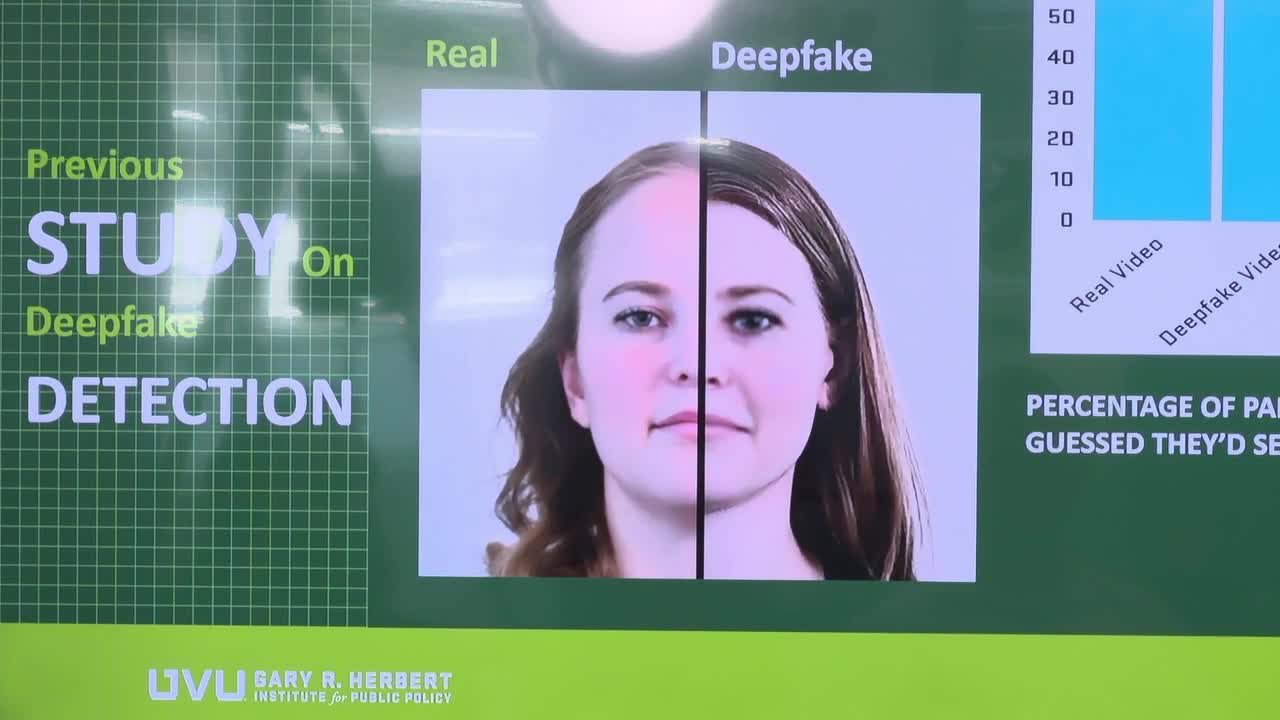
Fager was among the students at the Policy Lab who conducted a study of more than 600 people from across all age groups and the political spectrum.
“We used publicly available tools on an old, student-owned laptop," said Brandon Amacher, Director, Emerging Tech Policy Lab.
Students created deepfake videos and showed those to some participants, while showing real videos to others.
What did they find?
“Democrats, Republicans, and independents detected deepfakes at nearly identical, and I will add, uniformly poor, rates," said Amacher.
Those rates were between 15 and 19 percent, leading students to conclude that deepfakes are swaying public opinion just as effectively as real media.
“If a small university lab can do that, this is no longer a capability that is constrained to highly sophisticated, malicious actors," Amacher said.
With Utah’s primary day just around the corner, the director added that those who think they’re too smart to be deceived are the perfect marks.
Researchers said it’s critical to engage directly with candidates, and if you must engage online, Biele said, "to step back and think.”
