

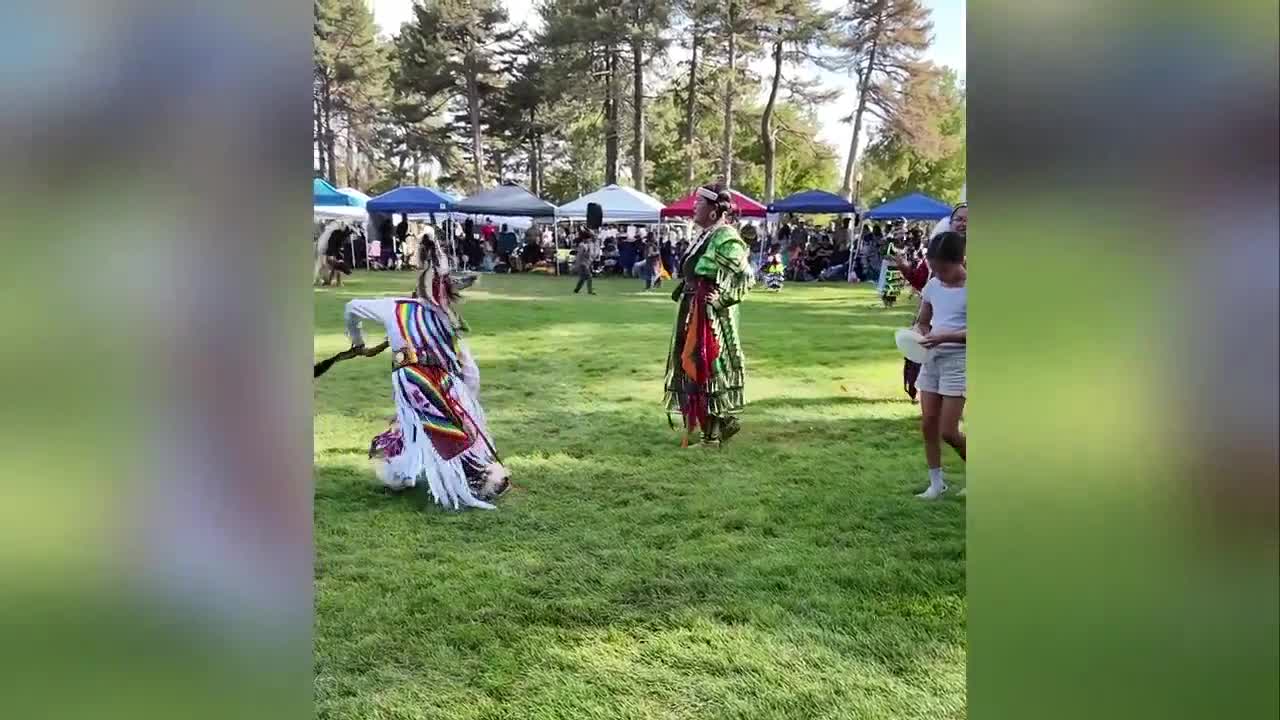


SALT LAKE CITY — As Utahns celebrated Pioneer Day on Friday, dancers and families gathered at Liberty Park to celebrate a history that began long before pioneers entered the Salt Lake Valley.
The Uniting Communities Powwow brought Native American dancing, drumming, and traditions to the park, offering visitors a chance to experience cultures that remain an important part of Utah today.
For powwow dancer Kayden Denny, that connection between past and present is part of what makes holding the event on Pioneer Day meaningful.
“History happens now, and we are the representatives of that,” Denny said.
Pioneer Day commemorates the arrival of Latter-day Saint pioneers in the Salt Lake Valley in 1847. Indigenous peoples had lived throughout the region for generations before their arrival.
Utah today is home to eight federally recognized tribal nations, according to the Utah Division of Indian Affairs: the Confederated Tribes of the Goshute Reservation, Skull Valley Band of Goshute, Northwestern Band of the Shoshone Nation, Ute Indian Tribe of the Uintah and Ouray Reservation, Paiute Indian Tribe of Utah, San Juan Southern Paiute Tribe, Navajo Nation and White Mesa Community of the Ute Mountain Ute Tribe.
Denny said Native American history is an important part of understanding Utah history.
“What comes with Utah’s history is Native Americans, the five tribes of Utah,” Denny said.
But for Denny, that history is not something that exists only in books or museums. At the powwow, it could be seen in the dancers, heard in the drums, and experienced by people attending the celebration.
“It’s very welcoming. It’s very healing,” Denny said. “A lot of these dancers, they tell stories that nobody can explain in words.”
Organizer Chelsea Nez said bringing the powwow to Liberty Park on Pioneer Day gives Native Americans an opportunity to share their place in Utah’s cultural story.
“It’s not that we are holding it against the pioneers,” Nez said. “It’s that we want to also show that we are also very much a part of Utah culture.”
For Nez, the powwow is also an invitation.
She said she hopes people unfamiliar with Native American traditions will come with questions and a willingness to learn.
“We want people to be curious about our culture,” Nez said. “More than anything, we want to be understood, and how we can be understood is celebrating and sharing with everybody here in Utah.”
That sharing could be seen throughout Liberty Park as generations gathered and dancers carried traditions forward.
Denny said the experience can convey something difficult to put into words.
“You can feel hope, strength, happiness, all of these wonderful things inside of you,” she said. “It feels like it’s speaking to you, but you don’t hear any words.”
For Denny, that is part of what Pioneer Day can represent: remembering Utah’s history while recognizing the people and cultures continuing to shape it.
“History happens now,” she said.