


PROVO, Utah — A couple of dozen Utah County residents spent a long night immersing themselves in the experience of homelessness Friday night.
Community Action Services and Food Bank (CASFB) in Provo hosted a unique event called‘Come to the Table,’ inviting the public to walk with them and learn what it’s like to live as a vulnerable member of this community.
“These will be different scenarios based on real people,” said Holly Johnson, who helped coordinate the event.
Each attendee got a profile that matches a situation that someone in Utah County has lived through or is living through right now.
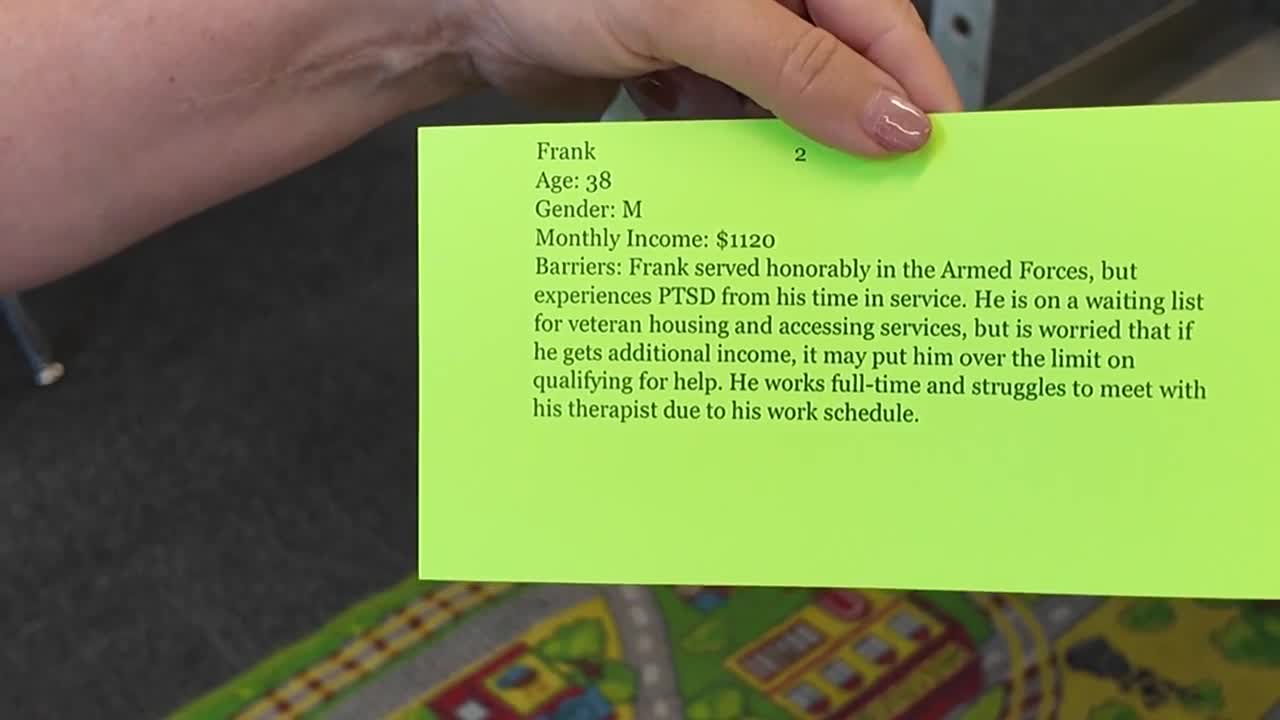
For example, ours featured a 38-year-old man named Frank. His monthly income is $1120, and his profile reads: “Frank served honorably in the armed forces, but he experiences ptsd from his time in service. He is on a waiting list for veteran housing and accessing services. But he’s worried that if he gets additional income, it may put him over the limit on qualifying for help. He works full-time and struggles to meet with his therapist due to his work schedule.”
With those personal histories and our own packs to carry, we were brought on a guided walk amid the 90-degree heat of the late afternoon.
“It gives us a chance to go through what they’re going through - see it with our own eyes,” said Brian Harris, who lives in Provo.
It also gave attendees a chance to learn about all the local resources here in the community - going from Community Action to the Food and Care Coalition to the Genesis Project.
Kena Mathews with CASFB says their 2025 ‘Point in Time Count’ identified 235 homeless individuals, which marked a 34 percent year-over-year increase in Utah County.
Utah County Commissioner Skyler Beltran, who also spoke at the event, told Fox 13 News they’ve actually seen a reduction in people experiencing chronic homelessness. So he says those figures are being lifted by those who find themselves temporarily displaced.
But county and community leaders both acknowledge the concerns with rising costs and a lack of affordable housing within the county.
So Mathews hopes people use this experience to help take part in solving the problem.
“Homeless people have to experience a lot of things that maybe you and I don't,” said Mathews. “We get to go home at night. We lay down, we get to take a shower.”
“It is a really eye-opening experience,” Mathews continued, speaking about ‘Come to the Table’. “They’re just people who are in need of love and encouragement and so if you can learn about these people - learn that they’re just people - I think that’s a really good education piece, your compassion may change.”
The group ended the night by returning to the profiles they were given. They walked a mile and a half to the Provo Community Congregational United Church of Christ for an activity that looked at each scenario and asked three important questions: Where do we go during the day? How do we get around (transportation)? What belongings can we take with us?
Attendees noted that those are three questions most of us don't have to think about on a day-to-day basis, which is eye-opening in itself.
Utah County is seeing a 34% increase in homelessness, but a county official says the rise is not in the chronically homeless population — it's in the number of people who need temporary shelter or assistance.
Utah County Commissioner Skyler Beltran says there are varying degrees of homelessness, and many of those now seeking help are people living on the financial edge.
"You know, the folks who are living paycheck to paycheck, and one car repair puts them out. You know, one missed mortgage or rent payment or one medical bill. We have a lot of those folks," Beltran said.
Beltran says Utah County has a comprehensive approach to providing services and that, compared to Salt Lake County, homelessness in Utah County is less visible — in part because of the larger number of homeless individuals in Salt Lake County.
He also pointed to the county's strict approach to public behavior and its partnership between law enforcement and social services as key factors.
"And so I would say that the sheer number is significant, but also our no tolerance. We don't tolerate vagrancy; we don't tolerate sleeping on the street. We don't tolerate law breaking, and we have a great partnership between our law enforcement and our social services. And that relationship needs to be there because law enforcement may have an entirely different approach than what social service teams would like to see. We get everybody in a room once a month and we hash out those things so that we can do it in the best way for the community," Beltran said.
Beltran says centralizing services at the county warming center and imposing stricter rules there has been successful in reducing the number of people who need help. He says for those who want to improve their lives and create stability, Utah County is a great place with great resources — but for those who don't want that, he says Utah County isn't the best place for them.
Meanwhile, statewide data shows an overall decline in homelessness. Last month, Gov. Cox released data from this year's "Point in Time" count indicating that on a single night last January, there were 4,512 Utahns without a home, compared to 4,584 in 2025 — a decrease of 1.6%.
For the chronically homeless, Utah saw a decrease of 6.7%. Chronic homelessness represents the highest-need, highest-cost segment of the homeless population.
This story was reported on-air by a journalist and has been converted to this platform with the assistance of AI. Our editorial team verifies all reporting on all platforms for fairness and accuracy.