

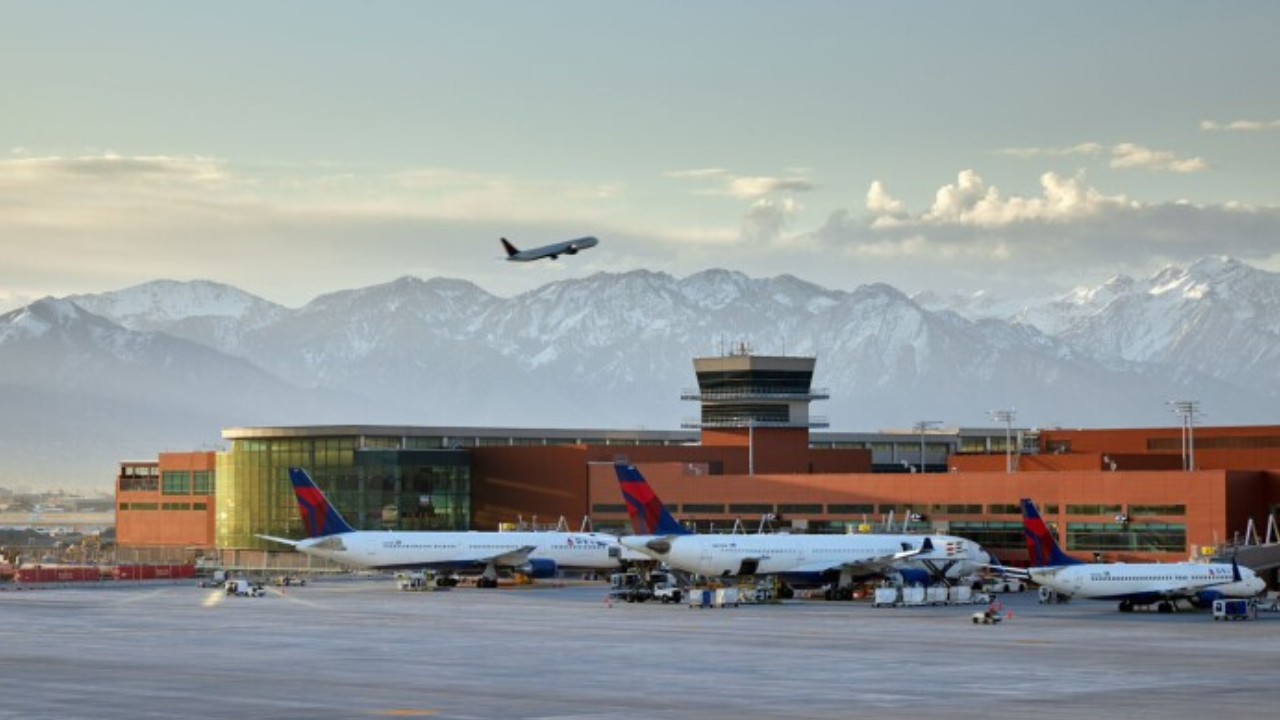


SALT LAKE CITY — Three flights were diverted away from the Salt Lake City International Airport over the weekend, with one pilot telling air traffic control that Sunday's record-breaking heat was the reason.
Liveatc.net captured the communications between a SkyWest flight and Salt Lake City approach as the temperature reached a record 109º, or in aviation terms, 43 degrees Celsius.
“Can you extend our downwind? I’m trying to discuss it with dispatch. We may have to go to Twin Falls. I think it’s too hot for us to land. You’re at 43º, is that correct?," asked the SkyWest pilot.
SkyWest told FOX 13 News that it operated a full schedule on Sunday with "100% completion," althought adding that a "small number" of SkyWest-operated Delta Connection flights were delayed or diverted due to the high temperatures.
"Our teams worked closely with our airline partners to minimize disruption for travelers," the airline said.
In the audio, the crew’s reasoning for diverting is something familiar to pilots.
“The feeling coming off of an airplane is someone turn the blow dryer off; it’s so hot here," explained pilot Kyle Cannon.
Listen to full pilot, air traffic control discussion about extreme heat below:
Not only a pilot but a flight instructor, Cannon said it all has to do with air density. As air gets warmer, it becomes less dense. The same thing happens as you get higher above sea level. On the ground, Salt Lake City is already about 4,200 feet above sea level.
“The density altitude when it’s exceptionally hot outside may be 8,000 feet or higher,” added Cannon, which is much different than sea level, and it can mean planes don’t get the same engine performance that crews expect.
“You take away the performance… you’re going to have longer roll times on the ground. Longer take-off distances, longer landing. You’re going to use up more runway," said Jason Clark, CEO and founder of FLT Academy.
Clark said much of the academy's fleet never makes it into the air once it gets above 100º.
“We have a really hard time flying in July and August," he said. "And we have a really hard time flying in January and February.”
During peak times in the fall and spring, Clark said Woods Cross Airport can see as many as 200 flights going in and out each day. That number dwindles to 50 or 60 when the temperatures tip towards the triple digits.
“[Temperature] is a big factor," said Clark. "I mean, we do lose a lot of money on these days. You see all these planes parked on the ramp: they’re not flying, they’re not generating revenue."
The heat isn’t just affecting business or performance. Weight is a huge consideration in flying, which is why training aircraft don’t have the same luxuries found in a car.
“All these smaller aircraft don’t even have air conditioning. So you’re flying around in this little bubble in the sky that’s being cooked all day long," said Clark.
That's why pilots ask for a little grace when the luxury of flying gets put on Mother Nature’s hot seat.
“Just being patient and recognizing... if it’s that hot, it’s probably going to be hot and uncomfortable on the plane," Cannon added. "Everyone just wants to get going… but we have to stick to safety as our first priority.”