



SALT LAKE CITY — A national blood supply crisis has been declared for only the second time in history. Here is what it means for Utah patients and how you can help.
The American Red Cross declared a national blood supply crisis after blood donations fell to a four-year low this summer. It marks only the second time in history a national shortage has been declared. The shortage is already affecting patients across the country — and in Utah, the impact is real.
Blood is needed in the U.S. on average every two seconds. In Utah, that translates to someone needing a blood transfusion every few minutes. Cancer patients, trauma victims, newborn babies, and people with blood diseases all depend on a steady supply. When that supply runs low, hospitals are forced to make difficult decisions about who receives care first — and surgeries, trauma care, and other treatments that require transfusions may be delayed.
One of the most critical facts driving the urgency: blood cannot be manufactured in a lab.
"We can't reproduce blood, so we have to donate it," Dr. Mike Woodruff, executive medical director of Regence BlueCross BlueShield of Utah said.
What blood types are needed most
Type O Negative is considered the universal donor blood type. Because it lacks A, B, and Rh(D) antigens, it can be given to patients of any blood type — including females of childbearing age — making it the first choice in trauma situations when there is no time to test a patient's blood type. Type O Positive can be given to male patients. Type O is typically the first to run out during a shortage, but there is also significant need for Type A and Type B.
What happens to your donation
When you donate whole blood, it is separated into 3 main components — each with a different use and shelf life:
- Red blood cells help patients who have lost blood during surgery or trauma. They can be refrigerated for up to 42 days.
- Platelets are tiny cells that help blood clot. Cancer patients on chemotherapy, organ transplant patients, and people with severe blood disorders like hemophilia depend on platelets. They have a shelf life of only 5 to 7 days at room temperature.
- Plasma is the liquid portion of blood, made mostly of water and proteins. Patients with severe burns, liver failure, and heavy bleeding need plasma. It can be frozen for up to 1 year.
Because each donation can be separated into these 3 components, a single donation has the potential to help 3 patients.
Who can donate
Most healthy adults can donate blood. In Utah, donors must be at least 18 years old, though 16-year-olds may donate with parental consent. Donors must weigh at least 110 pounds and feel healthy on the day of donation. Whole blood can be donated every 56 days — approximately every 8 weeks.
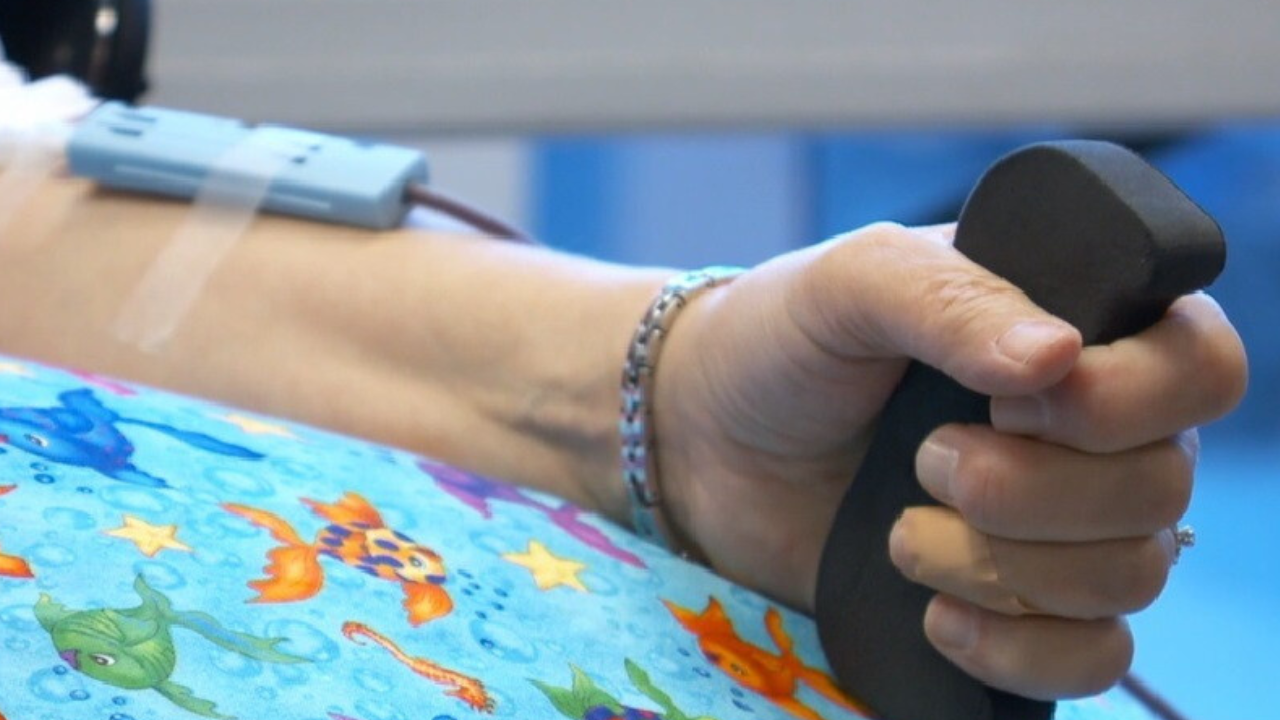
The process takes about 1 hour from start to finish, including a brief recovery period with juice and a snack after the blood draw. Donors are screened before giving blood, and most people feel fine immediately after and can return to their normal day.
Woodruff, who donated blood himself recently, said the experience is more manageable than many people expect — even for those who are nervous about needles.
"The people at these blood donation centers are so professional. They're experts. They do this all day, every day, and they're very smooth. And they know all the tips and the tricks to help you calm down," Dr. Woodruff said.
During a recent visit to a donation center, Woodruff said he met a college-age adult who had brought his father in to donate.
"They said, 'You never know when you might need or your loved one might need a transfusion. So, I'm paying it forward and I'm helping my community be prepared,'" Woodruff said.
Volunteer blood donation vs. commercial plasma donation
Not all donation centers are the same. Commercial plasma donation centers pay donors cash and allow visits up to twice per week. The plasma collected at those centers is processed offsite to isolate specific proteins, immunoglobulins, and clotting factors used to manufacture life-saving medications for people with rare diseases.
Volunteer whole blood donation at nonprofit centers — such as the American Red Cross and ARUP Blood Services — is different. That blood goes directly to patients, often within days of being donated. Nonprofit centers also supply liquid plasma for direct emergency transfusions in trauma and shock situations.
Plasma makes up about 55% of blood and is mostly water and proteins. Whether donated at a commercial or nonprofit center, plasma-derived products play a critical role in patient care — but whole blood donated at a nonprofit center is what goes directly to a patient in need.
How to donate in Utah
Utahns can schedule a donation appointment through the American Red Cross at redcrossblood.org or through ARUP Blood Services — which serves Huntsman Cancer Institute and the University of Utah — at UtahBlood.org.
This story was reported on-air by a journalist and has been converted to this platform with the assistance of AI. Our editorial team verifies all reporting on all platforms for fairness and accuracy.