


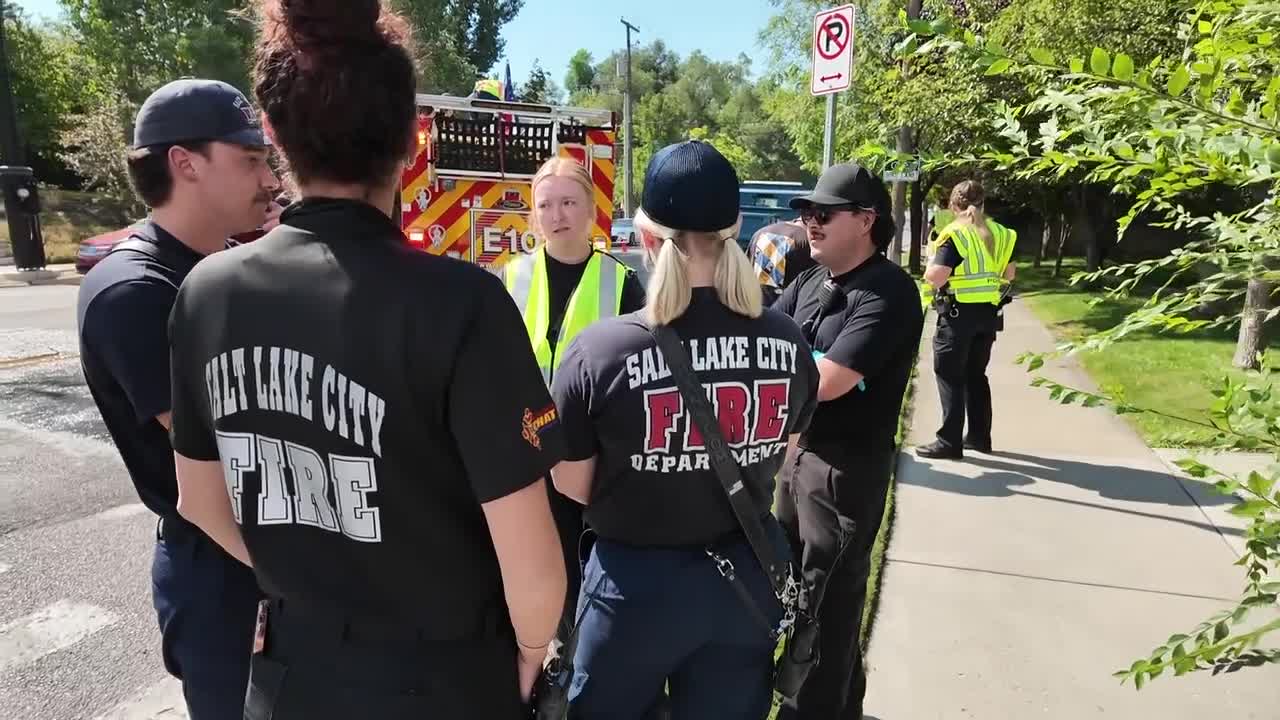

SALT LAKE CITY — The Salt Lake City Fire Department is one of only about 1% of fire departments in the country running a program that embeds social workers directly with paramedics and firefighters to respond to 911 calls involving a wide variety of issues, including mental health crises and drug overdoses.
The program, called the Community Health Access Team — or CHAT — has been operating for 4 years.
The goal is to meet people at their most vulnerable moments and connect them to services that can provide lasting help — not just immediate medical care.
"It's about sending the right people to the right call at the right time and changing their life," Salt Lake City Fire Division Chief Kyle Lavender said.
How the program works
CHAT team members are stationed at Salt Lake City fire stations, including Fire Station 5, located near 900 South and 900 East.
Social workers respond alongside paramedics and firefighters to calls involving issues that may require more than immediate medical attention.
"Salt Lake City probably has the lion's share of the homeless population in the state of Utah, and with that population comes a lot of substance abuse, mental illness — and for our firefighters, that's not really their training," Lavender said.
The team carries a binder of community resources and can enroll people in longer-term care programs directly in the field.
"Get a social worker there, find out if they are having a psychotic problem, a medication problem, a substance problem — and not only help them right then, but also get them into longer care programs," Lavender said.
A day in the field
FOX13 spent a day embedded with a CHAT team to see the program in action.
The first call took the team to a homeless resource center, where an altercation between two residents led responders to a patient who initially appeared to need help removing a ring stuck on her finger.
Through conversation, Lavender discovered the issues ran much deeper and the woman had nowhere to go after leaving the shelter.
A social worker spoke with the her about options for food and shelter, but she declined the help and walked away.
"Unfortunately, that happens a lot,” Lavender said. “We try to bring resources to someone and help, and maybe they have had a bad experience with the system, and it's hard to see out of that tunnel," Lavender said.
Responding to overdoses
Minutes later, the team was dispatched to a suspected drug overdose on North Temple — a call Lavender described as routine for his department.
"This is a very common call for us. We have a lot of opioid overdose problems in our city. There is obviously a medical component to this — the physical overdose itself — but there is also a psychiatric component as well. Why are they in this situation, and what is going on in their lives and the addiction? How can we help the person and not just the overdose?" Lavender said.
Salt Lake City police officers already administered Narcan to the patient when the team arrived.
Paramedic Anna Aldridge described the medication's impact.
"It's kind of like a miracle drug. It actually blocks the receptors in the brain that the opioid is trying to take over," she said.
CHAT program social worker Sarah Bohe said Narcan is standard on every overdose call.
"Narcan is used on every single overdose that we go on," she said.
It was unclear what drug caused this patient to overdose. The patient was transported to the hospital, but the CHAT team's involvement will not end when the ambulance leaves the scene.
"Medical treatment always comes first in these situations. She needs to be seen at the hospital because she was administered Narcan," Bohe said. "We offer them follow-up care — follow up with the hospital, ride with the ambulance, meet them at the hospital, or coordinate to have them follow up. Get their contact information. If they aren't interested in speaking, give them my card and resources. Say, 'Hey, if you aren't ready today, maybe tomorrow, a week or month — any time down the road, feel free to reach out.’”
Breaking the cycle
On average, paramedics in Salt Lake City respond to roughly 3 overdose calls every day. The CHAT team believes the program is breaking that cycle by connecting people to help before another overdose occurs.
Social worker Natasha Thomas said the team works to eliminate the hurdles that keep people from seeking treatment.
"We are trying to remove those barriers. We can meet people directly where they are — this street corner — offer them the program, enroll them right there," Thomas said.
Thomas also emphasized the importance of treating every patient with dignity.
"No one is immune to addiction, and addiction really doesn't discriminate," she said. "This is someone who is someone's kid, family member. This person deserves the same amount of respect that we would give to anybody, and I think that sometimes society forgets that.”
Social worker Hannah Nearman said simply showing up makes a difference.
"I think showing up and being there for them helps them know that they're not alone, and when people feel that they're not alone, they can do pretty amazing things. They just need to know the direction to go in, and so showing up there helps with that," Nearman said.
For Lavender, the measure of success is straightforward.
"The biggest win is when we get those people out of the 911 system because they get the resources and lead a happy, healthier life," he said. "CHAT is a chance to give them a new life, and to get them the help they need to make the decisions that are going to help them become better, and be able to overcome the addictions or overcome the problems, and really start a new life.”
This story is part of “Utah’s Fentanyl Fix,” a FOX 13 News series exploring the impact of fentanyl in Utah and what can be done to keep families safe. The next story in this series will air Tuesday night at 9 p.m.
This story was reported on-air by a journalist and has been converted to this platform with the assistance of AI. Our editorial team verifies all reporting on all platforms for fairness and accuracy.