

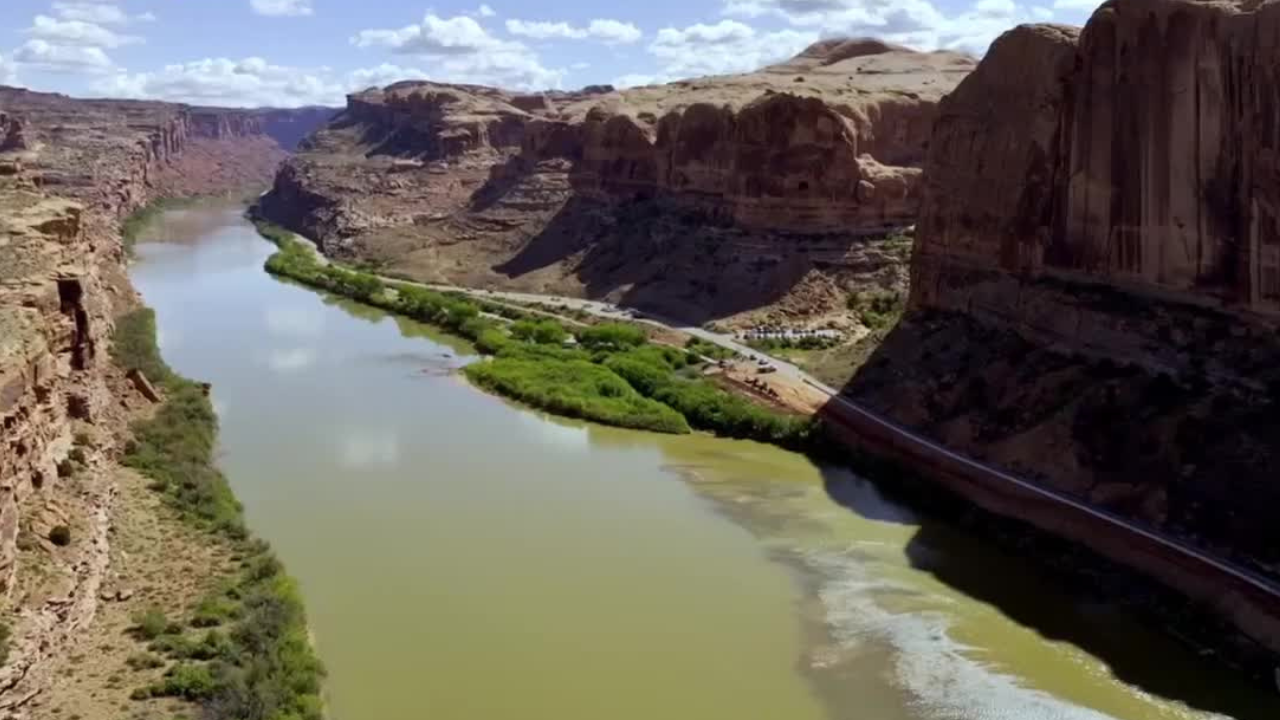


SALT LAKE CITY — The Colorado River is running low, and states that rely on it are facing a difficult question: How do you divide water you don’t have?
The results of a study were discussed Monday during a special meeting of the Upper Colorado River Commission, which includes representatives from Utah, Colorado, Wyoming and New Mexico.
Gene Shawcroft, chair of the Colorado River Authority of Utah, said the challenges are becoming increasingly difficult to manage as water demand grows while supplies remain limited.
“When you expect 100, and you get 10, you can’t give them 50. It just isn’t there,” Shawcroft said. “And that’s a difficult concept to those who’ve historically been able to pull whatever they needed from a reservoir.”
One immediate issue discussed Monday is the planned release of water from Flaming Gorge Reservoir into Lake Powell. By the end of September, the plan is to have released about 450,000 acre-feet from the reservoir to the lake.
Nevada sues federal government over Colorado River management:
The goal is to help maintain Lake Powell at levels that allow for continued hydropower production and downstream water deliveries.
“What we wanted to do was make sure that the reduced releases from Lake Powell and water coming from Flaming Gorge would keep the levels at a point where we could continue to produce power and deliver water downstream,” Shawcroft said.
Upper Colorado River Commission Chair Becky Mitchell acknowledged that the drought continues to create challenges.
“We know that our work isn’t done,” Mitchell said.
“We’re hoping next year is better, but we can’t count on that. So we need to be prepared for whatever comes, and I believe that we are.”
Utah has also seen significant impacts from a poor snowpack year.
“The April snowpack was the worst on record and not by a little bit, but by a very large margin,” Shawcroft explained.
'We're still 70% full;' Flaming Gorge deals with Colorado River releases:
He pointed to Ferron Creek, a tributary of the Green River, where water allocations were cut by 75%.
“This isn’t just Colorado River issues,” Shawcroft said. “The entire state this year was woefully inadequate as far as snowpack was concerned.”
The commission also received guidance on how the Bureau of Reclamation will operate the river over the next couple of years. That guidance provides a better picture of what lies ahead, but Mother Nature remains the biggest wildcard.
“That gives an idea of where we’re going, and the wildcard is what Mother Nature provides,” he said. “But the concept of these new documents is to deal with what actual water we have and not what we forecast.”
For Utah and the other states dependent on the Colorado River, Shawcroft said there is no easy solution.
“We wish we had an easy answer to deal with Mother Nature. Unfortunately we don’t. We have to live on what we get,” he said. “We can wish we had more, but that doesn’t put water in people’s taps or irrigate fields.”
This article is published through the Colorado River Collaborative, a solutions journalism initiative supported by the Janet Quinney Lawson Institute for Land, Water, and Air at Utah State University. See all of our stories about how Utahns are impacted by the Colorado River at greatsaltlakenews.org/coloradoriver
