

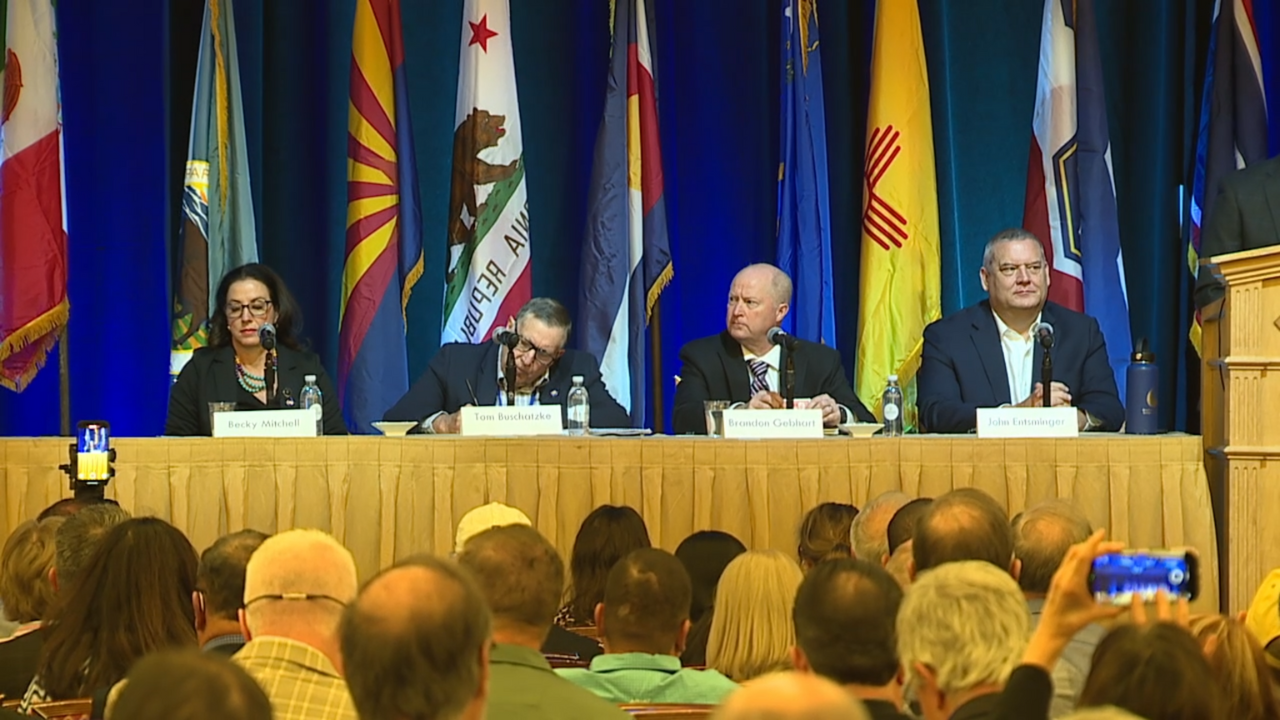


LAS VEGAS — The mood in the ballroom was like a family dinner where mom and dad have been fighting and may be headed for a divorce.
Everyone was trying hard to be polite in front of the children — but you could still sense tension.
"It's an honor and pleasure to be here today alongside my Colorado River family. As you all know, sometimes you can't pick your family," joked Becky Mitchell, who is Colorado's chief negotiator over the river.
The seven state commissioners negotiating agreements governing the future of the Colorado River were projecting optimism they can patch things up and work out a deal over the water that more than 40 million people in the western United States rely on to live.
"None of us are done trying," Wyoming commissioner Brandon Gebhart said.
In a standing-room only ballroom here in Las Vegas, people were hanging on their every word. The Colorado River Water Users Association is made up of people from all walks of life who use the water from growing food to providing drinking water.
One by one, the commissioners of Wyoming, Colorado, Utah, New Mexico, Arizona, Nevada and California outlined what they are bringing to the negotiating table. They've proposed cuts and conservation measures and called on others to do their part.
"We need conservation in the Upper Basin that is verifiable and mandatory," said Tom Buschatzke, the Colorado River commissioner for Arizona.
The central disagreements remain over who takes what from a river that is increasingly seeing less water in it. Upper Basin states (Utah, New Mexico, Colorado and Wyoming) argue that Lower Basin states (California, Arizona and Nevada) are taking too much water. Lower Basin states insist they're making cuts — including proposing a 1.5 million acre foot reduction in use — and want to see the Upper Basin do similar. The Upper Basin counters they're dealing with bad hydrology and they aren't even using what they're entitled to.
"Realize this is the amount of water we’ve got in the system, we’re looking forward to future declines in what the Colorado River can provide," JB Hamby, the Colorado River commissioner for California, told FOX 13 News and the Colorado River Collaborative. "It’s going to take all of us. That includes the Lower Basin, that includes the Upper Basin, that includes Mexico. Everyone is going to have to contribute through mandatory reductions in use."
Hamby said it would be a shift, but no state can opt out.
"What we’re trying to do now is understand how we can work with less water and where the biggest use is in the Lower Basin? In our minds is where the biggest cuts have to come from," said Gene Shawcroft, the Colorado River commissioner for Utah. "They’ve been using their allocation. We haven’t."
There are others who are impacted by whatever gets decided. Native American tribes are expected to offer some ideas from their perspective, said Shanandoah Anderson, a member of the Shivwits Band of Paiutes.
"I don’t know if they’ll ever come together and make any kind of agreement but on the tribal side of that? We have been involved which is a good thing," she said.
Ellie Oakley with The Nature Conservancy said she wanted to see a state-led deal rather than have the federal government intervene.
"I would really like to see a durable framework that will take the Basin into the future and ensure that the river is healthy and our communities and economies are healthy as well," she said.
The commissioners continued to meet while in Las Vegas in hopes of hammering out a deal. All sides indicate progress has been made, but it is slow and small. The commissioners told the crowd about one-time offers of upstream releases and downstream cuts.
"When you see [Lake] Powell at 27%, [Lake] Mead at 33%? We have to find some way to get through this crisis," Mitchell told reporters afterward. "How we get through that? First and foremost stop releasing more than comes into the reservoirs."
The current agreement expires in 2026. On Wednesday, Trump administration officials warned the states to get a framework agreement in place by February 14 or they may start making decisions for them and the states might not like what is decided. The federal government is expected to release a draft environmental impact statement in the next couple of weeks with alternative ideas.
John Entsminger, the Colorado River commissioner for Nevada, said he believed the pieces were there for a short-term deal between the states.
"I think the pieces are there for a five year deal," he said Thursday.
Asked by FOX 13 News and the Colorado River Collaborative about a long-term deal, he replied: "I think we should solve the five year problem and then work on the 30-year problem."
Shawcroft was optimistic about an agreement.
"We’ve demonstrated we’re willing to do some things. It’s a chicken and an egg thing to be honest," he said. "But we’re cracking that shell."
This article is published through the Colorado River Collaborative, a solutions journalism initiative supported by the Janet Quinney Lawson Institute for Land, Water, and Air at Utah State University. See all of our stories about how Utahns are impacted by the Colorado River at greatsaltlakenews.org/coloradoriver
