

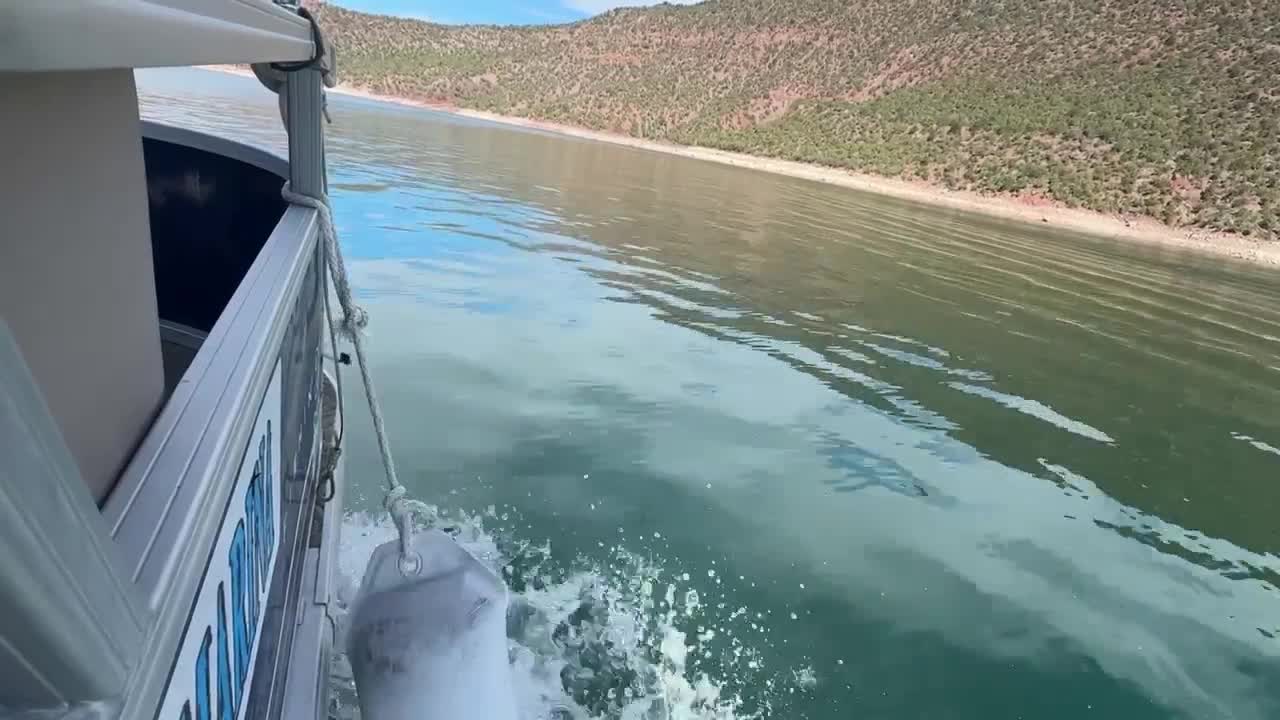


DUTCH JOHN, Utah — It's a beautiful day on the water here at Flaming Gorge Reservoir. The boats are out and people are fishing on the banks.
If you look closely, you can see where water levels have declined. It's made things a little challenging for John Rauch, who runs the popular Cedar Springs Marina.
"We’re down almost 12 feet. It’s almost September," he said in an interview Friday with FOX 13 News.
Rauch has had to relocate some docks, moving them out further as lake levels decline. But he's grateful people are still stopping by to grab a bite to eat at The Snag, the marina's floating canteen, or rent a boat.
"People are still coming out. We have a great backing. Our clientele are some of the best people in the world. They’re giving us support," Rauch said.
The U.S. Bureau of Reclamation ordered the release of up to a million acre-feet — roughly one-third of Flaming Gorge's total capacity — to prop up Lake Powell downstream and keep it generating power for millions. It's part of a larger series of problems facing the Colorado River system, which supplies water for more than 40 million people across the American West.
Flaming Gorge's releases have had an impact on nearby communities. While urging political leaders to get a multi-state deal to manage the river, Daggett County leaders have also had to combat the misperception that there's no water.
"We had people calling saying they were canceling because we heard you don’t have any water. We tried to turn that around to say we’ve got the water," said Daggett County Commissioner Jack Lytle. "If you’re used to high water, you’ve got to be careful. But at the same time we’re still 70% full."
On Friday, Utah political leaders, researchers from Utah State University, reporters and others visited Flaming Gorge to see up close some of the issues facing the area.
"Draining it to the extent that it’s happening is concerning to a lot of us," House Speaker Mike Schultz, R-Hooper, told FOX 13 News. "Although I am surprised it’s not a little lower so that's positive news."
The seven states along the Colorado River still remain divided, largely between Upper and Lower Basins, over who gets what. There is more demand for water than there is supply as drought and diversions have taken a toll. Recent studies have warned the entire Colorado River system is headed for a crash.
"There was no snow. There was extremely warm temperatures. There was no runoff. For someone, the Lower Basin or otherwise, to expect the Upper Basin to deliver water is a myth," said Gene Shawcroft, the chief negotiator for Utah over the Colorado River.
Since the states can't reach a new agreement, the Trump administration has stepped in with its own plan for managing the mighty river. It calls for deep cuts for the Lower Basin states of California, Arizona and Nevada. The Upper Basin states of Wyoming, Utah, Colorado and New Mexico, will likely face increased demands for conservation. It also offers 10 years worth of smaller plans, spread out over two years to try to give the states time to reach their own agreement.
Shawcroft told FOX 13 News on Friday that negotiations are slow, but he remains optimistic they can reach some kind of multi-state deal. He said it is highly likely the feds' plan gets implemented and the states will begin negotiating in earnest in October — after the current multi-state agreement expires.
But Shawcroft said the U.S. Bureau of Reclamation's plan actually offers some guardrails the states can negotiate from.
"They’ve established some requirements on shortages in the Lower Basin and frankly the Lower Basin is frustrated with those sideboards, those amounts of water. Yet in reality, those are the kinds of numbers of reductions that have to occur in order for us to build any kind of resiliency in the system," Shawcroft told FOX 13 News.
Asked about the Upper Basin's role, Shawcroft replied: "There will be pressure on us. The pressure right now is on Flaming Gorge as you see."
He said he could not rule out future water releases from Flaming Gorge, but believed federal officials would withhold more water in Lake Powell to keep it at minimum power pool.
Asked about the Colorado River negotiations, Rauch said he hopes everyone will do their part.
"We're at a point where everybody needs to conserve," he said.
This article is published through the Colorado River Collaborative, a solutions journalism initiative supported by the Janet Quinney Lawson Institute for Land, Water, and Air at Utah State University. See all of our stories about how Utahns are impacted by the Colorado River at greatsaltlakenews.org/coloradoriver