

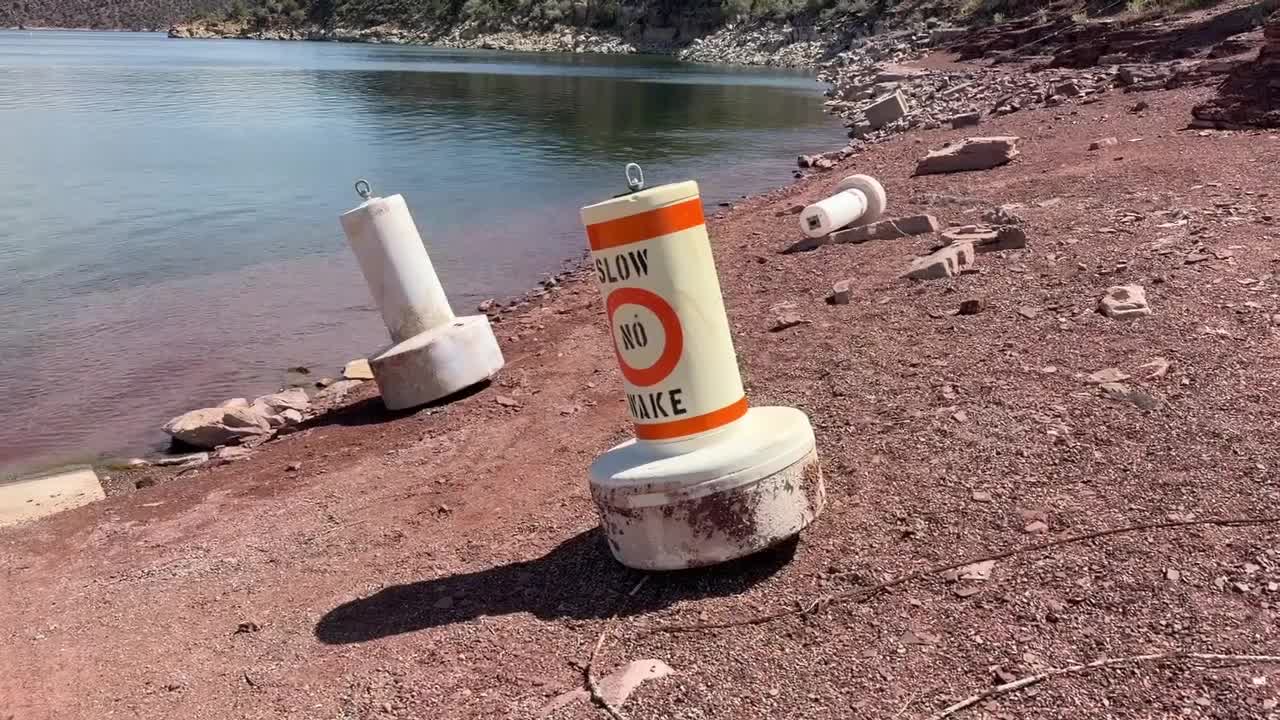


DUTCH JOHN, Utah — It's opening day at Cedar Springs Marina. The family-owned recreation hotspot is preparing to welcome visitors for another season of fun at Flaming Gorge.
"Hundreds of thousands come through," John Rauch, one of the marina's operators, told FOX 13 News on Wednesday. "Business wise? Boat rentals, we’re looking at thousands of boat rentals. We have a couple hundred almost seasonal customers here."
But Cedar Springs Marina may have to pack up and move to deeper waters if the U.S. Bureau of Reclamation orders the release of water from Flaming Gorge and other nearby reservoirs to prop up Lake Powell. A draft drought plan shared with FOX 13 News calls for anywhere from 660,000-acre feet to 1 million-acre feet from Flaming Gorge, down the Colorado River system into Lake Powell.
"Due to increasingly severe hydrologic conditions, it has become necessary to implement additional measures in the near future to ensure Lake Powell remains above the critical elevation of 3,500 feet. This action is essential to protect reliable water delivery, preserve key infrastructure, and maintain flexibility in our operations," a spokesperson for the U.S. Bureau of Reclamation, which operates Flaming Gorge and Lake Powell, said in a statement to FOX 13 News.
That would keep Glen Canyon Dam able to generate electricity and provide water for states downstream. Forecasts for the entire Colorado River system, which supplies water to more than 40 million people in the West, are bleak.
Lake Powell management responds to changes at Bullfrog Marina:
Cedar Springs Marina, located close to the dam, has moved before when water levels were low. But this year is different. Snow in the Uinta Mountains usually sticks around until June. It's not there now.
"It’s going to be a major impact," Rauch said. "We’ve seen drought before, but nothing at this magnitude."
Reclamation officials could make a decision soon. Releases could happen by May 1, said Gene Shawcroft, the Colorado River Commissioner for Utah.
"The impact would be on the economy of Daggett County, which is critical," he said.
The seven states along the Colorado River have been trying to negotiate new deals to manage the water. So far, they have been unable to reach agreement. Upper and Lower Basin states have divided over who cuts what as everyone deals with drought and a horrible hydrology. The Trump administration has warned that if the states can't strike a deal, they may step in and make decisions nobody likes.
Arizona recently hired a law firm, signaling the potential for litigation and has been aggressively signaling it will fight for water. Utah's legislature started socking money away for legal challenges and passed bills to defend the state's interests on the Colorado River.
Still the state negotiators continue to meet in hopes of reaching consensus.
"I’m committed to being at the table as long as there are those willing to be at the table. I think a state solution is far, far better than a federal solution," Shawcroft said.
Shawcroft told FOX 13 News he is still hopeful for an agreement — even a year-to-year one — but acknowledged that it may not happen.
"We may have to have Reclamation tell us this is what we’re going to do for ‘27," he said. "How do we get that water back in Flaming Gorge, how do we do what we call recovery, how does that happen? Those are the discussions we have to have between now and the end of September and if we can’t come to an agreement on even a one year deal, then Reclamation will have to provide a mechanism whereby they operate the system to do everything they can to stretch the water as far as possible."
For people like Rauch whose family is directly impacted by the discussions, he was hoping for the best but preparing for the worst. He urged people to do what they can to save water.
"We’re all in this together. So we have to try to conserve. That’s on the individual level, the state level," he said. "Everybody needs to do their part."
This article is published through the Colorado River Collaborative, a solutions journalism initiative supported by the Janet Quinney Lawson Institute for Land, Water, and Air at Utah State University. See all of our stories about how Utahns are impacted by the Colorado River at greatsaltlakenews.org/coloradoriver