



PRICE, Utah — At Four Corners Community Behavioral Health’s Crisis Receiving Center, everyone who comes through the door is having one of “the worst days of their life,” said Melissa Huntington, the organization’s executive director.
Some are experiencing thoughts of suicide or struggling with depression and anxiety. Others are in the midst of substance-induced psychosis or are actively responding to hallucinations.
All of them “just need somewhere where people can support them and take care of them and help them get through it,” Huntington said in a recent interview with FOX 13 News.
Four Corners' receiving center in Carbon County is one of several across the state that provides 24/7 care to those in mental health or substance use crisis. During a 23-hour admission, patients can see a psychiatrist and physician and receive therapy, case management and help with medications.
The goal, Huntington said, “is to get them stable and back into the community with their loved ones.”
“We know that a majority of the time, individuals can be stabilized within 24 hours,” she added. “And that’s kind of why this is developed the way it is, is if you get someone with the right people in a short-term setting, you can usually get them stabilized enough to stay in the community.”
As state leaders work to improve access to mental and behavioral health supports for the growing number of Utahns who need them, receiving centers have come to be seen as a significant component of the state’s crisis response system – particularly in rural areas with more limited resources.
But not every community has access to these services.
About 100 miles away from Price, a receiving center in Vernal has been ready to provide behavioral health support to residents in northeastern Utah since last June. Construction on another in Ephraim is expected to be completed this fall.
The facilities were built with one-time funds through the Utah Department of Health and Human Services. But neither has received the money it needs to operate in recent legislative sessions.
“Until ongoing operational funding is finalized,” the crisis centers “will remain completely offline, unstaffed, and unable to accept patients,” the Utah Behavioral Health Commission noted in a recent request for state funding.
Kyle Snow, the executive director of Northeastern Counseling Services, which plans to run the Vernal receiving center, acknowledged that elected officials have had to balance “a lot of funding priorities."
But he said a receiving center would provide significant value to residents in Daggett, Duchesne and Uintah counties, who live “several hours away from another one.” And he's hopeful state leaders will allocate the needed funds this year.
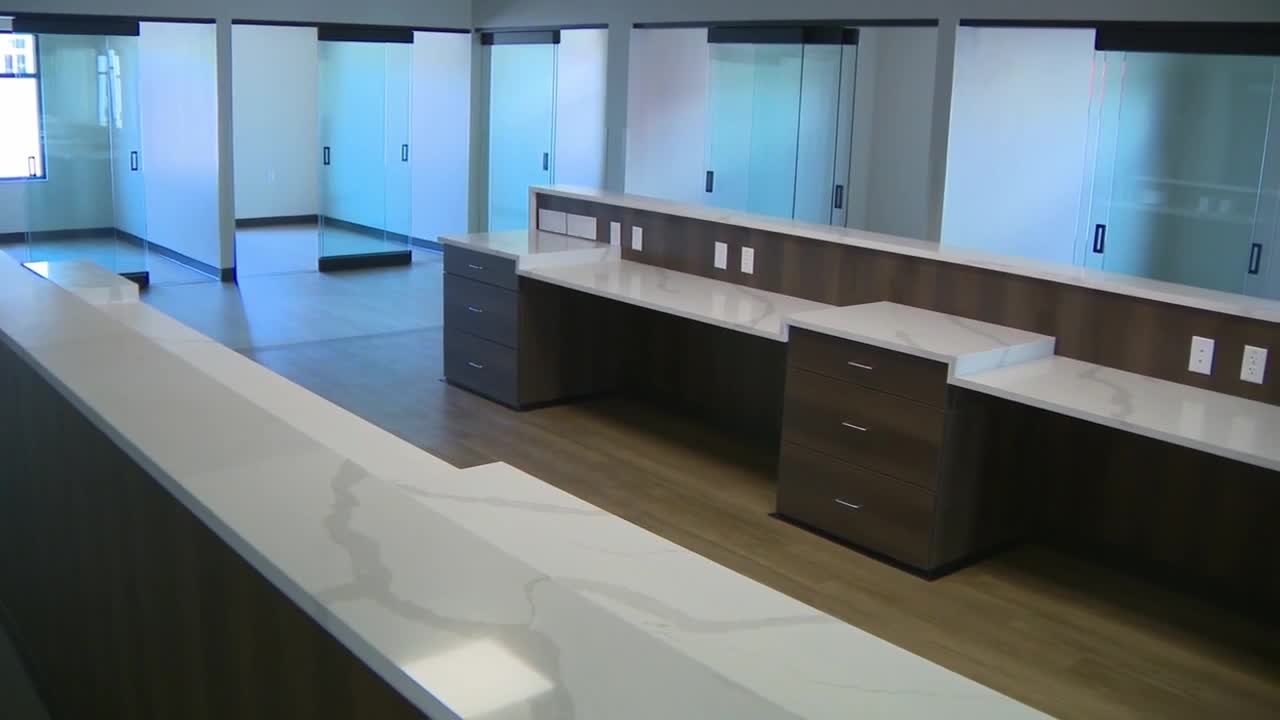
“We’d love to fill it,” he said in an interview from inside the empty facility.
The Utah Behavioral Health Commission, which is responsible for developing recommendations to improve the state’s mental health system, has requested $2.4 million in ongoing funding to run the Vernal and Ephraim receiving centers. It's one of the commission's top priorities for funding asks ahead of next year's legislative session.
“They’re a critical component of our crisis continuum,” explained Mike Deal, a member of the commission and the executive director of the Southwest Behavioral Health Center, during the September meeting of the Legislature's Behavioral Health Policy Committee. “And hopefully you’ll find the need to support them additionally as we move forward.”
'This is where they should be’
Utah has among the highest rates of mental illness in the United States. But nearly half of adults and more than half of kids in the state don’t receive needed support, according to a strategic plan on the state’s behavioral health workforce.
The plan points to particular challenges for those in rural areas – even though Huntington notes that these communities sometimes have “more significant crises” than those in urban settings because of issues like economic distress or substance use.
Snow, with Northeastern Counseling, pointed out that rural areas often see more deaths by suicide, as well. The suicide rate in rural Utah recently reached a decade high of 26 per 100,000 people – outpacing the urban average of 18.6 and the national average, according to the Behavioral Health Commission’s recommendation for legislative funding.
If the Vernal and Ephraim centers receive the requested funds, the commission said they would help combat the “disproportionately high suicide rates” in the nine rural counties they’d serve. They would also provide a “dedicated, safe space” for those who are “geographically isolated."
"These are not just needed in urban areas,” Snow said.
Receiving centers currently operate in Carbon, Davis, Salt Lake, Utah, Washington and Weber counties, according to the Utah Association of Counties. In addition to the Ephraim and Vernal centers, another is under construction in Logan.
Collectively, the state’s receiving centers have served more than 15,000 distinct clients and provided more than 35,000 services since fiscal year 2023, according to a state data dashboard. About 23% were experiencing situational stress and 22% were at risk of suicide.
If a receiving center wasn’t available, data shows 35% of those served statewide would have gone to a hospital or emergency room.
That's "the most common place that somebody that has a behavioral crisis will end up," noted Robert Hall, Northeastern Counseling's clinical director.
“And that can be a great place and it can be a necessary place sometimes," he added. "But it’s also very costly and not everyone requires that level of care. So this would be a great alternative to that.”
Advocates say crisis centers can also keep people out of jails.
Melissa Huntington explains how the Price receiving center has helped local law enforcement:
Law enforcement has been involved in about 6% of referrals to receiving centers statewide since 2023, according to the state’s dashboard. Without them, data shows about 2% of patients would have gone to detention or jail.
People having a mental health episode are “really not best placed in the jails,” Huntington argues.
“Being in a place where we’re familiar with mental health crisis, we’re familiar with individuals who may be struggling with internal commands or internal hallucinations, this is where they should be,” she added.
'This is lifesaving'
As a series of legislative audits has recently criticized the complexity of Utah’s mental health system, Huntington said one of the advantages of receiving centers is their simplicity for patients.
“They walk in, they’re not going to be turned away; they’ll receive the services they need, and then they don’t have to worry about a bill when they leave,” she said.
While the centers bill insurance when possible, patients are never charged.
"We would never want anyone to not come in for care because they were afraid of what the cost might be,” Huntington said.
Though receiving centers may be free for patients, that doesn't mean they're cheap to operate. The Utah Association of Counties estimates it costs about $5 million to operate one in an “ultra-urban” area each year, $3 million in an urban setting and $1.5 million in a rural community.
Snow, with Northeastern Counseling, said the Vernal center will cost about $1.5 million to operate annually, with $1.2 million requested in ongoing funds from the state and the rest covered by local resources.
“This does cost a lot,” he acknowledged. “But I think the resource it would bring would be well worth the money.”
Robert Hall explains below how receiving centers can provide an alternative to emergency rooms:
If legislators do approve the funds during the upcoming legislative session, Snow said the center could be up and running as soon as next summer.
“The exact thought process is that if we build it now, then when the funding comes, we will be up and ready to go immediately,” he said.
But if the money doesn’t come through, people in crisis in Daggett, Duchesne and Uintah counties – as well as those in Juab, Millard, Sanpete, Sevier, Piute and Wayne counties who would be served by the Ephraim center – may have no close place to go.
That’s a concerning prospect for Huntington, who wants policymakers to help ensure other rural areas can access the behavioral health services she believes have saved lives in her own community.
“There’s a lot of stakes,” she said. “If we weren’t here, based on our data, we would be seeing a lot more deaths by suicide. We would be seeing a lot more individuals who are suffering because of their mental illness. We would see a lot more stress on families. We would see a lot more people who are suffering unnecessarily.”
"This is lifesaving,” she added.