


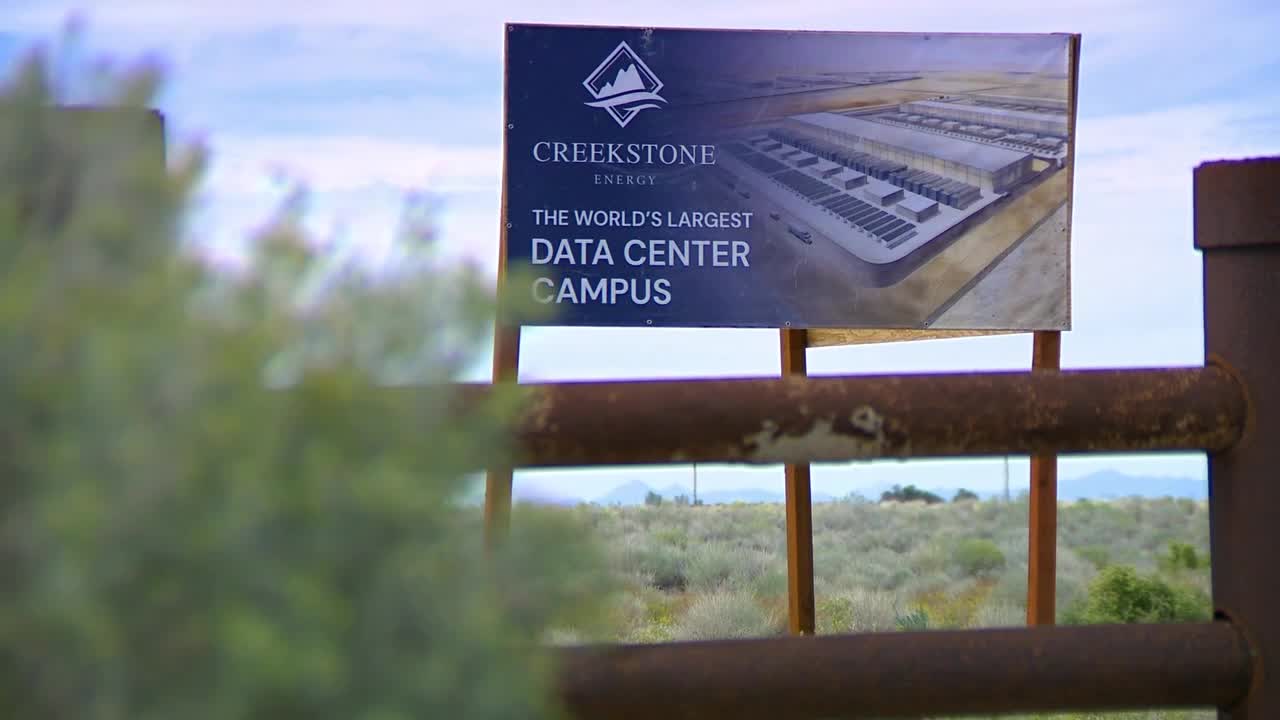

DELTA, Utah — In a field in central Utah, green sagebrush and barbed wire fences clash against flashes of orange cones and construction flags – signs of a very different future to come.
This is the planned home of what's been billed as “the world’s largest data center campus” on more than 10,000 acres of land in Millard County.At full capacity, the Delta site could use over 10 gigawatts of power, or more than double what’s needed for the entire state right now.
It’s emblematic of a national trend remaking rural communities across the country. As data centers scale up to support artificial intelligence, the Pew Research Center estimated earlier this year that around 67% of more than 1,500 new centers under development were planned for remote parts of the country.
Mark White, a University of Illinois professor studying the rise of data centers in rural America, said that’s in part because many modern data centers now require 500 to 800 acres – a footprint hard to find in urban areas.
“For a lot of these companies, they want to move quickly,” he added in an interview. “Because they feel as if they’re in a race. And so certainly looking to places where you can find, you know, greenfield land where you can come in and just build something kind of quickly, I think they see an advantage in that."
Though White notes that “the devil’s in the details,” he said data centers can bring some benefits to economically challenged rural areas – including new tax revenue, some jobs and replacements for lost enterprise.
“You can think of industries like a paper plant or a food processing plant that was already using enormous amounts of water that may have gone out of business,” he said. In those cases, he said, putting a data center in their place "may not be the worst thing in the world.”
But White found rural communities are also wary. In surveys, they were more concerned than urban and suburbanites about data center impacts on energy costs and farming land.
“If you’re in a more rural part of the country, a big development can really impact your way of life,” he said. “It’s just so much closer to them, I think, than another development in a big metro area.”
Dennis Alldredge, a city councilman in Fillmore, is a proponent of new data centers in Millard County. But he believes data showing heightened anxieties in more remote places is reflective of what he’s hearing in his own small community.
“It’s real; there is a lot of concern,” he said in an interview. “And I don’t fault them. We all need to be concerned. And we need to make sure that anything that comes here is done right and is not merely coming here to take advantage of our citizenry and our land.”
Weighing the pros and cons
When Howard Quackenbush first saw the signs heralding the massive size of Creekstone Energy's 10-gigawatt data center in Delta, it “made me worried,” he said in a recent interview with FOX 13 News.
“Like, why in the world would we try to put the largest thing, you know, in the world in Millard County?” he remembered wondering.
Quackenbush, a physical therapist and Millard County Commission candidate who is running unopposed in next month’s election, estimates that about 20% of his patients and those he's met on the campaign trail are opposed to Creekstone and Joule, another large data center project under development in the area.
About 40%, he believes, are watching and waiting.
The rest are “very enthusiastic about it for the same reasons I expressed – that potentially we can bring our kids home,” Quackenbush said, referencing the number of young adults who leave the county every year in search of better job prospects.
Alldredge, the Fillmore City council member, is among those who are optimistic about the potential economic growth data centers will bring to Millard County, which is home to about 13,000 people.
Creekstone Energy has said it plans to create 106 permanent jobs in the community, according to an April press release from the Utah Governor’s Office of Economic Development.
“That would be major,” Alldredge said. “Those are good-paying jobs in a community that needs them.”
Millard County Commissioner Bill Wright said the developments should also have advantages for residents moving forward in the form of reduced property taxes.
“We’ve tried to look at the future and tried to set laws and ordinances and rules and regulations whereby the data centers will be a contributor to our county in a positive way and not a contributor in a negative way,” he said. “If a data center can’t benefit every single resident in our county – whether they work there or not – they are not necessary for us.”
But Brenna Williams, who owns a home a few miles away from the Joule project, is skeptical that the promised economic benefits will outweigh the potential environmental harms.
"Data centers are known for overpromising and underdelivering,” she argues.
Williams is a part-time Millard County resident who lives the rest of the time near the controversial Stratos project in Box Elder County.
She’s been organizing against data centers in both parts of the state but worries Utahns don’t know as much about the plans in Millard County, which she believes is in “a lot more” trouble than Box Elder County.
“Box Elder, because it’s on the edge of the Great Salt Lake and the Great Salt Lake’s collapsing, I think that’s drawn a lot of attention,” she said. “But Millard is still going to be drawing down water supplies, and it’s in a worse drought than we are here.”
Millard County residents share why they think rural communities are more concerned about data centers:
Managing resources 'in the arid West'
Nearly 76% of respondents in a Utah State University survey released earlier this month said they oppose or strongly oppose building new data centers in the state. And 90% said they see the amount of water a project consumes as “very important” in determining whether they would support or oppose a particular project.
Creekstone Energy CEO Ray Conley told reporters recently that he recognizes Delta is “in the arid West.” But he said that doesn't mean the area has to choose “between economic growth and responsible water stewardship.”
"Because Creekstone's focused on building the largest data center campus in the world, that comes to the forefront very immediately,” he added. “And we think that the data centers have to be designed for the places where they're built.”
Conley said Creekstone plans to use a closed-loop system to conserve water. And the company recently announced that it’s partnering with the University of Utah to study the feasibility of technology that could create water onsite.
Less water-intensive systems tend to be more energy-intensive. To meet its energy demands, Conley said the company plans to bring its own off-grid energy with natural gas through the Kern River pipeline, along with more than 13,000 acres of solar under lease on state-owned land.
While data shows widespread public concern about data centers’ use of these resources, Conley told reporters that he believes the "vast majority” of data centers are going out of their way to be “environmentally sensitive” and to benefit the communities they're in.
"Ultimately, the reality will start to step in, and people will be like, ‘Oh, the amount of water they consume, the amount of electricity they consume isn't that much relative to the fear of what it is,’” he added.
(FOX 13 News also reached out to Joule, which is developing the other major data center project in Millard County, at the email listed on its website but did not hear back.)
Despite his initial concerns, Quackenbush counts himself among the supporters of the data center projects coming to the area now that he’s learned more about their plans to manage resources.
“If they’re bringing their own power, they’re utilizing unused land and we’re being conscientious with water resources, it can be a very good thing for rural areas,” he said.
But Williams still isn't convinced the data centers can mitigate downsides. And she said she's now reconsidering her plans to retire in Millard County, which she worries will soon become "noisy and polluted."
“I think as we understand more and more the negatives of these projects – and I don’t think we’re going to find many positives as time goes on; in fact, I don’t think we’ll find any positives – I think people will be devastated at what they’ve brought into the community,” she said.
Her son, Tameron Williams, shares those concerns.
“They're going to change the landscape, they're going to use water, they're going to use electricity, they're going to pollute,” he argues.
“I’m just highly skeptical of them,” he added, “from pitch to completion.”
'Process matters’
Conley said he feels like the Millard County community has largely supported the project.
But after a childhood spent on a tobacco and cattle farm in rural Kentucky, he said he can also “relate directly” to the worries people may have “when something new comes into your community."
“If you’re used to a rural bucolic landscape and a certain way of life that you enjoy, if something new comes in you don’t understand, fear is a natural response,” he added in an interview. “Especially when you don’t know, ‘How is it going to change the lifestyle that we value and the landscape that we enjoy?’”
To alleviate those concerns, he said it’s important for data centers coming to rural areas to communicate openly about the impacts a center “may or may not have."
"A collaboration with the community is essential to make sure data centers are put in a place where they’re both welcomed in the community and they’re put in a place that it helps the community flourish, instead of impair the things that made it a special place that people enjoyed in the first place,” he said.
White, with the University of Illinois, also believes that “process matters,” noting that his research shows unease about data centers has increased in recent months not only in rural communities but “across the board.”
He said small communities face particular challenges when they’re approached by large technology companies with “an army of lawyers and engineers and financial analysts” looking to advance a data center project.
“They may have a part-time mayor; they may have, you know, you know, a county board that that really knows their community well, but isn't well-versed on a lot of the issues that they need to be aware of,” he said. “And so they're being put in a position where they have to make or being asked to make decisions about things that they're just really not equipped.”
White recommended these communities “get ready” and be proactive about understanding the pros and cons of data centers before one comes knocking at their door.
“If it’s not there now, it might be coming later,” he said. “Don’t get caught flat-footed, I think, would be my advice."
Mark White warns about the potential power imbalances when big data centers come to small communities: