



MILLCREEK, Utah — In August 2021, a resident at a Millcreek nursing home left the facility on his electric scooter and attempted suicide.
Six months later, he left again and made a second attempt, a federal inspection report shows. Two months after that, a third. Police intervened each time.
But despite this evidence of “increasing suicidality” — and the fact that the man had attempted suicide a few years before in a different long-term care facility — federal regulators say the nursing home gave him only two psychosocial evaluations during his 13-month stay and did not arrange for needed mental health services.
Federal regulations require nursing homes to provide behavioral health services to patients who need them. But a FOX 13 News review of thousands of pages of inspection reports found at least 18 incidents since 2019 where Utah facilities were cited for failing to provide such support to patients who attempted suicide, expressed thoughts of suicidal ideation or engaged in self-harm.
“I gave up hope,” one resident told regulators, who found that her nursing home had failed to provide outside behavioral health services to evaluate her mental health and medications before she attempted suicide. “There was no one here to talk to.”
A 2010 study published by the National Institutes of Health estimated that between 65% and 91% of nursing home residents have some type of mental disorder — and other research indicates that the number with serious mental illness has been increasing.
But experts say these facilities were never designed to handle mental health at this scale.
“I see missed opportunities all the time,” said Anne Asman, a gerontologist and the program manager for the Geriatric Psychiatry Clinic and Optimal Aging Program within the Huntsman Mental Health Institute at the University of Utah.
Many facilities don’t employ a mental health professional, she noted. And without proper training, she said other staff may miss important warning signs.
"When you’re going to a nursing home — whether you have a physical issue or a mental health issue — the mental health issue always is set aside for the physical issues,” Asman said.
Lack of mental health resources is one of the top complaints the state of Utah’s Long-Term Care Ombudsman receives from inside nursing homes and assisted living facilities, according to Alianne Sipes, the office’s program manager.
“We sometimes hear that more from facility staff,” she said in an interview with FOX 13 News. “They are calling us concerned about residents, trying to find connections to address the mental health needs of residents.”
Allison Spangler, the president and CEO of the Utah Health Care Association, said facilities seek to provide personalized care to every patient. But she noted in an email that “nursing homes are not psychiatric hospitals.”
And while she said facilities are working to address the growing mental health needs of residents, she argues that solutions do “not rest solely with long-term care providers.”
“Long-term care providers remain committed to caring for Utah’s most vulnerable residents,” she wrote, “but sustainable solutions will require continued collaboration among providers, policymakers, and the broader mental health system.”
WATCH: Asman explains the circumstances that can contribute to mental health challenges among older adults
'Not really discussed’
Losing a partner. Physical changes. Cognitive decline. Social isolation and loneliness.
These are all aspects of aging that can uniquely affect the mental health of older adults.
"They’re really facing the unknown,” noted Asman, with the Geriatric Psychiatry Clinic, in an interview. “And facing the unknown is scary."
While many conversations around mental health focus on teenagers and young adults, research shows suicide risk “increases substantially after age 65,” particularly among men. White males 85 and older have the highest rate of suicide of any demographic.
Asman, who works with adults 60 and older who have mental health concerns or dementia, said she sometimes sees a “real sense of isolation and loneliness that can set in” among her patients.
“They feel as though they’ve done what they can do, as much as they can do, and so why does the world need me now?" she added.
While many older adults need extra support, Asman notes that stigma can make it difficult for some to seek services, especially because the Baby Boomer generation was raised in an environment “where mental health was really not discussed."
“I think it’s absolutely fantastic that we have young people who are willing to talk about it,” Asman added. "My generation and the generation before me were not programmed like that. It wasn’t such an open conversation.”
Mental health challenges can affect older adults across the community. But research shows those living in long-term care facilities face particular risk factors for suicide — including physical and mental health limitations and loneliness.
One review of suicide risk in long-term care facilities found “both passive and active suicidal thoughts are common among residents," indicating that this subgroup may need extra support.
"We have certainly seen people that enter long-term care facilities are at greater risk of depression,” noted Lori Smetanka, the executive director of the National Consumer Voice for Quality Long-Term Care, which advocates for better conditions in long-term care facilities across the country.
“Often they feel isolated,” she added. “We saw during COVID as people were separated from their loved ones — particularly for extended periods of time — that they became very, very depressed. Many lost their will to live. And so it’s a real problem in long-term care facilities.”
WATCH: Asman discusses different generational approaches to addressing mental health
‘More psych than we can handle’
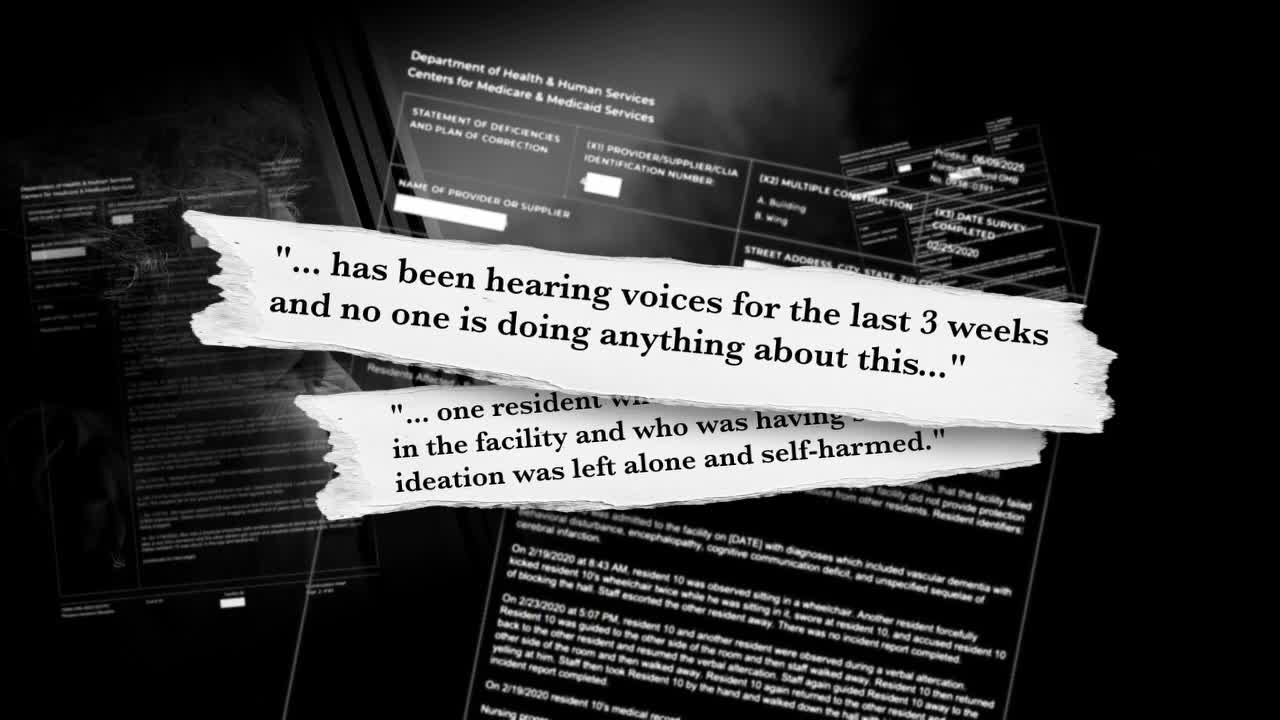
A resident at a Millcreek nursing home told staff she’d been hearing voices for weeks.
But even though she’d previously self harmed and attempted suicide on multiple occasions, a federal inspection report at the facility shows she didn’t feel like staff took her concerns seriously.
“No one is doing anything about this,” she said, according to the report.
A month later, the woman was taken to the hospital after a suicide attempt.
Federal regulators cited the nursing home for failing to provide her with necessary behavioral health services. They noted that their review of her records showed employees had repeatedly downplayed the woman’s symptoms, referring to her as “needy, attention seeking and medication seeking” in 21 separate nursing notes.
The director of nursing said staff were “doing the best we can” and had tried everything from an essential oil diffuser to getting her involved in Bingo and listening to her feelings. But “the more attention given, the more she demands,” the director said.
The resident was “probably more psych than we can handle,” she added, “but everyone else has refused taking her.”
Insufficient mental health services “has been a long-time issue in long-term care facilities” not only in Utah but also across the country, notes Smetanka.
And it’s a problem that has grown in recent years, she added, “frankly because there’s a lack of other good housing options in communities for them to go.”
She and other experts point to the de-institutionalization movement in the 1960s and 1970s — when many people with mental health needs were transferred out of state-operated psychiatric hospitals and into nursing homes — as a turning point.
That’s when these facilities became the “de facto destination for individuals with mental illness,” according to a 2010 literature review on the quality of mental health care for nursing home residents.
While the number of older adults in psychiatric hospitals decreased by about 40% during that time, the number in nursing homes grew by more than 100%, according to the review.
“The reality is we’ve just re-institutionalized that population in jails, prisons and nursing facilities,” said Nate Crippes, an attorney with the Disability Law Center of Utah.
He said older adults with a "primary diagnosis of mental illness probably shouldn’t be in a nursing home” but believes they are often placed there “because our mental health system really doesn’t exist.”
“I don’t think we have a robust system for people with serious and persistent mental illness that provides them care in the community at all,” he added. “And so I think there is a huge gap in the system that is probably leading to a lot of people in that population ending up in nursing facilities.”
'We need to adapt’
There's been a growing recognition of the need for mental health services in nursing homes, noted Smetanka.
The Centers for Medicare & Medicaid Services has been “beefing up requirements related to behavioral health,” she said. And the federal government also developed a three-year initiative, which recently ended, to provide additional training to nursing homes on mental health and substance use.
For Smetanka, improved training is one of the most important ways to ensure resident needs are appropriately addressed moving forward.
“In many facilities, the staff are not adequately trained to not only address mental health needs but also to identify them,” she said.
"If a resident is showing signs of depression or talking about self harm, they really need education on what are the steps that they should be taking, who should they call and that they need to be taking it seriously,” Smetanka added.
In Utah, several nursing homes have begun contracting with private therapy companies, according to Sipes, the Long-Term Care Ombudsman.
“We have a few early-adopter facilities who are recognizing ‘we need to adapt,’” she said. “Naturally, we’re going to have facilities that lag behind a little bit as well.”
Facilities across the state have also been working to expand staff training and are modifying care models to better support residents with behavioral health challenges, said Spangler, with the Utah Health Care Association.
The state Legislature recently appropriated additional funding to support a behavioral health program for nursing home providers, she noted. And Sipes said the Ombudsman’s Office is having ongoing conversations at local and state levels to figure out how to help facilities find additional resources.
“We try to give them tools for their toolbox,” she said, “so that when they have a resident that has an issue with mental health, they know where to turn.”
While Spangler stresses the need for changes at a system level, Asman’s role at the Geriatric Psychiatry Clinic is often to tackle mental health on an individual basis, by helping older adults manage their medication and adapt to the changes that come with age.
Much of that work is centered around helping older adults “reframe” aging from something they view as a negative experience to something filled with opportunity and adventure.
“It’s a mindset,” she said.
“You have to understand that you may have a mobility issue; OK, but that doesn’t necessarily mean you can’t do this with adaptation,” Asman continued. “Your cane doesn’t have to be a cane. It can be a ski pole or it can be one of the hiking poles. It doesn’t have to be ugly and, you know. I just think that we have to think beyond. We’ve got to think beyond where we are.”
Editor’s note: If you or someone you know is struggling with mental health, you can call or text the 988 Lifeline, which provides 24/7 support. Adults 50 and older who need additional mental health support can also contact the Optimal Aging Program at the Huntsman Mental Health Institute at 801-587-8007.
Read more from FOX 13’s ongoing coverage of Utah’s elder care systems here:
- ‘It should never happen’: Vulnerable adults sexually assaulted inside Utah nursing homes
- Why FOX 13 News is reporting in-depth on gaps in Utah’s elder care systems
- Consensual sex between residents, employees in long-term care raises concerns
- Q&A: Utah’s Long-Term Care Ombudsman is ready to advocate for you and your loved ones
- Utah’s Adult Protective Services is substantiating few cases of elder abuse
- What you should know before choosing a nursing home
- Older adults are wandering away from Utah care facilities, sometimes with tragic outcomes
- Critics say taxpayer dollars for nursing homes should be spent on care, not new buildings
- Nursing homes receiving millions in extra taxpayer funds face allegations of poor patient care