

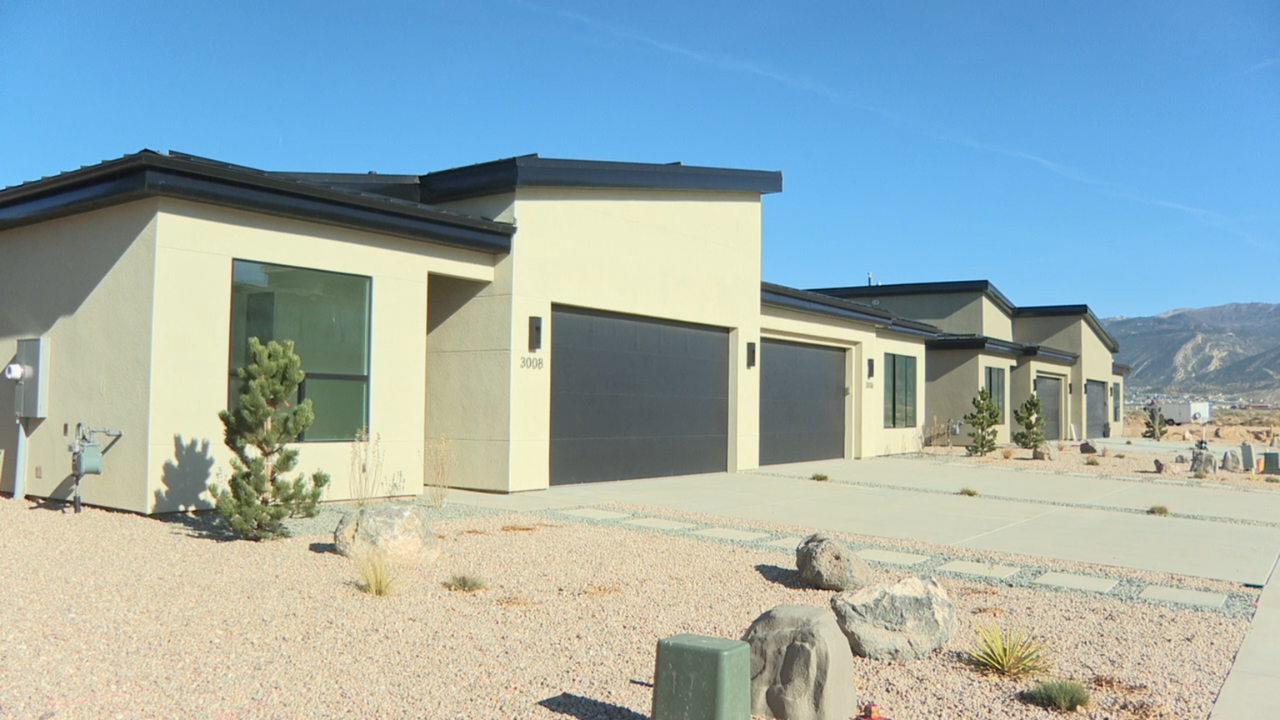


CEDAR CITY, Utah — A local homebuilder said he has a different approach to the housing affordability crisis that's gripping Utah communities.
Jarrod Grannum, Director of Operations for Temple View Commons, said he's not building homes out of charity, but he's also not trying to get rich.
"We're not looking to get rich. We're just looking to build a quality product and move it," Grannum said.
His strategy centers on keeping construction costs lower through a lean, family-run operation and what he calls a Henry Ford "Model T" philosophy of mass production.
"Why don't we take all these luxury, beautiful items that we're putting in these properties and build them in a mass quantity at an affordable price?" Grannum said.
The operation is a tight-knit team: a father-son duo, with the owner's wife serving as the designer, and a good friend acting as the general contractor.
"We're so tight-knit and small that we're able to essentially cut the profit within ourselves to therefore transfer it over to the consumer," Grannum said.
The two-story homes feature three bedrooms, walk-in closets, and giant view windows. Inside, buyers get recessed lighting, fireplaces, quartz countertops and walk-in glass showers with Moen fixtures. The fenced backyards include gas lines for grilling.
Single-story, three-bedroom homes start at $389,000.
Grannum said he didn't have an exact figure on his cost savings, but the approach allows him to offer price points similar to what a "cookie-cutter manufacturer" does. He said it's much less than similar builds he completed in Washington County luxury communities like Kayenta and Entrada.
According to Rocket Mortgage's June 2024 Cedar City Housing Market report, the median listing price for a comparable three-bedroom home in Cedar City is $500,000.
But is $389,000 to $425,000 really affordable?
"I think that, gosh, for me and I think the people of Iron County could agree that that $300,000 to $450,000 range is a pretty sweet spot to be at. And even then, that's still pretty expensive if you get down to mortgages and interest rates," said Jenna Simpson, a prospective Cedar City homebuyer.
Josh Crandal, a Cedar City resident in his 20s, doesn't think so.
"Not with what I'm making now. I feel like you don't think about the idea of buying a house. It's like, you've got to rent for this because you can't afford to buy a house," Crandal said.
Ariana Marble, a Southern Utah University college student, agrees.
"I'm a college student, so nothing's affordable right now. It's scary, honestly, thinking about having to figure that out down the line," Marble said.
What constitutes affordable housing varies by perspective, but Utah state code defines "affordable housing" as a home where a family spends no more than 30% of their income on housing costs, including utilities, insurance and upkeep.
James Wood, Senior Fellow at the University of Utah's Kem C. Gardner Policy Institute, said housing analysts use another metric called the median multiple, which considers a home affordable if it costs three times the average household's annual income.
In Iron County, with a median income of around $67,000 per year in a joint 2023 state-Gardner Institute study co-authored by Wood, a home needs to cost $200,000 or less to be considered affordable under this measure.
That affordable threshold is $227,000 in Washington County to the south, $275,000 in Salt Lake County to the north, and highest in Summit County, home to Park City.
"What I've done in the last few years when I'm comparing is if you say... Look, to buy the median price home in Washington County, you've got to have an income of $160,000. That's the median price home. And that registers," Wood said.
Wood said mass production approaches like Grannum's represent a "big change."
"You can cut costs by really a significant amount, more than any of the programs that the state or counties were looking at. You can really make a difference," Wood said.
He predicts that more manufactured housing assembled off-site and brought to construction sites will make homes "much more affordable."
Grannum said Temple View Commons remains an experiment in progress, and he's not certain it will solve the affordability crisis.
"So is it affordable for everybody? No, of course not. But for those that have gotten to that point and are there, we're not going to let you sacrifice anything," Grannum said.
Eight homes currently stand at the development, with crews working to double that number by the start of the year.