

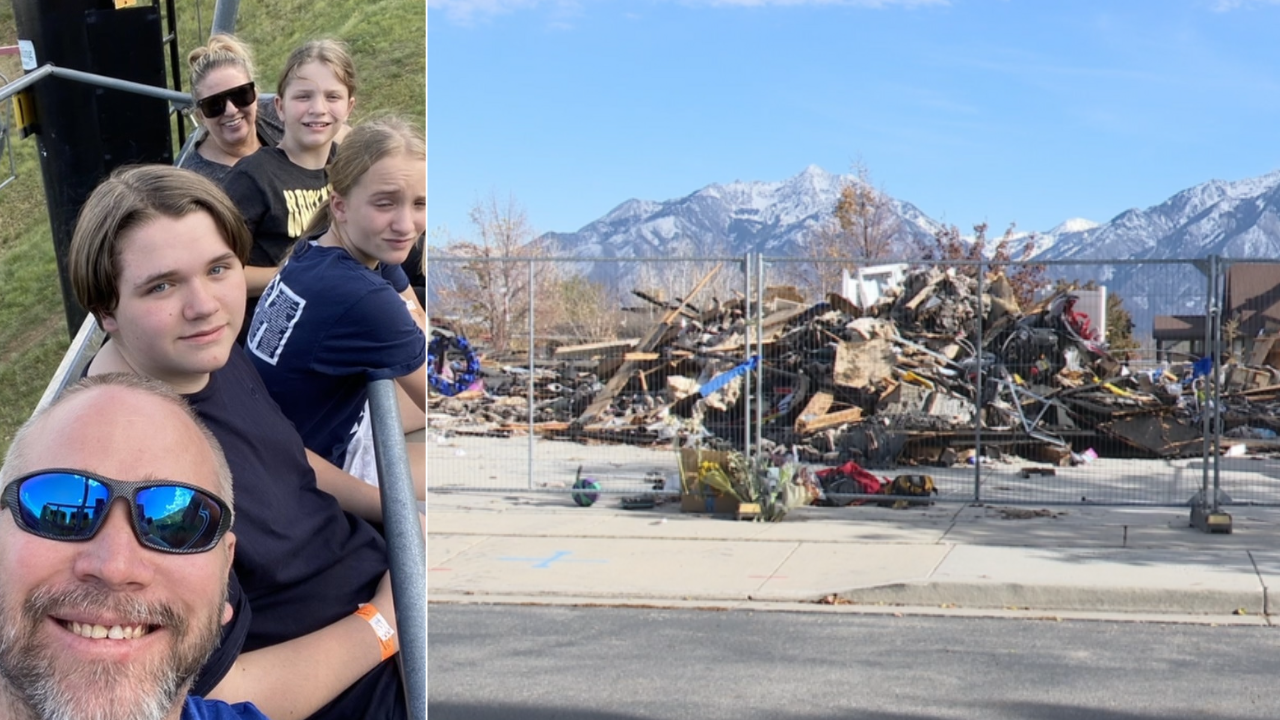


SOUTH JORDAN, Utah — One year later, Jordan Hansen still remembers the moment when he heard a loud noise coming from an area near where his family lived in South Jordan
"I live pretty close to here, so I heard it,” said Jordan Hansen. “I thought it was something else, and when I realized it was coming from here, I ran over here. It’s something you don’t expect, and it took my mind a minute to process; this was my family's home.”
Hansen's family was changed forever on November 6, 2024, when their home exploded from a natural gas leak. Fifteen-year-old Logan Hansen was inside the house at the time of the blast, killing him, and leaving his family to figure out a way forward.
Jordan's parents and two younger sisters lived with Logan in the house. All that’s left in the now-empty lot is dirt and reminders shaped like blue ribbons that friends, family and neighbors tied for the teen.
"Finding out my brother was inside, that was just, you feel so helpless, you don’t know what to do,” said Jordan. First responders found Logan's body six hours after the explosion. He was the only one inside the house.
"My family lost everything that day,” said Logan. “Not only lost my brother, but they lost everything that they’ve ever built in their life."
From vigils to posters to donations, the community stepped up to help the Hansen family.
"Logan was a pretty good kid, he loved his family, and his friends. He loved spending time with everybody,” added Jordan.
In the weeks after the incident, investigators determined a gas leak was the cause of the home explosion.
"An incident like this is so unexpected and tragic that nobody can, nobody would expect something like this to happen, especially to their family,” added Jordan.
Recent reports and documents from the National Transportation Safety Board showed the leak was caused due to a crack in the Aldyl-A pipeline installed in the 1970s. It's believed the spot with the cracked pipe was about 250 feet from the Hansens' home, but the agency is unsure when the pipe cracked and how long it had been leaking.
"You’re dealing with a very volatile substance, and people don’t realize the severity of the outcome of what natural gas can actually do,” said Heath Givan with Utah Leak Detection. Givan is a certified plumber who specializes in gas leaks and their repairs, but was not involved with the South Jordan case.
In the report, investigators noted that prior to the explosion, the Hansen family had felt dizzy and suffered from headaches and flu-like symptoms. They were also without hot water for a few days, but had not smelled any gas.
Even after the explosion, first responders on scene could not smell gas, even with readings showing a high concentration. Givan said that was not unusual because the soil can often absorb the odorant added to the gas to provide its distinct smell.
"That has happened before,” added Givan. “I've been in a home before where they can’t smell it, I’ve had to use my gas sniffing device to actually detect it, and I couldn’t even smell it when I was in their house."
Jordan said his family is trying to raise awareness about installing gas detection devices to help make sure what happened to them does not happen to anyone else. "We want people to start buying these gas detectors to put in their homes,” he said.
“With an incident like this, where a gas leak is undetectable by scent, or anything when it travels so far, through the soil, you don’t know until it happens, and that’s exactly what happened. We had no idea until you come home and there’s just nothing."
Hansen said he and his family are doing their best to keep moving forward without Logan. "It won’t ever be normal again," he said, "especially without him, it will never be the same."
