



EMIGRATION CANYON, Utah — Newly released emails show Emigration Canyon officials discussed whether HF Sinclair could help pay for survey and right-of-way data collected for a proposed road safety project as the company evaluated a fuel pipeline route through the same corridor.
The road project and pipeline are separate proposals. But the discussions have added to concerns among some residents who say they were already struggling to get answers about how widening Emigration Canyon Road could affect their property.
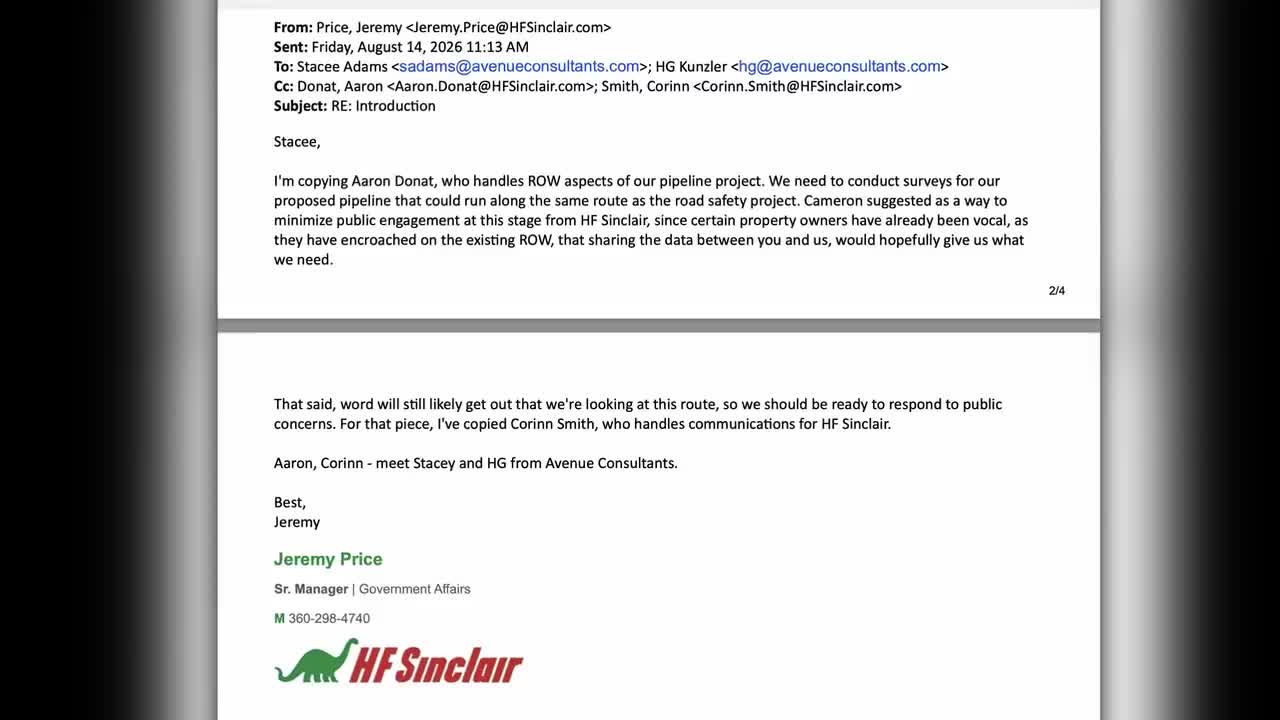
One email in particular has drawn scrutiny. In an Aug. 14 message, HF Sinclair’s Jeremy Price described data sharing as a way to “minimize public engagement at this stage” and attributed the suggestion to Emigration Canyon city attorney Cameron Platt. Price went on to reference property owners who had already been vocal about the road project.
Mayor David Brems disputes that account. He said Platt did not suggest sharing data to avoid public engagement and that Price’s email mischaracterized their conversation.
The city said it explored whether HF Sinclair could help cover the cost of survey work already performed for the road project. No agreement was finalized, no data was transferred and no payment was made.
A road project and a pipeline
FOX 13 News previously reported on homeowners’ concerns about the proposed widening of Emigration Canyon Road, a $6.5 million federally funded road-safety project.
Some residents have questioned how the city’s right-of-way assumptions could affect driveways, yards and other private property.
The project is in its first phase, which includes studying existing conditions and developing preliminary designs. No final road design has been approved.
Pamela Carpenter, an Emigration Canyon resident who has spoken out about the road project, said she felt residents’ concerns were not being meaningfully addressed.
“I was amazed at how unheard I felt and how little public engagement there really was,” Carpenter said.
A fellow resident, Justin Kahn, obtained the emails through a request under Utah’s Government Records Access and Management Act, or GRAMA.
On Aug. 10, Price told Platt that the likely pipeline path was along the road expansion project. HF Sinclair has said its pipeline proposal, known as Westline Connect, remains under evaluation and that no final route has been selected.
In a separate Aug. 14 email, Platt described the pipeline as distinct from the road project but wrote that sharing survey information could help recover some of the road project’s costs.
“The pipeline is obviously not part of the road project,” Platt wrote, adding that HF Sinclair also needed survey data for the same section.
Debate over public engagement
Later that day, Price wrote to representatives of Avenue Consultants, the firm working on the road project, about the possibility of sharing data.
Price described the potential arrangement as a suggestion from Platt that could minimize HF Sinclair’s public engagement at that stage. He also referred to property owners who had already been vocal about the road project.
The email reflects Price’s account of the conversation; it is not a direct quotation from Platt.
“Their impression of the public outcry about the road project … that it was something to be managed, not to be engaging in,” Carpenter said.
Brems rejected Price’s characterization in an interview with FOX 13 News.
“The city attorney did not suggest sharing data in order to minimize, reduce or avoid public engagement,” Brems said. “Mr. Price’s email mischaracterizes what was said.”
Brems said he authorized the city to explore whether HF Sinclair could pay a share of the cost of survey data already collected for the road-safety project.
A proposed agreement
The emails show Platt drafted a proposed agreement for HF Sinclair to share in the cost of survey and right-of-way data from the road project.
On Sept. 8, Price proposed paying $30,000 for the information. The city said it did not agree to that amount.
On Oct. 6, Price told Platt that the company was taking a different direction and asked him to disregard the proposed data sharing contract.
Brems said any arrangement would have required approval from both the Emigration Canyon City Council and the Greater Salt Lake Municipal Services District’s governing board. The city said neither approved an agreement and that HF Sinclair did not receive the data.
HF Sinclair presented its pipeline proposal to the Emigration Canyon City Council on Sept. 15. The company has said the project is intended to increase regional fuel transportation capacity and improve supply reliability.
In a statement to FOX 13, HF Sinclair said Westline Connect remains in the evaluation phase and that the company continues to engage with local leaders and other stakeholders.
Questions about the road process
Separately, at a special meeting Monday, some Emigration Canyon council members expressed frustration about their role in planning the road-safety project.
Council member Nick Griffith said he felt the council had been excluded from the planning process and called for council involvement as the design moves forward. Griffith also said he supports a road safety project and wants a design that addresses dangerous driving while protecting residents and visitors.
An MSD representative said the district applied for road-project funding with a letter of support from the mayor at the time. Council members said they had not known about the application. The representative also noted that Emigration Canyon had a member on the MSD Board of Trustees.
The design team said it expects to reach a preliminary design stage next spring, followed by a public hearing and comment period.
For Carpenter, the newly released emails have deepened a concern she said began with the road project: whether the people affected by decisions are being heard.
“It actually erodes more trust,” she said. “Now people are going to be more suspicious and have to feel like they have to advocate for themselves even more.”