

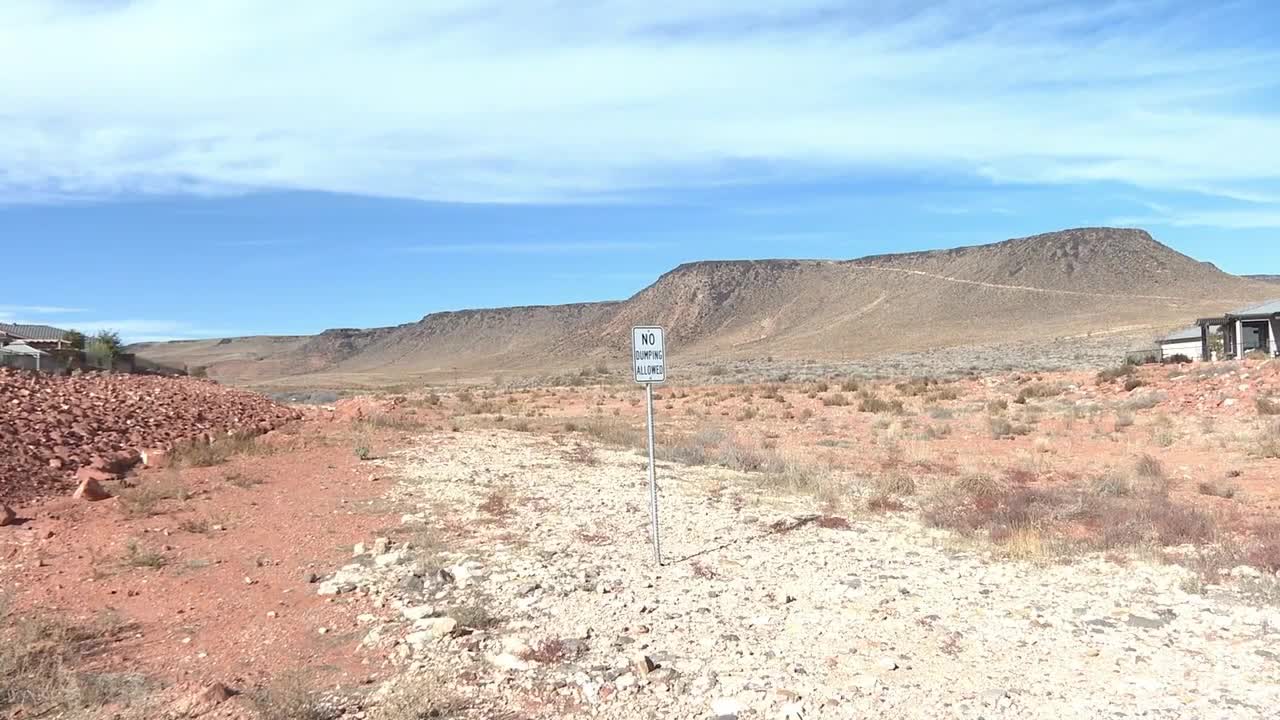


WASHINGTON CITY, Utah — The decades-long debate over Utah's proposed Northern Corridor highway has taken a new turn as residents weigh in on how the controversial project would actually affect their daily commutes.
The four-lane highway would cut through Utah's Red Cliffs Conservation Area, connecting St. George and Washington City more directly. But for residents living along the proposed route, the project raises concerns about safety, noise and environmental impact.
Brett Johnson, who lives on the edge of western St. George near Santa Clara and Ivins, supports the project. He said the current route forces drivers to take a longer path to reach Washington City.
"I don't know that the northern parkway is really going to change most people's commute," Johnson said. "It's not about commuting — it's about getting from here onto the freeway to go north."
Johnson said the current Red Hills Parkway route isn't problematic most of the time, but drivers must either access the freeway at the boulevard or drive all the way to Washington City's Green Springs neighborhood.
The project gained momentum recently when the Bureau of Land Management under President Trump approved the project. Multiple conservation groups are now suing to reverse that decision.
WATCH: Northern Corridor go-ahead draws ire, support from southern Utahns
Residents in Green Springs say the highway would run through their suburban community rather than providing the direct route supporters promise.
Jeanette Troise, a retired school psychologist who lives in the Green Springs neighborhood, said she's mainly concerned about vulnerable populations in the area.
"My concerns are really on not only the environment, plants, and animals," Troise said. "The two sensitive groups that live along here are seniors, and there are young children, so all of these age groups are highly sensitive to this kind of pollution, both noise and exhaust."
Troise emphasized that her opposition isn't political, noting the Trump flags and signs throughout her neighborhood. Washington County leaders have credited the president with getting the highway approved.
"I'm in support of the president. I think he's putting America first," Troise said. "But it's very easy when you are in Washington, looking at maps, looking at something, and someone says, 'This is great, it's just BLM land.' That's fine, but when you are here and it's personal and you're seeing it up front and close, I bet if he came to my backyard right here, he might think a little different. And I invite him."
The intersection of Green Springs Drive and Telegraph Street represents one of the busiest corners in southwest Utah. Local residents frequently cite traffic bottlenecks at this location, as well as at 100 South and River Road, and St. George Boulevard and River Road.
Green Springs neighbors argue that the proposed highway would create a third bottleneck in their area rather than solving existing traffic problems.
"I don't know that this is the best route because it's not direct," Troise said. "They said there would be a direct route, and this is not direct. It's going to go through quite a few neighborhoods, quite a few homes. They can make an exit nine right onto Red Cliffs."
Johnson disagreed with concerns about creating new traffic problems.
"I don't think that's going to be a bottleneck right away," Johnson said. "Eventually, if that area gets built up enormously, then yeah, that will become a crowded interchange too. It won't be as bad as trying to cram everybody into the two existing interchanges, at least."
Beyond traffic flow, Green Springs residents worry about safety and environmental impacts. Troise pointed to increased vehicle traffic bringing strangers through residential areas where children cross streets.
"That increase of cars is the increase in strangers in our neighborhood making it unsafe," Troise said. "That's trash and cigarette butts that could cause them fires out here, and we've already seen how that happens. It's just the safety issue."
She also questioned whether the route would actually save time for commuters.
"Distance-wise, it's about the same by the time you do all the round and here and there," Troise said. "So it's not a direct route. It's not what they talked about, a direct high-speed route."
Jeff Jobe, another Green Springs resident, noted that road noise is already audible in the neighborhood. Ed Bergthold raised concerns about the highway's width, estimating it would span about 100 feet, including travel lanes, a median and turn pockets.
"They just finished it and they didn't plan for it," Bergthold said. "That's my point: no planning.”