


OREM, Utah — Researchers and professors at Utah Valley University are using AI to help uncover ancient history from what they call The Buried Library.
“It’s a complete game changer for what papyrology can do," said UVU philosophy student Orpheus Isom.
Isom never foresaw herself delving into the world of ancient papyrus scrolls.
“For a while, I wanted to be a political science major… and then I wanted to be an illustrator," she admitted.
That led her on a study abroad trip to Italy, where she learned about the neighboring civilizations of Pompeii and Herculaneum.
“That’s where we first encountered the Herculaneum papyri,” Isom explained.
The relationships built with the people at the archaeological sites in Europe have helped the school bring an exceedingly rare sight to Utah.
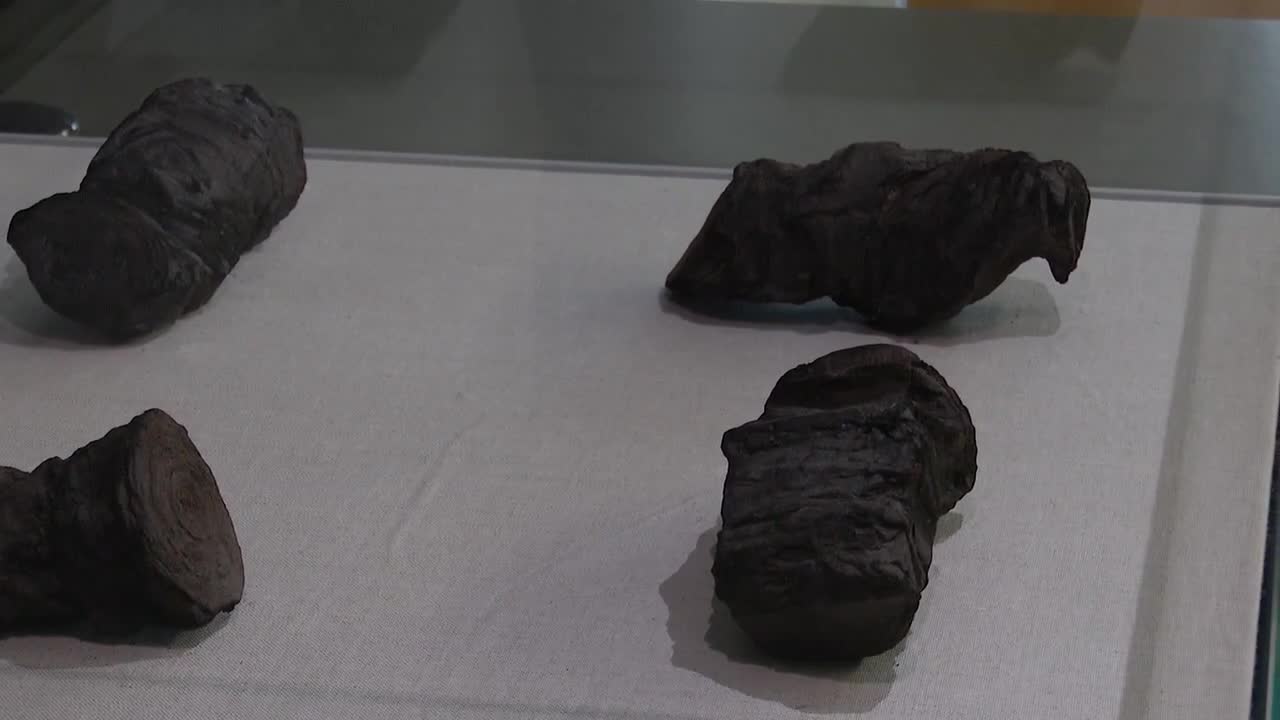
The four scrolls, 2,000 years old and never before seen in the United States, sit behind glass at the UVU conference this week, where scholars from around the world are gathering. They're all paying attention as University of Kentucky researchers show how they’ve pioneered the art of ‘virtually unrolling’ the scrolls with AI.
“We started thinking... that we didn’t want things to be left behind in the digital age. Things that are damaged and fragile are really hard to digitize,” said computer science professor Brent Seales with the University of Kentucky.
Seales soon realized that in some cases, it’s about being able to see anything at all.
“The Herculaneum scrolls are quite unique," explained University of Kentucky research assistant Seth Parker. "They’re basically pure charcoal. But in another sense, that’s what preserves them.”
Because the pages are so brittle, researchers came up with a way to non-invasively recover the text.
“The basic idea is that we CT scan them, which shows the internal structure of the scrolls,” explained Parker.
The group then puts that data into custom software to unfold the wraps of the scrolls and see their texts.
“The recent discovery was an extended passage on Epicureanism and, in particular, a discussion of scarcity and abundance," said Seales.
“We’ve scanned about 50 or 70 scrolls, and of those, we’ve only recovered text from maybe two or three,” added Parker.
The task remains daunting, but they're driven by what they’ve uncovered so far.
“There’s going to be more in this library about what we didn’t know about the ancient world," Seales said. "We’re standing on the edge of a future that we can hardly even imagine.”
The Buried Library Conference is being held in Utah Valley University's Clarke Building through Friday. Anyone wanting to see the scrolls can do so for free, but you must first register on the university’s website.