

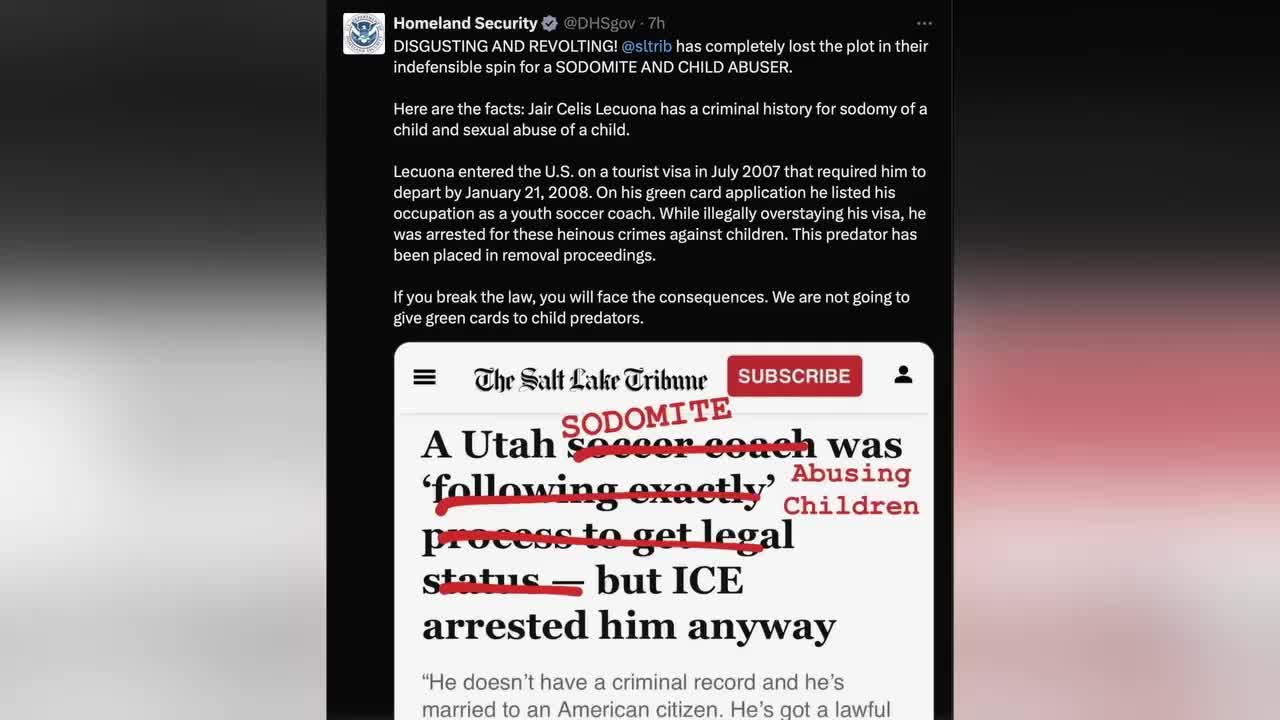


SALT LAKE CITY — The legal battle for a Utah soccer coach detained by ICE has taken a dramatic turn.
On Tuesday, the Department of Homeland Security posted a message on X, labeling Jair Celis as a “predator” and “child abuser.” Celis’ attorney, Adam Crayk, immediately condemned the post.
This post from DHS has garnered more than three million views over the past 24 hours.
“I’m reading it, going, 'Wait wait wait. Our government really said this?'” Crayk said when asked about his initial reaction to the post.
Crayk said he’s never seen anything like it. DHS posted online that Celis had a criminal history for sodomy of a child and sexual abuse of a child. They did not cite where that information came from.
FOX 13 obtained a court filing from 2014. According to that court filing, Celis was accused of a second-degree felony allegation of sexual abuse of a child. Crayk said he was under the age of 18 at the time the alleged incident occurred.
“So, they have publicized something that was handled in a juvenile adjudication or juvenile rehabilitative adjudication, and they publicized something that wasn’t agreed to, never admitted to, never pled to,” Crayk said. “But that’s what’s happened.”
ICE documents from Dec. 2, the day Celis was detained, show that a criminal history search came back negative.
Over at the University of Utah, political science Professor Matthew Burbank said this administration uses social media in a different way than he’s seen in the past.
“It’s a little bit surprising to see, for example, government agencies using social media as a way to comment on groups of people or on particular individuals or comments on something that clearly involves legal issues, because historically, government officials have always been extremely cautious about being involved in anything that seemed to be commenting on an ongoing legal issue,” Burbank said.
When it comes to the words attached to the X post from DHS, Crayk believes they have a case.
“There’s some actions that can be brought. Specifically, there’s one that’s called the 1974 Privacy Act, where the government is actually supposed to get permission to post or to publicize, so they don’t have permission especially on a juvenile record to publicize this kind of thing,” Crayk said. "They have to get permission to get the record first because this is a state record. So, it’s a separation of power issue too.”
While he hopes he can get DHS to retract what they’ve said, Crayk said it’s just one more thing this family will have to deal with.