

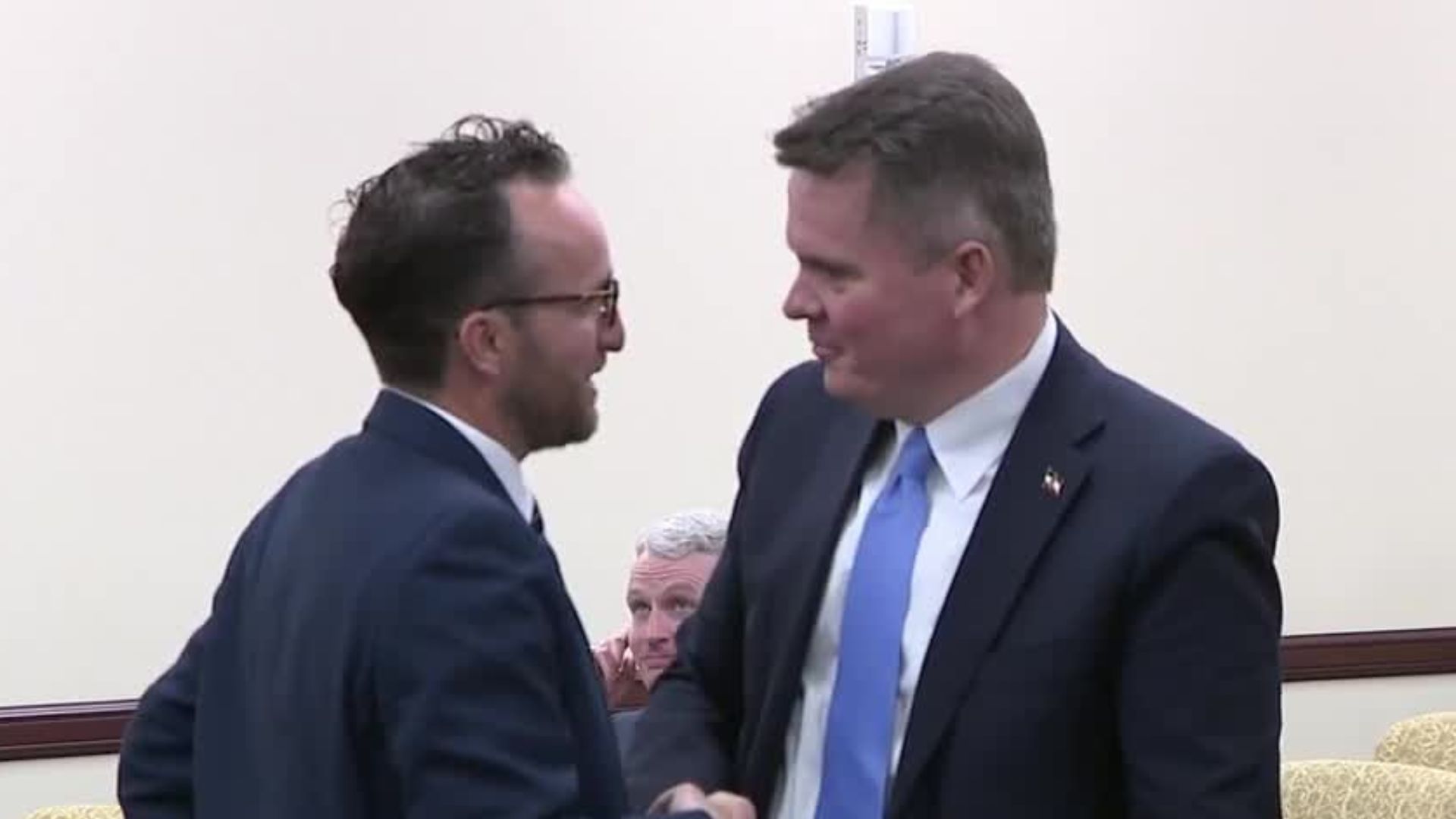


SALT LAKE CITY — Two of Governor Spencer Cox's nominees for an expanded Utah Supreme Court won approval from a Senate committee on Monday.
In back-to-back hearings, lawmakers questioned Jay Jorgensen and Stephen Dent on their judicial philosophies and how they would handle certain cases if they joined the state's top court. But Jorgensen, an attorney for The Church of Jesus Christ of Latter-day Saints, faced the most pointed questions.
Right out of the gate, he was asked by Senate Judicial Confirmation Committee Chair Todd Weiler, R-Woods Cross, if he would recuse himself from certain cases. His employment with the Latter-day Saint church brought it to the forefront.
"The law of judicial recusals is quite clear. I commit I’ll follow it 100%," Jorgensen replied.
WATCH: Cox appoints two to expanded Utah Supreme Court
Sen. Stephanie Pitcher, D-Salt Lake City, pressed him about pending litigation before the Court.
"Have you been asked either directly or indirectly how you would rule or you would have ruled on any issue involving either the redistricting litigation, ongoing abortion litigation or any other matter that either has or could be in front of the Court?" she asked.
"I have not, no," he replied.
Sen. Pitcher continued to grill him about his residency and whether he met the legal qualifications to serve on the Court given how long he'd actually lived in Utah. She went through his resume and asked him where he was living at the time with jobs and callings in the Washington D.C. area, Arkansas, Chile, South Korea and Provo.
"Given these questions surrounding residency, of course, you don’t get to decide and we all have a vote, but that ultimately if it’s challenged? That would be for a judge to decide. If we were brought into litigation over this confirmation, you recognize that would cost the taxpayers money in order to address that question, correct?" she asked.
"It would cost the taxpayers in any litigation," Jorgensen replied.
But other lawmakers believed Jorgensen had met the threshold for residency having been in Utah the past five years.
"You can take the boy out of Utah but you can’t take that Utah out of the boy is what I would say," quipped Sen. Brady Brammer, R-Highland.
Sen. Weiler raised questions about diversity and bias, including pointedly asking Jorgensen if he had any difficulty working with LGBTQ people? "Not at all," was Jorgensen's reply, adding that a judge's role is to show no bias in a case.
Jorgensen was confirmed by the committee on a 5-2 vote with Sen. Pitcher and Senate Minority Whip Karen Kwan, D-Taylorsville, voting against it.
Dent did not face as pointed of questions about his background, but focused largely on his judicial philosophy. Both Jorgensen and Dent have described themselves as "originalists" and "textualists" which means they take a plain language and original interpretation approach to constitutional questions. Lawmakers asked him several questions on the "separation of powers" between the legislature and the judicial branch.
Dent's answers persuaded Sen. Pitcher to vote for his nomination. He advanced out of committee on a 6-1 vote with Sen. Kwan casting the lone "nay" vote. Both men are expected to be confirmed by the full Utah State Senate on Wednesday.
The Utah Supreme Court has become a source of controversy and scrutiny for Republicans on Capitol Hill in recent years. The Court has issued rulings some don't like on the power of citizen ballot initiatives, independent redistricting and abortion rights. The Utah State Legislature has passed bills expanding the Court and creating a special court to hear legal challenges to what lawmakers do pass (itself now before the Utah Supreme Court).
Recently, Justice Diana Hagen resigned in the face of an investigation demanded by GOP leaders (she denied any wrongdoing and a separate investigation found "no merit" to the accusations); Associate Chief Justice Jill Pohlman is the target of a campaign by some in the Utah Republican Party to persuade voters not to retain her over redistricting rulings; and Chief Justice Matthew Durrant announced his retirement this summer due to health issues. When all is said and done this year, Gov. Cox will have appointed six of the seven justices to the Utah Supreme Court.
Asked by FOX 13 News if he felt he was stepping into a more political role on the Utah Supreme Court given the tension between the judicial and legislative branches lately, Dent replied: "The role of the judge is to resolve disputes based on the law. That’s what I plan to do."
