

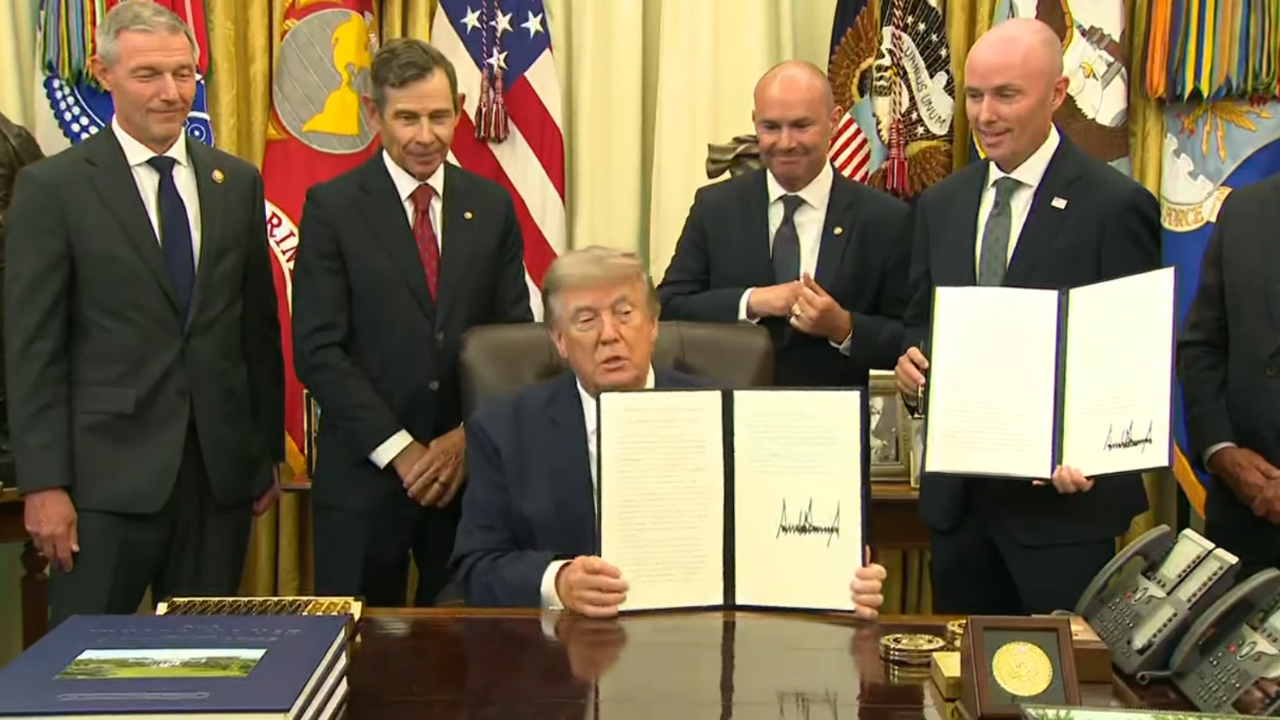


BEARS EARS NATIONAL MONUMENT, Utah — President Donald Trump has issued another executive order once again shrinking the boundaries of Bears Ears and Grand Staircase-Escalante national monuments.
In an event at the White House, the president reduced the boundaries of the monuments for the second time. This time he has shrunk them by three million acres. Bears Ears National Monument will be reduced from approximately 1.36 million acres to about 121,000 acres. Grand Staircase-Escalante National Monument will be reduced from approximately 1.87 million acres to roughly 181,500 acres.
"This is very nice, very happy about this," he said as he signed the executive orders, telling people in the Oval Office that what happened with the boundaries being restored was "very unfair to the people of Utah and now fairness has been brought back."
President Clinton created Grand Staircase-Escalante National Monument in 1996. President Obama created Bears Ears National Monument in 2016. In 2017, President Trump reduced the boundaries of both monuments. President Biden restored the boundaries (and added some to Bears Ears) in 2021.
Surrounded by Utah's congressional delegation, Governor Spencer Cox and House Speaker Mike Schultz, President Trump signed the orders and declared: "We’re putting it back but we’re actually giving more than we did the first time back to the people of Utah."
Nonprofit organization expects litigation over shrinking of Bears Ears and Grand Staircase-Escalante national monuments:
He got words of support from Utah's leaders in the Oval Office. Sen. Mike Lee argued the previous monument designations "have been abused" with the sheer scale and scope of the designations under the Antiquities Act.
"It was done by executive action, President Trump is rightsizing it to bring it into compliance with what the law says," he told reporters.
It will trigger new legal fights over the boundaries and a president's powers under the Antiquities Act. The Southern Utah Wilderness Alliance immediately vowed to go to court.
"We’re going to take him to court because the president simply doesn’t have the authority to reduce or eliminate them," said SUWA legal director Steve Bloch.
Tribal groups, who had been part of managing the monuments, said they were left out of the conversation entirely by the Trump administration.
"To make this decision from the president, that just goes to show that again we are not a part of that decision-making. We’re overlooked," said Davina Smith-Idjesa, a Navajo representative and co-chair of the Bears Ears Inter-Tribal Coalition.
Native American tribes in the area say the area is culturally sensitive and is still used by them.
"This area of Bears Ears is a living cultural site," Smith-Idjesa told FOX 13 News. "I go there because I know there are significant places of my people that I can revisit and reflect on. There are also places I can harvest sage for ceremonial purposes."
Others in southeastern Utah use them too, but believe the boundaries were simply too big.
"Bears Ears has meant a lot to everybody here," said Rep. Logan Monson, R-Blanding, whose district in the Utah State Legislature includes the monument. "This is home, this is where we grew up, where we go camp, recreate, gather wood and do different things. What it’s done is make this issue a political issue. It’s made this land a political issue."
Rep. Monson said he viewed it as "an opportunity to step back and look at everything differently."
Congresswoman Celeste Maloy, whose district includes both monuments, praised the move by President Trump.
"Utahns have long supported protecting our state's extraordinary cultural and natural resources. This action honors that goal while following the law Congress passed and giving greater consideration to the people who know these lands best," she said.
While Republican leaders in Utah cheered the decision, Democrats were fuming.
"Today’s executive order opens up some of America’s most treasured public lands so special interests can do what Congress wouldn't let them do. Bears Ears and Grand Staircase-Escalante aren't bargaining chips. They belong to all of us—not the mining and energy interests that have spent years trying to roll back their protections," said Ben McAdams, who is the Democratic candidate in the newly-created First Congressional District.
There are currently two lawsuits pending over presidential actions related to the national monuments. Environmental and tribal groups have one lawsuit pending in the Washington D.C. federal courts. The state of Utah has a lawsuit pending in federal court in Salt Lake City.