

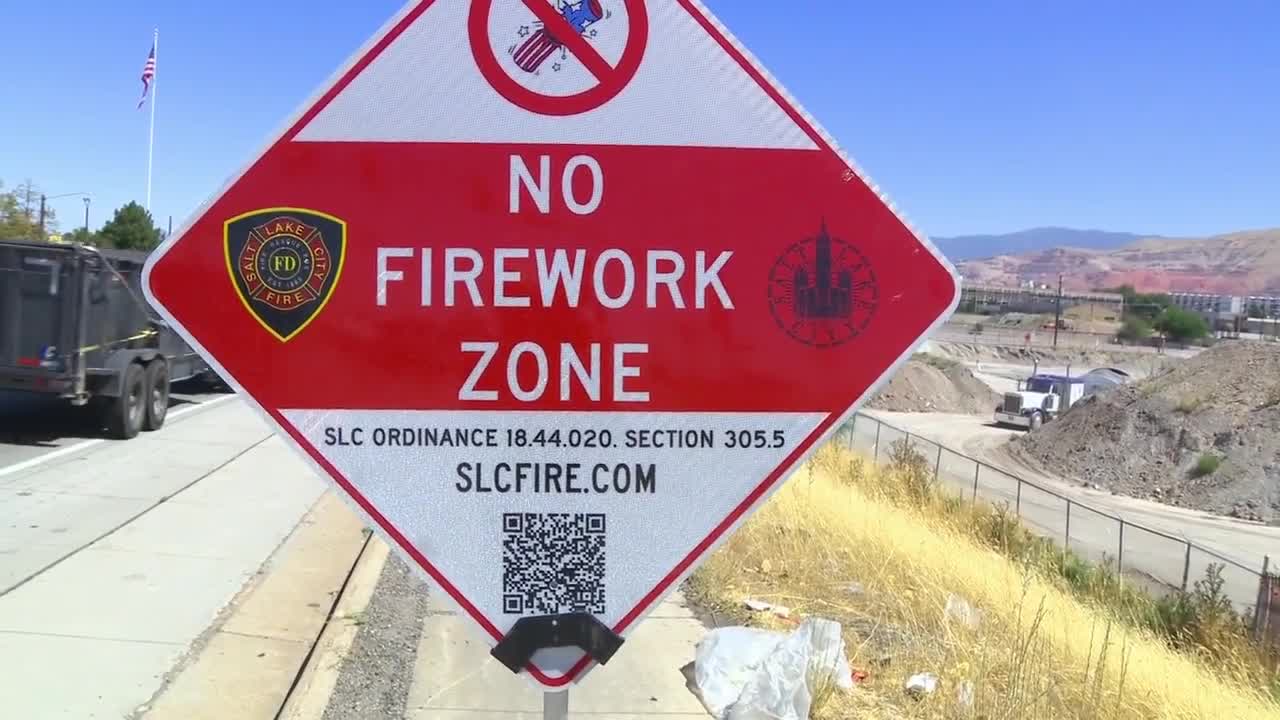


SALT LAKE CITY — The Utah State Forester is evaluating whether to seek another emergency order extending the ban on personal fireworks through the Pioneer Day holiday.
"We don’t like to be restrictive if we don’t have to be. We want people to enjoy what they can," Jamie Barnes said in an interview Thursday with FOX 13 News. "Right now, as it moves into another holiday and fireworks, where we could allow that, we’re looking at whether we need to issue another order. It’s warm. It’s hot. We’re hitting 100-degree temperatures. It’s still drying out the fuels."
When he declared a state of emergency due to wildfires, Governor Spencer Cox suspended a law that blocked cities and towns from issuing fireworks bans. That enabled the State Forester to issue an emergency order enacting a default ban across Utah on personal fireworks. But her order also allowed mayors and fire chiefs to decide places where people could set off fireworks with some restrictions. Some communities (like every city in Salt Lake County) adopted the ban, while others went with designated areas for fireworks.
Overall, Barnes said, the ban appears to have prevented more catastrophic wildfires. Utah is currently home to several of the largest wildfires in the nation, with more than 360,000 acres burned so far and the majority of them being human-caused.
The state did document numerous fires as a result of fireworks over the Independence Day holiday. She said most people in banned areas did comply.
"I think people understand the fire danger this year and that this year is different," Barnes said.
Fireworks ban appears to keep Fourth of July weekend quiet in Salt Lake City:
Gov. Cox's order is only good through July 21. When he announced the emergency action, the governor said he would re-evaluate things for Pioneer Day and hoped monsoonal moisture would improve conditions to allow fireworks. Barnes said while Utah has received rains recently, it has not helped as much as everyone hoped.
"I'm not seeing the amount of rain we would need in the forecast to make a big difference," she said.
It increases the likelihood of another ban, though no decisions have been made.
"These hot temps and what we’re seeing does increase the likelihood. I mean, today we’re in red flags down south again," Barnes said, referring to what are known as "red flag conditions," when hot temperatures and strong winds significantly increase fire danger.
Fireworks ban douses hopes of local businesses ahead of Fourth of July:
The Utah League of Cities & Towns, a group that represents the state's municipal governments, is planning to send a survey to mayors across the state to get their experiences with the Fourth of July ban and restrictions. The group's president, Bountiful Mayor Kate Bradshaw, told FOX 13 News that it could help advise the governor and other state leaders as they consider whether to issue another emergency order for the 24th of July.
One environmental group said it wouldn't mind if the ban was extended.
"I'm not anti-firework. But I think I am pro-lung and pro-clean air in Utah," said Lexi Tuddenham, the executive director of the Healthy Environment Alliance of Utah.
Tuddenham said there were significant drops in air pollution as a result of a lack of fireworks. Utah's Division of Air Quality confirmed to FOX 13 News that it did record less pollution at air monitoring stations over the Fourth of July holiday compared to previous years.
"When I think about my lungs, my kids’ lungs, my community’s lungs, it’s worth it," Tuddenham said. "And also because it has such a dramatic impact on air quality in terms of wildfire smoke."
Another group noticed a decrease that it attributes to the fireworks ban. Salt Lake County Animal Services said in an Instagram post that it saw a drop in animals it took in (38) compared to last year (57).
Under laws passed by the Utah State Legislature in response to the COVID pandemic, an emergency order by a governor is only good for 30 days. Then, the Utah State Legislature would have to meet in a special session to vote to extend it. After the law passed, then-Governor Gary Herbert reacted by issuing a new emergency order every 30 days.