

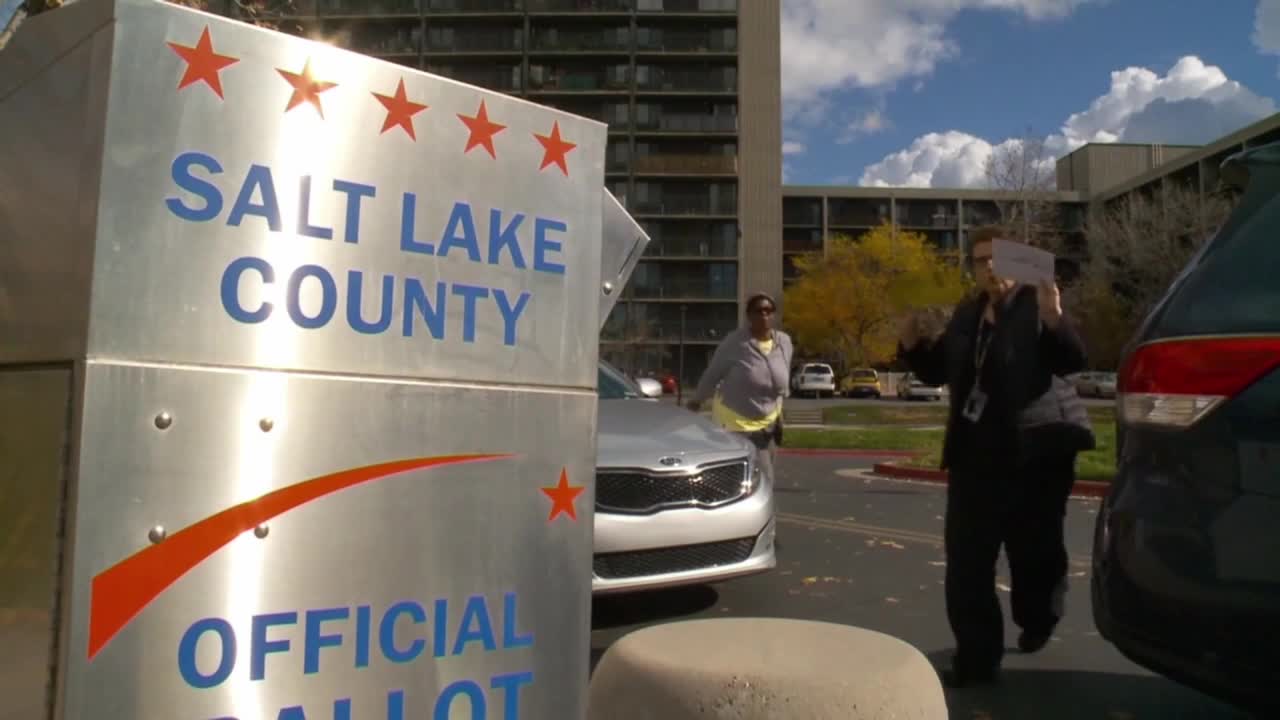


SALT LAKE CITY — Shelly Jackson has seen the social media posts and fielded the phone calls from people very concerned about the letter they got from the Lt. Governor's Office.
"So we’ve heard people say, 'You’re telling people how I voted, who I voted for.' That’s not true," said Jackson, who is the deputy director of elections for Lt. Governor Deidre Henderson. "Not even your county clerk knows who you voted for. The ballots are anonymized through the process. We’d love for you to go visit your county clerk to see that process. We’ve heard people say you’re releasing birthdays, Social Security, those things. We’re not. It’s a standard data set."
Online, people have feared all their information is about to be public for anyone to see. On Tuesday, the Lt. Governor's Office was trying to combat some misinformation.
This past legislative session, lawmakers passed Senate Bill 153, sponsored by Sen. John Johnson, R-Ogden, which changed the criteria for voter information that can be declared private. Under Utah law, there were three categories: public, private and withheld.
"We’ve gone from three levels of privacy to just two," Jackson said. "So now you’re either an at-risk individual or your voter information is public."
That's publicly available information, which can be purchased from the Lt. Governor's Office for a $1,050 fee for statewide lists or from county clerks for smaller batches. Utah and other states have offered such information to political parties, candidates and causes for decades. What they get is a voter's legal name, an age range, address, voting precinct and districts, party affiliation, whether they're an active or inactive voter and the elections they voted in. The Lt. Governor's Office will not release driver license numbers, Social Security numbers or date-of-birth. It is also a criminal offense to publish any of the information they do get.

Somewhat related: much of the same information still protected under SB153 is also what Lt. Gov. Henderson has refused to hand over to the U.S. Department of Justice that the federal government is now suing her over.
Under SB153, political parties can get email addresses and phone numbers starting next year — but only if a voter opts-in to share that information.
Who uses this information? People like Gabi Finlayson and Jackie Morgan. The two are popular Utah political social media influencers and also senior partners at Elevate Strategies, a firm that works on campaigns for Democratic candidates. They insist people are not being "doxxed" by the state of Utah.
"We totally understand the concern, right? People have heard a lot of things about what this bill would do, that it will make their data public. That is not necessarily the case," Finlayson said.
Finlayson said political campaigns and parties rely on the information to reach voters through mailers, knocking on doors or other ways to get them to turn in that ballot. It helps to reach someone who maybe hasn't voted in a while, or avoid a progressive candidate knocking on the door of a die-hard MAGA voter, saving everyone time, money and aggravation. She did not believe the law would change much for people's privacy.
"There are not a lot of people who have a lot of interest that they’re going to go and buy the Utah voter file, right? It’s a thousand dollars and it’s not that helpful for most people," Finlayson said.
Morgan and Finlayson also point out Utah is hardly alone. Dozens of other states have similar laws. From 2018 until now, Utah was the only state to allow someone to designate their voter record private for no reason at all
"This brings Utah in line with almost every state in the country. A publicly accessible voter file to political campaigns, to parties to anyone who’s doing political work is actually pretty essential to our democracy," Morgan said. "We need to be able to know who people are, where they live, if they voted in order to make sure we have the information to turn them out to vote and for campaigns and candidates to talk to them."
As FOX 13 News was there interviewing them about SB153? They created a social media video to try to combat misinformation:
The form and criteria for people to seek to have their voter information withheld can be found here. A county clerk will make the determination if someone qualifies to have their voter information declared private.
Online, some who have noted this is how political campaigns do their work have said those who object to it should contact their representatives and senators on Utah's Capitol Hill to complain.
Jackson said she has heard from some people angry over the law change who have now threatened to un-register as a voter.
"We have, unfortunately, and I do think that’s an unfortunate side-effect," she said. "I think the most important thing you can do, and I'm biased, is participate in the electoral process to vote."