

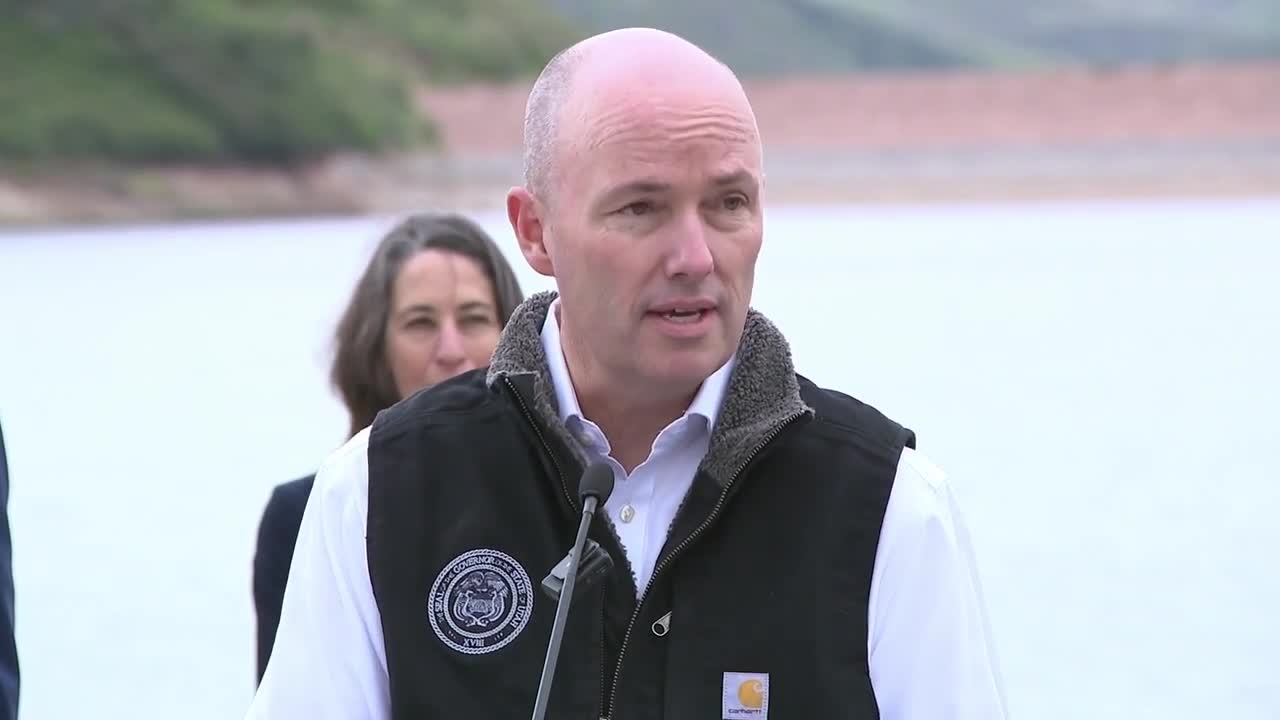


SALT LAKE CITY — Governor Spencer Cox issued an emergency declaration on Thursday in response to worsening drought conditions statewide.
"We are coming off a winter that was the warmest on record, by nearly three degrees. Unfortunately these warmer temperatures are expected to continue through the summer," the governor said at a news conference at Little Dell Reservoir.
The entire state is in drought. Some areas are in worse shape than others. Altogether, 22 of Utah's 29 counties are in what is called "extreme" drought. Uintah County is in exceptional drought, the worst category. FOX 13 News first reported earlier this month that a group of state and federal agencies had recommended to the governor that he make an emergency drought declaration.
"The numbers are clear. Utah is in one of its worst droughts in history," said Joel Williams, the director of Utah's Division of Water Resources.
Utah's snowpack, which supplies 95% of drinking water, has been dubbed "no-pack," after a very warm winter. Reservoirs are expected to be strained. Currently, they are at 70% of capacity. Some reservoirs only have enough storage to last another year. The Great Salt Lake and Colorado River continue to be in crisis.
"We can’t control the weather, but we can control the tap," Gov. Cox told reporters on Thursday, calling for conservation measures across all sectors.
All over the state, local water districts are calling on people to cut their outdoor water use. Some communities have found themselves enacting tough restrictions. The small town of Emery, for example, shut off outdoor watering entirely to ensure an adequate drinking water supply.
"We’re using water like it’s June right now," said Laura Briefer, the director of Salt Lake City Public Utilities, which has enacted "Stage 2" drought restrictions in Utah's largest city that calls for cuts to outdoor watering.

Briefer has urged 20% reduction in water use to ensure supply carries Salt Lake City through the rest of the year, but warned of restrictions should things get worse.
"I really want to ask our residents to be very deliberate about their water use," Briefer told FOX 13 News. "Reduce their outdoor watering. That’s going to keep us in Stage 2 and not go into Stage 3 with mandatory restrictions."
Because of conservation efforts already carried out by residents? Briefer said Salt Lake City and Sandy have been able to dedicate more water to the Great Salt Lake, which continues to be in crisis.
Agriculture, the state's top water user, has already seen water reductions forced on them. Farmers and ranchers have seen their allotment of water reduced. Gov. Cox noted that his own farm in Fairview had seen its production cut in half because of drought.
"Farmers and ranchers are the first to see these cuts," said Matt Hargraves of the Utah Farm Bureau.
The governor's drought declaration will help agriculture producers make ends meet with loans and other assistance available. Communities can also receive money and infrastructure help with the drought declaration. But Hargraves said Utahns will notice the effects of drought at their local farmers markets.
"You’ll see reduced amounts of fruits and other crops like that," he told FOX 13 News. "As far as our livestock producers? They’ll be making difficult decisions right now. Do they have enough feed to feed their animals? Do they have to sell herds right now?"
Asked by FOX 13 News what he would say to people who complained about being told to conserve while agriculture still uses more water or being told to cut back while state leaders support a massive data center development, Gov. Cox pushed back and said farmers are conserving.
"That’s where the biggest cutbacks will always be, always have been. I get pretty fired up about that one because it’s a lie and it’s wrong and anybody who says that either doesn’t know what they’re talking about or do know what they’re talking about and they’re intentionally trying to lie about it," he replied. "As far as the data center? Again, this data center is going to use less water than its original use. So this data center is going to return water to the lake. Again, there are issues that people should be concerned about, for sure. Water is not one of them in that particular case."
Environmental groups urged everyone to conserve water. The Youth Coalition for Great Salt Lake, a group of young people dedicated to reversing the lake's declines, said everyone needs to take action now.
"This is going to take everyone reducing their water consumption and support policies like water leasing, investing in soil health practices and supporting native, drought tolerant landscapes, and reducing water consumption as a whole, from rural to urban parts of the watershed. Small actions today can grow into big changes that protect our future, air quality, and our Lake," the coalition said in a statement to FOX 13 News.
Marcelle Shoop of the Audubon Society said what people conserve this year will help the Great Salt Lake. She urged people to view the drought declaration by the governor as a wake-up call.
"Anybody who’s concerned about Great Salt Lake or their environment around them, it really just emphasizes the need to take individual to work on water conservation in your own backyard," she said.
The state is offering resources and incentives to replace non-functional turf, replace toilets and save water throughout homes and yards. You can find out more information about what's offered in your neighborhood from Utah Water Ways here.
Read the governor's drought declaration here: