

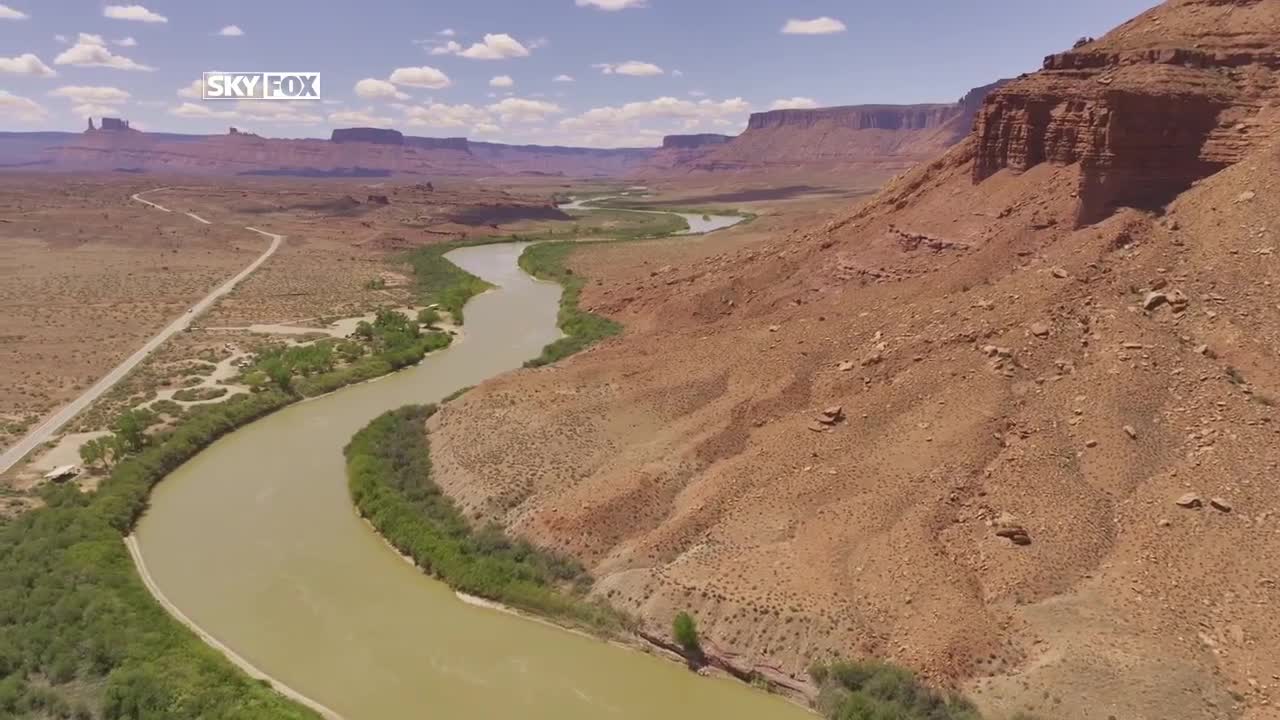


SALT LAKE CITY — The multi-state agreements managing the Colorado River for decades now have officially expired.
When the clock struck midnight on October 1, the agreements ended. In their absence, the Trump administration is now managing the water for more than 40 million people across the American West until the states can get a deal together.
"I don’t think you’ll notice anything different as far as the river’s concerned," Gene Shawcroft, the Colorado River Commissioner for Utah, said in an interview with FOX 13 News.
Water will still flow to Utah and other states along the Colorado River (a portion from the Colorado River system is pumped into the Wasatch Front through the Central Utah Project for drinking water needs). But there will be noticeable changes. For example, FOX 13's sister-station KTNV reported on Thursday that Nevada will begin taking reductions in how much water it gets from the river over the next two years.
"Our water supplies are not changed for the remainder of 2026. The beginning of the new Water Year, Oct 1, begins a new 'Lake Powell to Lake Mead' release pattern. But any impact to Arizona's water supplies under the new guidelines don’t occur until Jan1 2027," Tom Buschatzke, the Colorado River Commissioner for Arizona, said in a statement to FOX 13's sister station ABC15 in Phoenix.
Under the U.S. Bureau of Reclamation's plan for managing the river in the interim, Arizona, Nevada and California will take cuts to how much water they get. In Utah, the feds ordered a million acre-feet of water to be released from Flaming Gorge to prop up Lake Powell downstream. Water is also being held back in Lake Powell to keep it above the minimum level to generate electricity for millions. That means not as much is going downstream to Lake Mead in Nevada.
Upper Colorado River Basin states like Utah have argued they can't cut any more as they are on the front lines of a horrible hydrology and limited snowpack.
"There’s just not water to cut back. We are cut back not by a piece of paper or an agreement, we’re cut back just by the fact we don’t have snow in the mountains," Shawcroft said.
But he fears that may not be the end of it.
"If next year is as dry as this year, there will be, I don’t want to get people nervous, but there will be draconian changes on how things are at play," Shawcroft warned. "We could end up in a situation where we’ve released a million acre feet from Flaming Gorge, maybe another half. Beyond that, there’s not that much water to release from Flaming Gorge."
It's a politically volatile situation. Nevada is already suing the federal government over its Colorado River management plan. Shawcroft confirmed that he and his fellow Colorado River commissioners have not negotiated in months — though they have traded some draft proposals that he calls "successor agreements."
"We put that together with the Bureau of Reclamation, we’ve sent that to the Lower Basin states for comments," he said. "We understand the Lower Basin states are trying to again conclude how they’re going to share those shortages. Until they conclude how they’re going to share those shortages, it doesn’t make a lot of sense for us to try to get back together."
Utah political leaders, who have expressed concerns about the Flaming Gorge releases, are nervous.
"It’s not an easy problem to solve. The problem is, 100 years ago when the Colorado River compact was agreed to, there was more water than what we currently have today," House Speaker Mike Schultz, R-Hooper, told FOX 13 News on Thursday. "The Upper Basin states including Utah have taken those cuts over those hundred years. The Lower Basin states, since Lake Powell and Mead, haven’t had to take those cuts. The reality is now facing them."
While they would prefer a states-led deal, some environmental groups say neither the states nor the feds are addressing the bigger realities of the situation and less water.
"It is not going to solve the fundamental issue at the heart of the Colorado River crisis," said Zanna Stutz of the Glen Canyon Institute. "We are continuing to just kick the can down the road."
The Glen Canyon Institute is among those who have called for re-evaluations of the river's operations and questioned the viability of Lake Powell and Glen Canyon Dam going forward. The lake is currently at about 22% capacity and has hit new lows not seen since the Glen Canyon Dam was constructed in the 1950s. The group has pushed for filling Lake Mead and letting Lake Powell go.
"We should be seeing reservoir consolidation be on the table. We should be seeing infrastructure modification, particularly at Glen Canyon Dam, be on the table in order to deal with this dryer hydrology," Stutz told FOX 13 News.
Republican Utah political leaders have made it clear they would not support letting Lake Powell go.
Meanwhile, Shawcroft said he hopes the states can reach a deal and address hydrological issues.
"As always is the case, I'm convinced and committed to working on a seven state agreement. I believe the states can come to a better resolution than the feds," he told FOX 13 News. "But in the meantime, if we don’t come to an agreement, we know what’s going to happen in '27, we know what’s going to happen in '28."
This article is published through the Colorado River Collaborative, a solutions journalism initiative supported by the Janet Quinney Lawson Institute for Land, Water, and Air at Utah State University. See all of our stories about how Utahns are impacted by the Colorado River at greatsaltlakenews.org/coloradoriver