

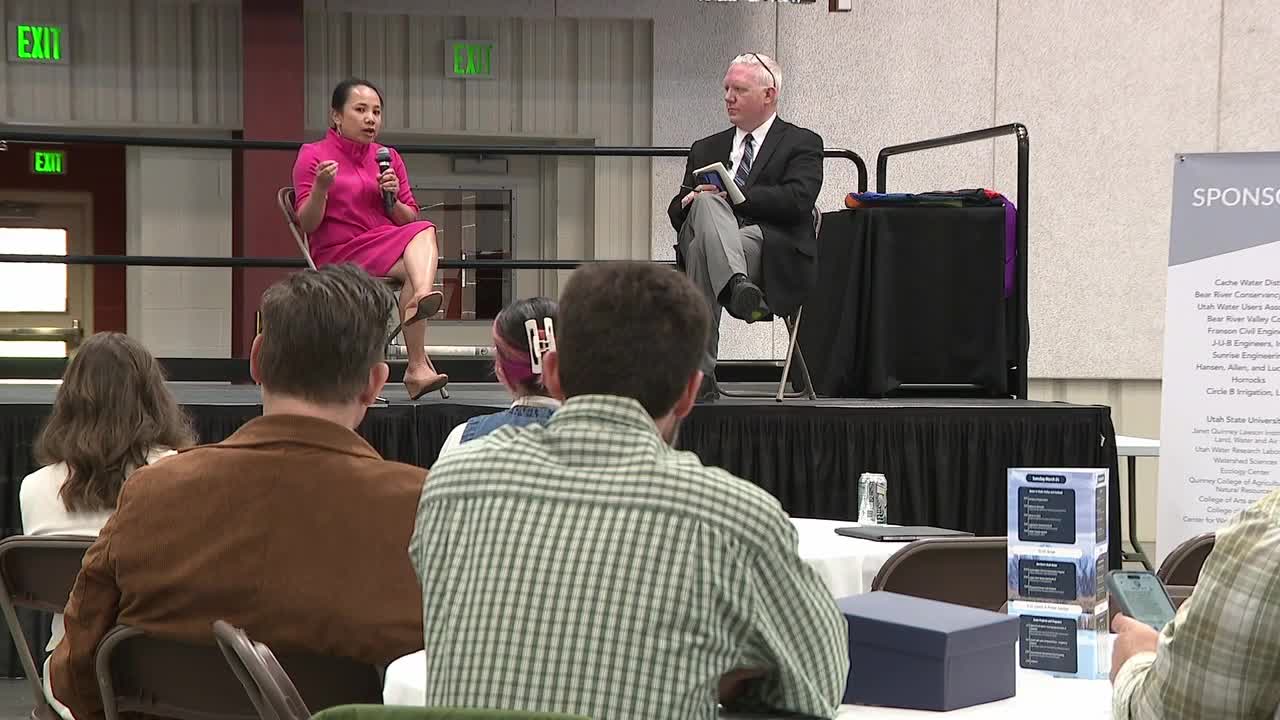


LOGAN, Utah — The former commissioner of the U.S. Bureau of Reclamation under President Joe Biden told a group of Utah water users to avoid looking at water from a red state, blue state lens.
"It's inherently clear," Camille Touton said, pointing out that it flows through communities regardless of politics.
Touton, who served under President Biden, had praise for Governor Spencer Cox and Utah leaders for the work they have done on water issues. She said the state worked well with the U.S. Bureau of Reclamation during her time in office because of a mutual trust and work done on both sides.
"The Great Salt Lake work that we did," Touton told FOX 13 News in an interview Wednesday. "But we also worked on the Junesucker and the Strawberry Irrigation District, the Highland Canal as well as with Washington County and water recycling and Toquerville Reservoir."
As the West faces more drought and declining water resources, Touton said people need to get involved and do their part for conservation.
Cox signs bills to help farmers dedicate some water to the Great Salt Lake:
"Understand the issue. Where your water comes from, what it means and get engaged," she said. "Very small actions. You decide maybe you water less outside during the heat, or maybe you take on some efficiencies in your home. Those add up."
The U.S. Bureau of Reclamation exercises oversight of the Colorado River system that supplies water to millions of people across the Western United States. It also runs Lake Powell and Lake Mead, which supplies power for millions. With forecasts from the agency that Lake Powell could drop to levels so low it ceases to generate power this year, Touton noted she faced similar issues with hydrology when she was in office in 2022.
She expressed hope that the problems can be solved, praising the agency and its workers.
"I think that everyone knows the importance of the system and I have confidence they’re going to continue to move towards that," Touton said.
The seven states along the Colorado River are still trying to hammer out an agreement to manage the water supply. On Tuesday, the Upper Colorado River Commission — which includes Utah — met and negotiators said they still continue to talk.
"Our goal is that an agreement on the near-term operations will allow us to continue talks about the long-term. All seven states are still at the table," said Brandon Gebhart, the Colorado River commissioner for Wyoming.
But the horrible hydrology is a concern as states continue to fight over who cuts what and where. Estevan López, the Colorado River Commissioner for New Mexico, called the situation "dire."
"The stakes have never been higher, and unfortunately, the reservoirs have never been drier," he said.
The current agreements between the states governing the Colorado River expire on Oct. 1. The Trump administration has threatened to make decisions no state may like. Recently, states have traded offers on water releases to prop up Lake Powell. Arizona Governor Katie Hobbs announced the hiring of a law firm in anticipation of potential Colorado River legal fights. Utah's legislature started stashing money away in case of lawsuits. Gov. Cox told reporters on Tuesday he hoped to avoid litigation over the Colorado River.
"It takes sometimes decades and doesn't resolve anything. So we think that's a mistake, but we're prepared whatever happens," he said, adding: "Even if there is a lawsuit we will continue to negotiate."
Touton declined to weigh in on the negotiations in her interview with FOX 13 News, saying of the states' Colorado River negotiators: "I know all of those people. I know the passion that they have for it and the immense responsibility they carry, and I support them in what they do moving forward with this."
This article is published through the Colorado River Collaborative, a solutions journalism initiative supported by the Janet Quinney Lawson Institute for Land, Water, and Air at Utah State University. See all of our stories about how Utahns are impacted by the Colorado River at greatsaltlakenews.org/coloradoriver