

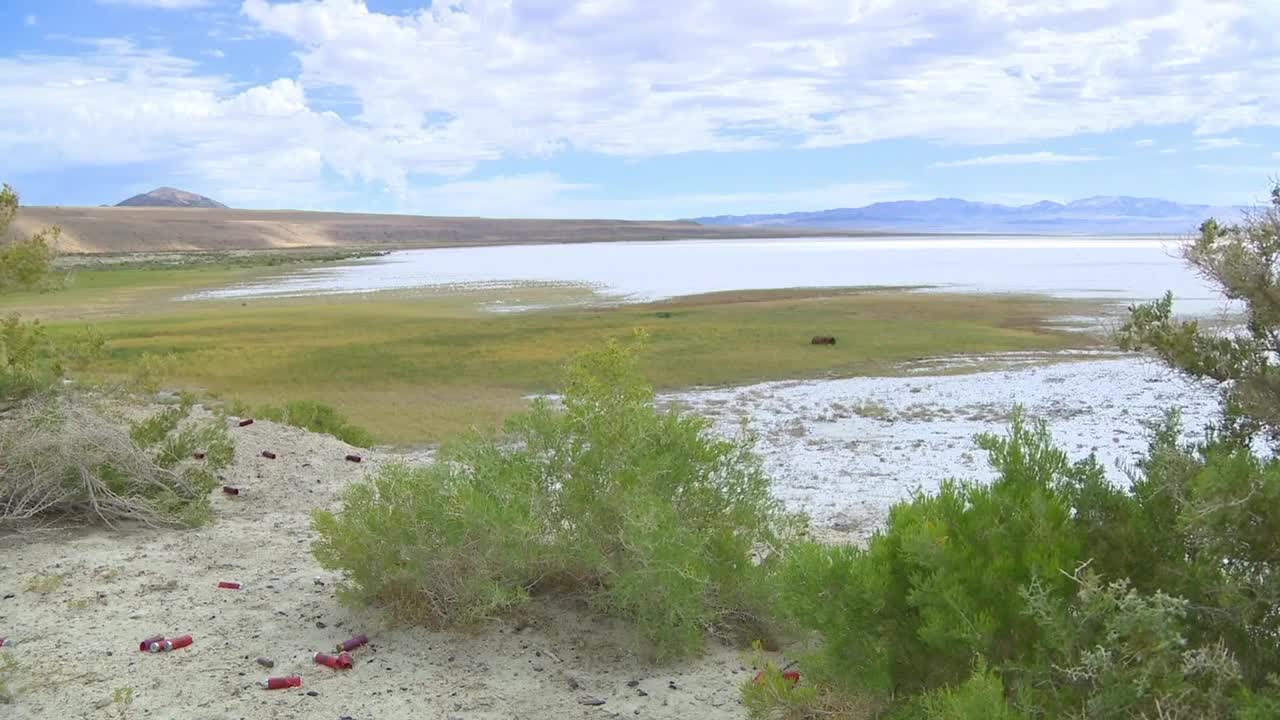


SNOWVILLE, Utah — The lands north of the Great Salt Lake are brown dirt, sagebrush and tumbleweed.
And to Brenna Williams, they are pristine.
“I raised my kids out here,” said Williams. “We went camping and rock hounding, and my husband took the kids hunting and come out here and camp and star watch.”
“This is my kids’ and my history,” she added. “I don't want to see it ruined.”
Williams calls herself a liaison for Box Elder Accountability Referendum, or BEAR. It was created to oppose the Stratos data center planned for Box Elder County. Investor Kevin O’Leary, best known as one of the businesspeople hearing pitches on the reality show “Shark Tank,” is the developer behind the project. In the debate over Stratos, BEAR and a “Shark” are both talking about water.
The Great Salt Lake and all the people, animals and ecosystems who rely on it have a stake in the arguments, too.
Why water matters
A FOX 13 News reporter and photographer accompanied Williams recently as she took journalists from Germany and Sweden on a tour of the Great Salt Lake’s north shore – or what used to be that – and the surrounding area. As of Wednesday, the Great Salt Lake was sitting about 8 feet lower than its healthy baseline. The lake helps generate snow, which provides the majority of the Wasatch Front’s drinking water.
The exposed lakebed has caused dust to blow into Utah’s urban areas. The Great Salt Lake is also a stopover for birds migrating between South America and the Arctic.
“When I had to write my letter to the (Box Elder County) commissioners, I came up with 15 reasons why this is a really bad idea,” Williams said. “One of them is water.” Stratos would sit between the Great Salt Lake and Interstate 84.
But Paul Palandjian, the co-founder and CEO of O’Leary Digital, the company that wants to develop the Stratos project, pushes back on concerns about water.
“We know factually that we will not be a net negative to the Great Salt Lake,” he said in an interview.
“The modern data center does not use a lot of water,” he added. “Period.”
Palandjian says Stratos will cool by recirculating water.
“Now it's become very efficient,” he said of the cooling process. “It requires little to no ongoing water use to cool the data centers.”
Stratos would use potable water for data center workers to drink, flush toilets, etc. Palandjian said, but little to no water for power generation.
The liquid number
So how much water does Palandjian expect to use annually?
“I can't give you an exact figure at this time,” he said.
But he estimated that, “at full scale of the project,” the data center would use “no more than the acre-feet that’s available to us there at the present,” or approximately 1,800 acre-feet. That would be as much water as 5,000 homes use every year, according to Environmental Protection Agency estimates of household water usage, even if it would be less than some data centers consume.
“We know that the (data center) numbers illustrate the massive dependency on water systems,” said Feras Batarseh, a Virginia Tech professor and the university’s Artificial Intelligence lab director.
Batarseh, who studies data centers and water, is skeptical available technologies will save as much water as O’Leary and his team say. He says whatever method Stratos uses “there are tiny differences in improvement.”
The water is supposed to come out of the ground – nothing taken directly from the Great Salt Lake or the rivers that flow to it.
Groundwater, though, is its own story.
What used to be
“If you say, ‘I'm going to pull from groundwater,’” Batarseh said. “And assume that's disconnected from surface water, it shows the lack of understanding.”
“The cycle from rain,” he added. “From lakes, from rivers, groundwater, it's all basically connected.” In 2024, the Utah Geological Association published research estimating ten percent of the Great Salt Lake’s water comes from groundwater.
On that trip out to the edge of the lake with journalists, Val Anderson carried a large, framed photo of his late father. Anderson, executive vice president of Mineral Resources International Inc., stood near the same spot where his dad posed for the photograph.
“This is a picture of him out here in the mid 1980s,” Anderson explained. “When the state was worried about the water line coming up too high and the water came right up to the shore here.”
When the younger Anderson stood near the spot earlier this month, the shore was dry. Anderson, whose family has been harvesting minerals off the Great Salt Lake since the 1960s, said you used to be able to see water seep from the ground.
“The groundwater traditionally would make it into the lake during certain years,” he said.
Much of the groundwater in the area goes to raising cattle or growing alfalfa, including for export.
O’Leary and Palandjian have argued Stratos is a way to keep water in Utah.
But Batarseh, the Virginia Tech professor, said what the data center produces will be shipped abroad, too.
“Who's going to use those data centers?” he asked. “Is it going to be all America? Absolutely not.”
Piping plan
Yet O’Leary and Palandjian say they see potential for Stratos to add water into the lake, partially through plans to not use some of the water shares that are going to agriculture now.
And they have an idea.
Palandjian said their engineers are asking: Is there a way “to take excess unused water that exists already on the site and build a pipeline infrastructure to be able to channel that water to make sure that it gets to the Salt Lake?”
He says any pipeline carrying water will have to be treated first and might have to travel 10 miles or more to reach the lake or a drainage. And it would happen only if all the landowners between Stratos and the lake cooperate.
One pipeline engineer FOX 13 spoke to said such a pipe could cost 10 million dollars.
Batarseh says he isn’t necessarily opposed to data centers, but he recommends a cost-benefit analysis first.
“At this point, there's not enough data to illustrate what [O’Leary and Palandjian are] claiming,” Batarseh said.
Meanwhile, Palandjian described his and O’Leary’s company’s status as: “We are all systems go on the project."
“We continue to advance it in the most environmentally responsible manner.”
Williams said she’s never cared about something like she has Stratos and what she fears it could do.
“I know what's going to happen out here,” Williams said. “I've talked to the scientists, even if I'm not one.”
“You take water out of the aquifer,” she added. “It's going to lower the water table for everybody.”