



AMERICAN FORK, Utah — When Haley Lewis gave birth to twin girls in December 2021 after years of infertility, it was a complicated moment.
Her daughter Sorin was healthy, delivered at 7 pounds at 37 weeks.
Astrid was stillborn. She’d previously been diagnosed with triploidy, a rare genetic abnormality that proved fatal at 23 weeks.
"It’s a blur,” Lewis said as she recalled the day of their delivery in an interview with FOX 13 News. “Like, everyone’s coming in all at once for this healthy baby. And they’re also not really focused on the baby that’s passed.”
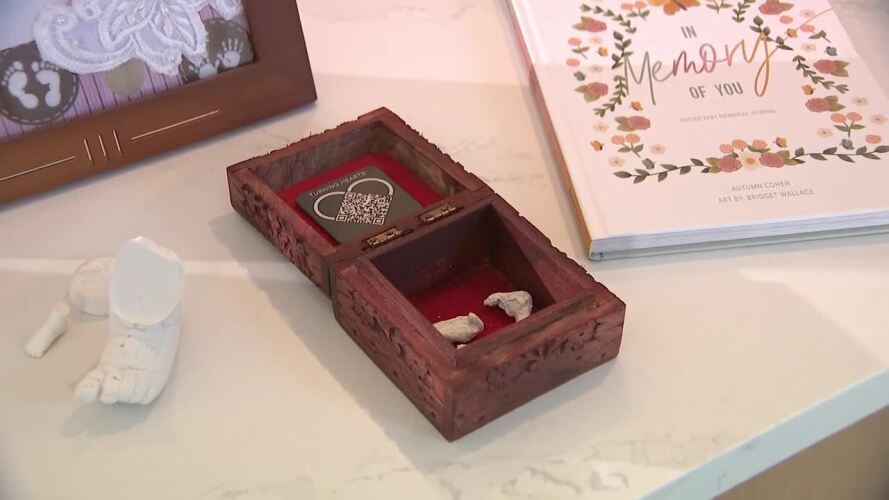
But a group that specializes in pregnancy loss support helped ensure Lewis and her husband received the mementos of Astrid that are so important to them now, including photos of their daughter and the tiny molds of her hands and feet, which Lewis now keeps with her almost “at all times.”
"Making sure that all of those items are there for the parents is super important,” she said.
Nearly 24,000 families across the United States will experience a stillbirth, when a baby dies at more than 20 weeks of pregnancy, each year. About 275 of those cases are in Utah.
Hundreds of Utah families lose babies to stillbirth each year, but experts say many are preventable:
And while these losses are not often discussed, experts say they can have profound mental health impacts.
"These are considered, for a lot of people who experience it, a traumatic event,” noted Dr. Rana Jawish, who works on bereavement support and mental health at the University of Utah’s Stillbirth Center of Excellence. “There is a potential for the adverse mental health outcome following stillbirth to last for decades.”
One of the main themes she hears from parents after a loss, Jawish added, is the “lack of consistent care in the system.”
Lewis now serves as president of the nonprofit Share Parents of Utah, which supports families after pregnancy loss, and told legislators earlier this year that some families receive “exceptional, trauma-informed care.”
"Others leave without memory-making opportunities, without clear counseling referrals and sometimes without acknowledgment of their baby’s life,” she added, while testifying in support of a bill that would create a standard of care for parents who lose a pregnancy in a Utah health care facility.
Rep. Ryan Wilcox told his colleagues he was motivated to sponsor HB559 after his sister's recent pregnancy losses.
He also reflected on his own experiences from decades ago.
“We had a baby at one point who we weren’t allowed to see and was disposed of in the trash,” he said during an emotional debate of the bill. “I don’t know if my son is, to this day, if he went to the landfill or if he was incarcerated with the biowaste. I don’t know what happened.”
Wilcox, R-Ogden, said he believes practices have improved since then.
But "we have some ways to go," he added. "We can do better.”
The bill ultimately passed with strong support and became law in early May.
Required practices might include providing parents with memory-making opportunities (such as photos, hand and foot molds, keepsakes or written materials), offering them access to grief counseling or allowing parents to have “sufficient time and space” with their child after a loss.
The Department of Health and Human Services told FOX 13 News that it is currently working with the Office of Maternal and Child Health to formalize rules around the bill.
Haley Lewis discusses the role of Share Parents of Utah and the importance of mementos after a death:
'I was so depressed'
When Jawish began working with the Stillbirth Center of Excellence at the University of Utah, she was surprised to learn that she knew people who were struggling with pregnancy loss even decades later.
“They still talk about it with the same pain,” she said in an interview with FOX 13 News. “It’s like... it looks like it’s very raw to me, as a mental health provider. And that was very kind of eye-opening for me and very humbling.”
The Stillbirth Center is among the leading institutions in the country working to address the nation’s stubbornly stable stillbirth rates, through a combination of training, research, education, advocacy and in-clinic care.
Among its goals is to double the proportion of families who receive grief counseling or other bereavement support after a loss.
“Having mental health support embedded as early as possible not just improves the mental health outcomes; it prevents worsening mental health outcomes,” Jawish said.
When families don’t receive needed support, the impacts can be long-lasting and wide-reaching, notes Dr. Bob Silver, co-director at the Stillbirth Center.
“These families have tremendous mental health issues,” he said in an interview. “Often that leads to divorce. It can lead to difficulty in raising other kids. It can lead to disrupted marriages, substance use disorder. A lot of downstream time off from work and careers derailed and those kind of things.”
As the Stillbirth Center looks to support families even years after a loss, it’s also worked to ensure hospital staff are equipped to respond to stillbirths in the moment.
“The stenographers, the nurses, the medical assistants all undergo specific training to become better able to emotionally support these folks and to say things that are supportive and not triggering and harmful,” Silver said. “Education is a huge component of this.”
Silver explains the long-lasting mental health impacts of stillbirths for families:
Lewis saw the mental health outcomes of her loss manifest physically, as she said her weight approached nearly 300 pounds “because I was so depressed.”
“I didn’t think that I could continue on without having my other daughter,” she added.
She said support groups, the mementos, and events like remembrance walks have gone a long way to helping her work through her grief. But she believes the loss will always have a profound impact on her life.
"One week you are under the covers and hiding,” she said, “And the next week you’re perfectly fine and you’re serving people that need your help.”
As she works with families who have experienced a loss, Lewis told legislators that she’s seen “the quality of care they receive in those first moments profoundly shapes their long-term healing.”
And she hopes the new law will now ensure all parents who lose their children have a chance to honor and remember them.
"I hope, at least, if it’s done correctly through Health and Human Services, everyone gets mementos for their babies,” she said in an interview. “Everyone gets to know that their loss is valid and gets the time to grieve.”