

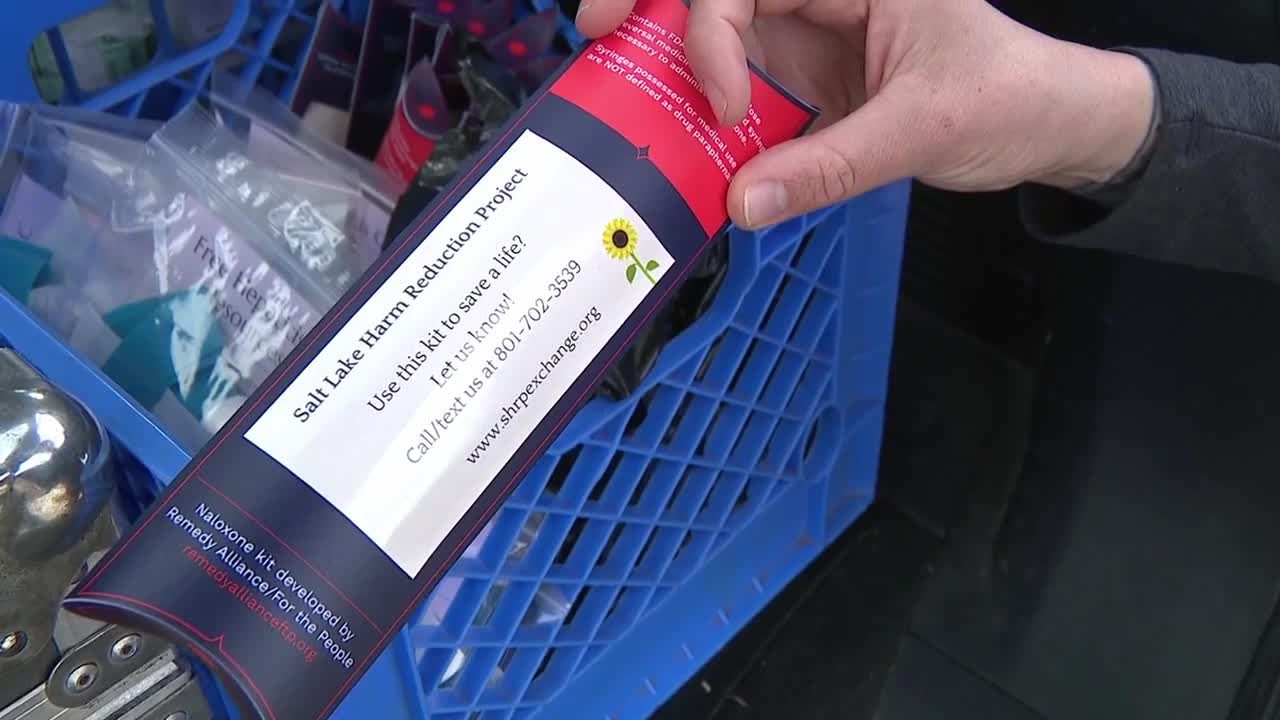


On a cold spring day earlier this year, Ellie Golden drove around the Salt Lake Valley, the backseat and trunk of her black SUV stocked with syringes, fentanyl test strips and naloxone, the opioid overdose reversal drug.
As the mobile outreach coordinator for the Salt Lake Harm Reduction Project, Golden spends her days meeting with people who use drugs and providing them with supplies meant to diminish the negative impacts that can accompany illicit substances.
It’s part of a public health philosophy called harm reduction, which seeks to “meet people where they’re at,” Golden said.
"We recognize that people do use drugs in our community,” she told FOX 13 News in between visits with clients. “And our goal is just to reduce the risks associated with that use and just try and keep people alive, essentially.”
Harm reduction has sometimes drawn opposition from those who see it as a way of enabling or even helping people use drugs. President Donald Trump signed an executive order last summer that expressed opposition to such efforts, which it said “facilitate illegal drug use and its attendant harm.”
But advocates stress research showing harm reduction services can reduce overdose deaths and infectious disease transmission and lead people to change their behaviors.
“Somebody who uses some of our overdose prevention services, some of our syringe exchange programs, our harm reduction programs, they're five times more likely to get into treatment,” noted Tricia Bishop, the overdose prevention coordinator with the Utah Department of Health and Human Services (DHHS).
Amid surging deaths due to fentanyl, a synthetic opioid that can be fatal even in tiny amounts, advocates say these services have become more essential than ever.
Fentanyl test strips in particular are “an important tool to have in your toolbox,” Bishop said. They cost only about $1 each and allow someone to quickly check their drugs for the presence of fentanyl.
Suppliers often add fentanyl into other drugs, since it’s cheap to manufacture and can yield a high profit margin. But because it’s odorless and colorless, users may not know it’s there if they don’t test for it.
“And that’s when you see a lot of people have fatal overdose,” Golden noted.
One of Golden’s clients — who FOX 13 News agreed not to identify by name due to his concerns about the possible legal ramifications of talking openly about his drug use — said he worries about fentanyl in his supply and wants to avoid it.
He said he’s personally witnessed overdoses due to the drug, which he confirmed when he tested the substances involved afterward.
“And to be quite honest with you,” he said, “if I wouldn’t have had access to the naloxone kits that Ellie provides with the group, those people would not be around any longer.”
Watch as MacKenzie Bray, executive director of the Salt Lake Harm Reduction Project, explains the history of harm reduction services:
‘Positives all around’
After a pilot project proved their effectiveness, harm reduction groups began distributing fentanyl test strips in Utah more widely after the state Legislature decriminalized their use in 2023.
Data shows that was the deadliest year for fentanyl overdoses in the state on record, with nearly 300 fatalities.
Sen. Jen Plumb, D-Salt Lake City and the co-founder and medical director of Utah Naloxone, sponsored the bill and described the test strips as a “commonsense solution” that could help prevent deaths.
“We want people to have the ability to stay alive while they’re hopefully on a path to getting well,” she told her colleagues during a debate on the proposal that year. “And this is a tool that can help empower that.”
SB86 ultimately received overwhelming support in both chambers. But before offering their support, some legislators wanted to understand whether helping people test their drugs could lead to unintended consequences.
Rep. Trevor Lee, R-Layton, asked whether test strips would “possibly create an increase in drug use” among those who believe after testing for fentanyl that “the bad stuff’s out of there.”
Plumb said that’s a “really common” concern.
But, she added, “we do not find that people having tools that make them safer makes them more likely to engage in a behavior they would not have engaged in."
Heather Bush, then with DHHS, also pointed to the pilot project on fentanyl test strips in Utah, which found many people who used them changed their behaviors after a positive result.
“They made sure that they had naloxone on hand,” she told legislators. “Maybe they didn’t use the drug. Maybe they went back and confronted where they received the drug to say, ‘Hey, we keep getting fentanyl laced in these drugs.’”
A 2021 report from the Utah Drug Monitoring Initiative noted that it was “difficult to estimate the lives that may have been saved by the use of these test strips.” But it said their distribution and the overdose prevention education provided alongside them "have created an opportunity for increased awareness and empowerment.”
A report the group released a few years later was even more definitive on the impact of harm reduction services.
It found that when those resources declined in Utah between 2022 and 2023, drug overdose deaths spiked 12%. When harm reduction offerings increased the next year, the reverse occurred: deaths decreased 2.5%.
“I think there are positives all around when it comes to the data that we are seeing,” Bishop, with DHHS, said in an interview.
MacKenzie Bray, executive director of the Salt Lake Harm Reduction Project, said fentanyl test strips “have done a lot of good.” But she also stressed that they’re not a perfect solution, since fentanyl is usually dispersed unevenly in a substance like chocolate chips in a cookie.
“When you use a fentanyl test strip, you’re only testing a portion of a substance,” she said. “So someone could break off a corner of their cookie, test it and there might not come up positive for fentanyl, which is typically good. But that might just mean there’s no chocolate chips kind of in that section.”
To avoid a false sense of security, the Salt Lake Harm Reduction Project encourages people to test as much of their supply as they can before taking it.
"Kind of like letting people know, ‘Hey, these are really good; they’re not perfect,’” she said. “But, you know, few things in life are perfect.”
Watch Bray discuss the limitations of fentanyl test strips:
‘Free from stigma and judgment’
On the day FOX 13 News observed her route, Golden greeted each of her clients with a big smile.
As she exchanged needles and passed out other supplies, she talked with one about his birthday plans. She asked another for details about his upcoming surgery while petting his dog.
“It’s building a connection with people so that when they’re ready for treatment or, you know, need something from us, we’re there for them," Golden said later of her approach to these conversations. "They feel accepted by us, free from stigma and judgment."
In an interview, the Salt Lake Harm Reduction Project client who said he had witnessed several overdoses due to fentanyl described the value of harm reduction services as “enormous.”
Years after he reused a needle in a “really desperate situation,” the organization offered him Hepatitis C testing. When the result was positive, they helped him get into a clinic for treatment.
Having the ability to easily exchange needles also means he doesn’t have to use them more than once, which has reduced the skin abscesses that “caused a real problem for me for a while,” he said.
“Thank God for that group,” he added.
A second client FOX 13 News interviewed — who also agreed to speak on the condition that he not be identified by name — said he tests his drugs before taking them out of concern about fentanyl.
“I’m not as prevalent as being around the drugs as I used to be,” he added, “because I mean I’ve been kind of laying off, which is good.”
Asked whether they believe test strips and other harm reduction services enable drug use, both disagreed. They said people will do drugs regardless and seek treatment only when they’re ready.
“They’ll do anything to get either pain control or get relief of their addiction,” the first man said. “And I think being able to have access to safe materials that actually decrease harm to the individual is a great asset.”
“They’re going to get their fix no matter what,” agreed the second client. “And if these guys weren’t around, there would be more — a lot more — deaths.”
While harm reduction groups can offer many concrete resources, the first client FOX 13 News interviewed said the connection he has with Golden also helps him in a more subtle way, by keeping him “in touch with reality” about his drug use.
“She asks me, you know, how I’m doing, which makes me touch base mentally, you know?” he said. “‘How am I doing?’ it makes me ask myself. And quite frankly, I've had times where I realize I wasn’t doing that great, you know? Because I don’t pose that question to myself that often. And it puts me in a safer place, I think, emotionally.”
For Golden, this is the part of harm reduction that critics often miss.
“I feel like our services kind of plant seeds for people so that they remember that they matter, they’re human, that they’re loved,” she said. “And that they’re deserving of care, wherever they’re at on their journey and their use."
When people are ready to get treatment, Golden said, the Salt Lake Harm Reduction Project will be there to help.
But that can only happen if someone lives long enough to get to that point.
