



In 2007, Congress passed a resolution to designate the first week of June as National CPR and AED Awareness Week. This week is to showcase how many lives can be saved with these crucial skills.
According to the American Heart Association, about 70% of out-of-hospital cardiac arrests happen in homes. The AHA also reports that 90% of those who have a cardiac arrest outside of the hospital do not survive.
Automated external defibrillators (AEDs) can be used by anyone and provide step-by-step instructions to deliver a shock if needed, according to the American Red Cross. Those are important to locate at workplaces, local businesses, and in people’s own homes. So, this week not only showcases the lifesaving skills, but also the importance of having more bystanders with the skills to act in an emergency situation.
Benjamin Donner, the executive director of the American Red Cross Central and Southern Utah Chapter, said often times, someone in distress might be someone you know.
“You want to know the basic skills, so in that moment, you aren’t hesitating. You just jump right in and are able to help them,” Donner said.
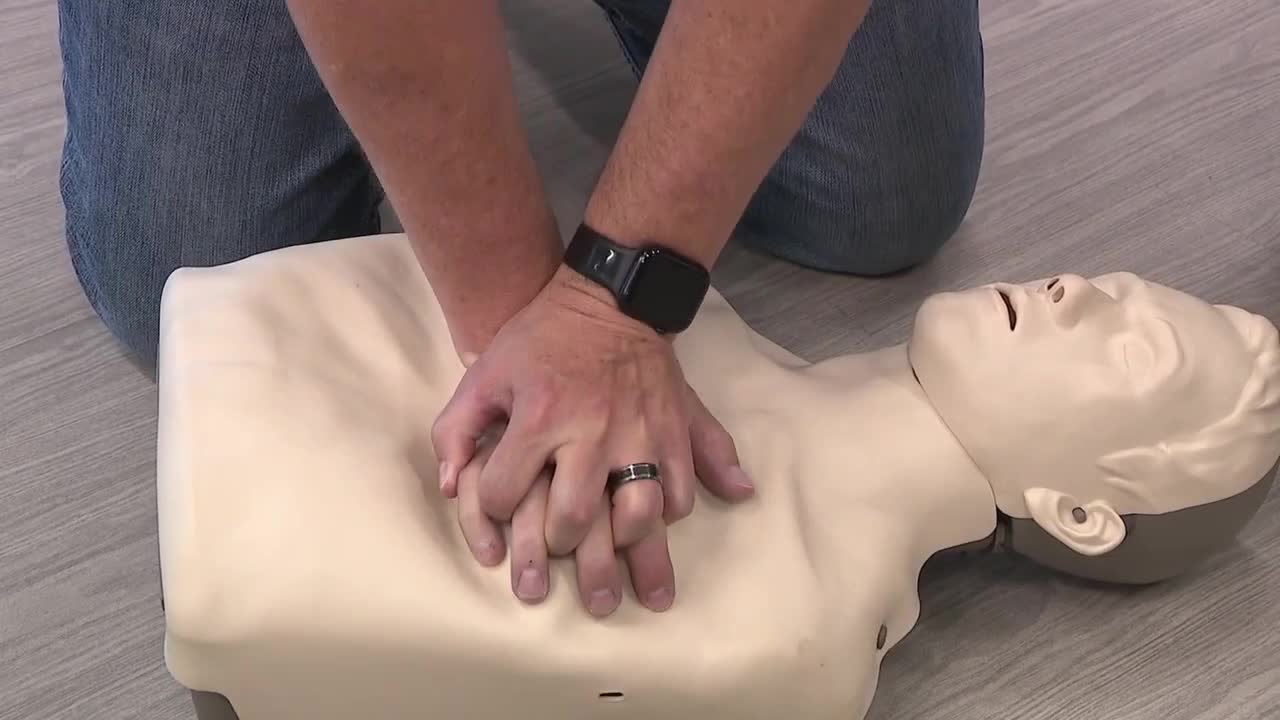
WATCH: CPR/AED demonstration with American Red Cross
Donner said when a person is in distress, it’s important to make sure the scene is safe and to firmly tap the person on the shoulder to see if they are unresponsive.
“If they don’t respond, go right into compressions,” he said. “The first thing to remember there, though, is to call 911 and hit speaker phone. Then set that down because then you’ll have this calm voice that will walk you through what to do next.”
According to the AHA, compression-only CPR is as effective as conventional CPR and provides more people with an opportunity to save a life. Chest compressions are used on adults and teens, and each compression helps push the remaining oxygen through the body to keep all the organs alive. The key is to have straight arms, place the palm in the middle of the chest and push down hard and fast.
Donner said if people are looking to learn conventional CPR, which includes breaths, the Red Cross offers many different classes that can be found here.