

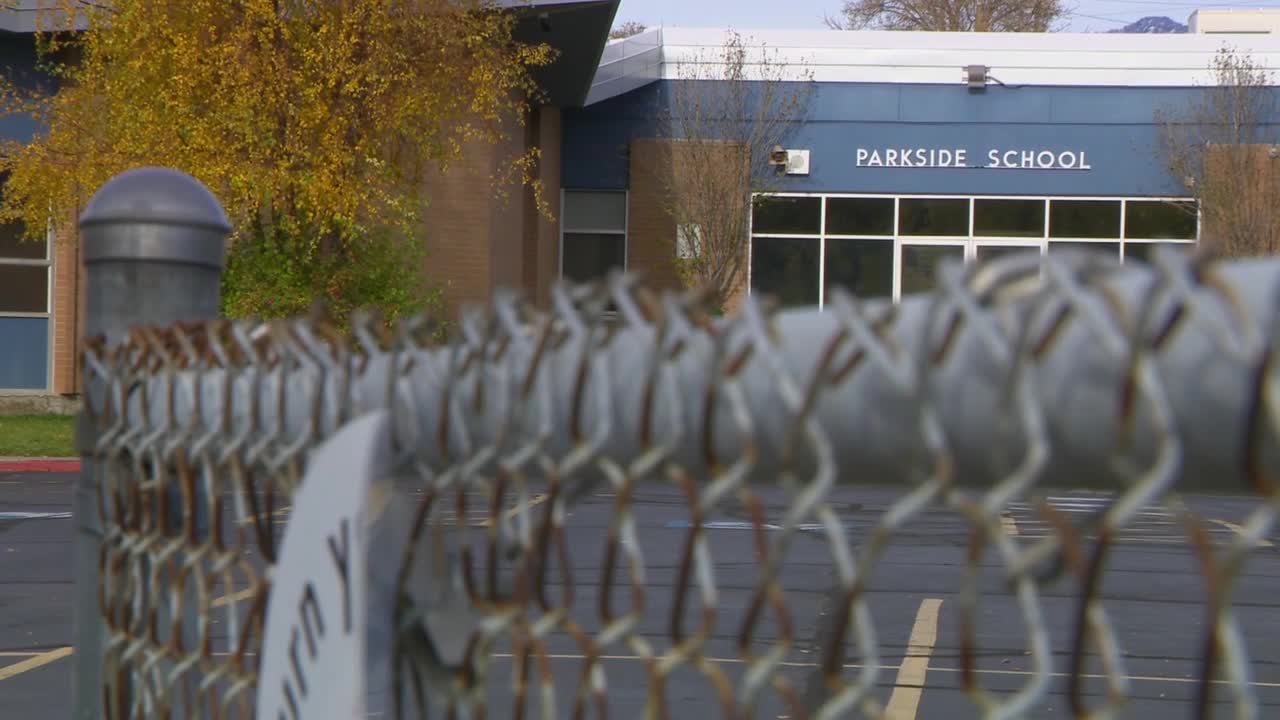


MURRAY, Utah — Billie Lopez spends her "days and nights worrying” about her 8-year-old daughter, who has been diagnosed with autism and is nonverbal.
“She can’t tell me anything about her day,” Lopez noted in a recent interview with FOX 13 News. “She can’t ever tell me what trauma she’s dealt with. She can’t express her feelings.”
So Lopez wasn’t sure at first what made her third grader suddenly want to keep the lights on and the door open at night, or why Lopez would find her “huddled by her door” in the mornings.
Then Lopez learned that her daughter’s school, Parkside Elementary in the Murray City School District, had put her in seclusion – a controversial emergency safety intervention where students are involuntarily confined and isolated from their peers, sometimes in small, padded rooms.
Under state law, seclusion is allowed only under extreme circumstances when a child poses an "immediate and significant" safety threat to themselves or others.
But an investigation by the Murray City School District said the school didn’t meet that high threshold. It also found the school failed to properly notify Lopez and continued using seclusion when her daughter exhibited physical distress, according to a copy of the document Lopez shared with FOX 13 News.
“After finding out what I found out,” Lopez said her daughter’s new behaviors made more sense. “I thought, ‘Those are probably a trauma response to being in a room and the lights are off and you’re stuck in there.’”
The most recent federal data shows Utah students – the vast majority of them with disabilities – were put in seclusion more than 2,200 times in the 2023-2024 school year. That's compared to about 1,300 times just a few years before, in 2020-2021.
School districts and teachers say it’s used sparingly and only to ensure the safety of students and staff. But the Utah Legislature has put additional guardrails around seclusion in recent years, as parents, students and advocates have raised concerns about instances of misuse.
Because seclusion can cause trauma and worsen behaviors for the children subjected to it, “these are things that should be emergency interventions, only happening in situations that could really result in an imminent danger of serious harm,” noted Guy Stephens, a national opponent of seclusion with the Alliance Against Seclusion and Restraint.
But "in my experience,” he added, “the majority of restraint and seclusion that I see not only in Utah but across the country often fails to meet that high criteria.”
In the case of Lopez’s daughter at Parkside Elementary, the Murray City School District’s investigation found:
- The school “repeatedly” used seclusion in response to “non-violent property disruption,” such as “throwing uncooked beans, food, or a lunch tray and knocking over desks.” That failed “to satisfy the legal prerequisite of an imminent risk of physical violence or serious bodily harm to self or others.”
- Parkside Elementary did not stop using seclusion when Lopez’s daughter exhibited signs of physical distress, urinating in her clothing and disrobing in the room. That violated policies “requiring immediate release upon physical distress or risk of harm.”
- School staff did not continuously observe Lopez's daughter “when interior lights remained off” and “window coverings or staff positioning blocked direct visual supervision.”
- Parkside employees engaged in “improper physical intervention” by tipping a wagon on its side to remove Lopez’s daughter “rather than follow approved physical guidance protocols.”
- The school did not properly document instances of seclusion, including one that was not reported until 10 days later. State law requires that schools provide notice to a student’s parents immediately after the use of seclusion, or within at least 15 minutes.
Asked about its findings, the Murray City School District stressed in a statement to FOX 13 News that it prioritizes “the safety, dignity, and well-being of every student.”
When concerns about the use of seclusion arose, the district said it “immediately initiated a thorough internal investigation” and implemented corrective action, including staff retraining on documenting and reporting instances of seclusion.
The district said it also performed a professional conduct review of those involved, took internal personnel action and is performing weekly compliance audits.
“We sincerely apologize to the student and family,” the district added. “Entrusting a child to our care is a profound responsibility, and MCSD remains fully committed to maintaining a safe, nurturing and transparent environment for every student we serve.”
While Lopez is grateful to the district for its investigation, she also said it can't undo the damage she feels has been done.
“When you have a nonverbal child, you spend a lot of time thinking about, ‘I really hope nobody hurts my child,’” she said through tears. “And we don’t have any choice but to trust our school districts. And when they break that trust, there’s no repairing that. And there’s no repairing the trauma that they’ve caused my daughter.”
Stephens said the details in the Murray City School District's investigation are "really concerning," and demonstrate that new laws don’t guarantee seclusion will be used appropriately. Cases like these also show the need for additional training for educators, he argues.
"If we made sure that everybody knew what the law said, we would probably see far less restraint and seclusion happening,” he said, “because people would understand it’s a pretty high threshold there in Utah.”
Lopez hopes sharing her daughter's story will improve awareness about the state's seclusion laws among parents, especially those with nonverbal children.
And while she would like to see better compliance with existing seclusion policies moving forward, she hopes that legislators will ultimately ban the practice altogether, as some other states have done.
“I think we should just get rid of it,” she said. “I don’t think that schools should be allowed to put children in rooms and shut the door.”