


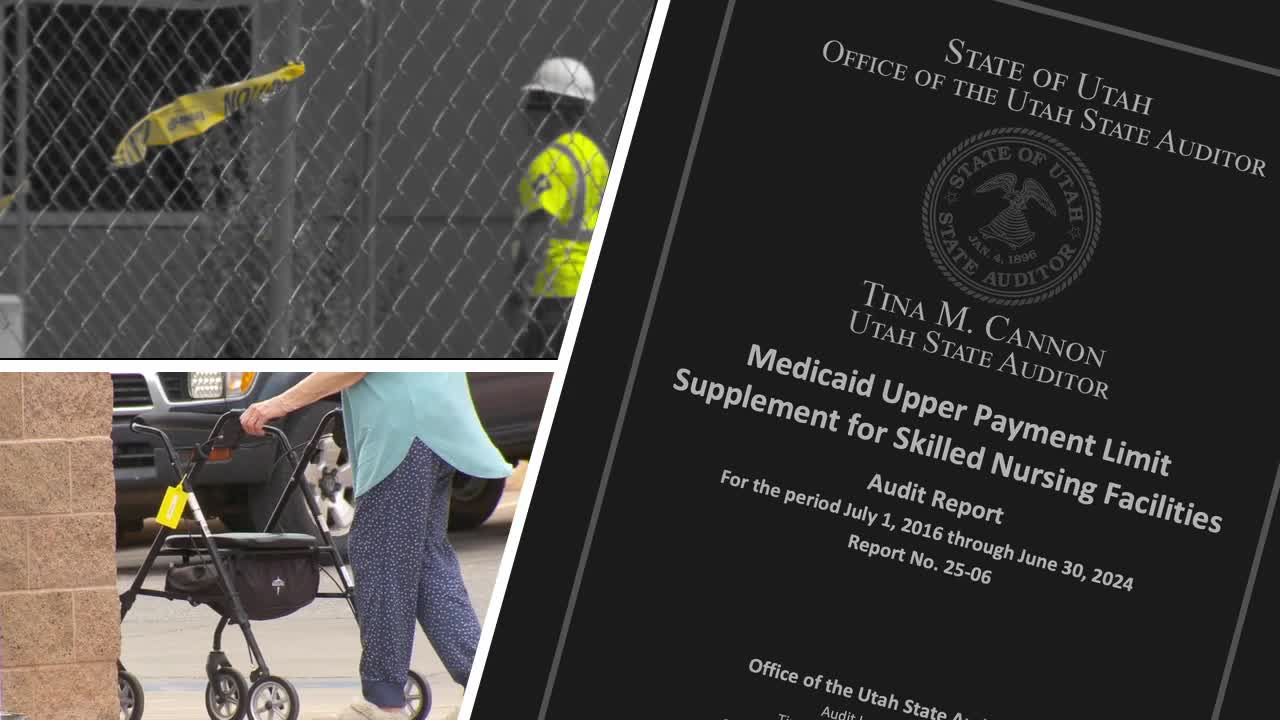

SALT LAKE CITY — Hundreds of millions of federal dollars meant to improve care at Utah’s government-owned nursing homes were never spent at the facilities — or on the patients — the money was meant to help.
That’s according to a state audit of the Upper Payment Limit program released earlier this month by the Utah State Auditor’s Office.
The report comes amid growing concerns about staffing and quality at these nursing homes, and as dozens of residents and their families have raised allegations of poor care in both lawsuits and interviews with FOX 13 News.
“I have a mother who was in a long-term care facility,” State Auditor Tina Cannon said of the audit’s findings. “To argue that the long-term care facilities were fully funded? No, they weren’t.”
The months-long audit, sparked by a legislative request, focused on spending by three city and county hospitals: Beaver Valley, Gunnison Valley and Kane County. They own the majority of the nursing homes under the Upper Payment Limit program.
Auditors found the nursing homes spent just 49% of nearly $1 billion in federal Medicaid funds that flowed to them through the program from 2016 to 2024. The hospitals kept the rest – 51%, or about $472 million – “for a combination of owner compensation, administrative costs, and hospital operating expenses,” according to the report.
The audit also found that funds meant for nursing homes went to improve care at those rural hospitals.
“In governmental accounting, money is not fungible,” Cannon said in an interview with FOX 13 News. “It is set for a specific purpose. And in this case, it is set for improving care in a skilled nursing facility. So any time that you see an excess administrative fee coming off, it’s not making it to where it’s intended to be.”
Beaver Valley Hospital owns 44 nursing homes under the Upper Payment Limit, which allows government-owned nursing homes to receive the substantially higher Medicare reimbursement rate for Medicaid patients. Gunnison Valley Hospital owns 15 facilities and Kane County Hospital owns five.
Barry Toone, an attorney with the Elder Care Injury Group, believes the audit validates fears that money in the program is not always “going where we wanted it to go."
"We’re seeing all of the problems, all of the injuries, all of the death,” he added, referencing several medical malpractice complaints the group is pursuing against nursing homes in the Upper Payment Limit. “That likely and probably would have prevented those injuries and those deaths if that money had been used.”
Blaine J. Benard, an attorney at the firm Holland & Hart LLP who is representing the three main hospitals in the program, did not respond to requests for comment from FOX 13 News.
In a written response to the state auditor, Benard acknowledged that the hospitals have used funds through the Upper Payment Limit for non-nursing home health care purposes. But he said that was done “only after all nursing facility costs have been paid” and was in compliance with state and federal law.
Benard also argued in an opinion piece published in the Deseret News after the audit was released that the program was “specifically designed to provide some of the additional federal funds for rural health care generally.” That spending, he wrote, is an “intended” outcome of the Upper Payment Limit, rather than “misuse or fraud.”
But Cannon counters that the intent of the program is clear: the funds should be spent at nursing homes, not on rural health care.
“I’m hoping for a very open, transparent conversation of how the best way to fund rural health care can be accomplished,” she said. “This is not the way to do it.”
'Asking for an improvement’
Over the course of several months, auditors who reviewed the Upper Payment Limit interviewed local government employees and staff at the Department of Health and Human Services (DHHS), reviewed state and federal Medicaid guidance, and traced the flow of funds through the program.
They ultimately identified a lack of DHHS oversight, improper use of federal matching funds and “excessive” overhead and administrative fees.
Cannon noted in an interview that the Utah Supreme Court has established a “reasonable” administrative fee of 1% to 3%. The hospitals have collected far more than that through the Upper Payment Limit.
“It’s outrageous by anyone’s definition of a ‘reasonable’ administrative fee,” she said. “Fifty-one percent is not reasonable.”
The audit also found that DHHS collected about $1.8 million in excess administrative fees for overseeing the program in 2025.
Auditors recommended that DHHS set amounts or percentages allowed for administrative fees and improve monitoring to ensure funds are used in accordance with the state Medicaid plan. DHHS told FOX 13 News in a statement last year that it does “not track specific spending related to how UPL monies are being used.”
The audit also highlighted that a “significant portion of the funds” meant for nursing homes were instead used to “improve care” at the city and county hospitals that own them.
Beaver Valley, for example, told FOX 13 News last fall that upgrades at its hospital and its new wellness center – complete with a recreation pool and lazy river – were funded with a portion of Upper Payment Limit dollars.
Critics say taxpayer dollars for nursing homes should be spent on care, not new buildings:
While the audit doesn’t mention those projects specifically, it says hospital expenditures appear “to be contrary to the purpose of” the program’s funds.
Noting that there’s nothing in the state Medicaid plan that permits the hospitals to retain money for administrative fees and owner compensation, the report recommended DHHS either stop allowing funds to be used for those purposes or clearly allow for them.
DHHS formally concurred or partially concurred with the recommendations in its response to the state auditor and noted that it will reach out to the Centers for Medicare and Medicaid Services to seek additional clarification on several points.
The hospitals were more defensive.
They pushed back on the findings in their response, implying that the auditor’s recommendations were based on misunderstandings of the program and raising questions about the auditor's independence.
Release of the audit, they wrote, could sound the “death knell” of the program.
Implementation of its recommendations, they added, would “literally destroy an essential state program, cause the loss of nearly $100,000,000 annually for healthcare, cause dozens of nursing facilities to close their doors, and leave thousands of patients annually with no professional care options.”
Asked about those concerns, Cannon said the audit’s role was to determine whether the program was operating as intended and added that her office was “very careful and very meticulous in exactly what we said and how we said it.”
"We’re telling you that the federal funding was not used appropriately, and it hasn’t been used appropriately in these circumstances," she said. “We’re asking for an improvement.”
As a rural Utahn, Cannon said she's empathetic to concerns about how to fund rural health care. But she said it needs to be done “openly and transparently.”
She also noted that the hospitals’ reply to the audit was "not what you typically see in a governmental response” and may spark additional questions about how funds through the program have been spent.
“It’s not lost on me that Beaver Valley Hospital as a small, rural hospital – Gunnison Valley, Kane County – can afford one of the largest regional law firms in the country to represent them in this case,” Cannon said. “If you have to hire a very expensive defense attorney to provide your response to a state audit, you’re making my point for me.”
‘A conversation that we will continue to have’
This isn’t the first time the Upper Payment Limit has come under scrutiny.
In 2017, a legislative audit raised concerns about Beaver Valley’s administration of the program and called for additional oversight and transparency of spending.
Among their findings, auditors at the time noted that nursing homes were using a little less than half of the federal dollars flowing through the program – while Beaver Valley collected the remaining 51% for seed funding and administrative fees.
Nearly 10 years later, “the percentage that they’re estimating was held back for owners and for administrative fees is about the same between both audits,” noted Toone, with the Elder Care Injury Group. “Quite literally nothing changed when it comes to the dollars.”
Toone shared an analysis with FOX 13 News last year showing that the quality of care at Upper Payment Limit nursing homes is worse than at facilities that aren’t part of the program and haven’t received extra federal dollars.
Beaver and Gunnison Valley and DHHS pushed back on those findings at the time.
But Toone said he believes this audit now provides additional insight into why the money hasn’t made a bigger impact – and hopes this review will spark more change than the last one did.
“An extra couple of million dollars a year for each of these nursing homes could absolutely change the way those nursing homes are run and operated,” he said. “It could increase staffing, which is desperately needed. It would improve training. It would give them all kinds of tools and all kinds of clinical opportunities that they don’t currently have.”
Families who rely on nursing homes in the program to care for their aging and vulnerable loved ones have long had questions about how Upper Payment Limit funds have been spent.
Brandon Harris – whose mother, Nancy, lives in a Beaver Valley-owned nursing home in Roy – was surprised to learn that Heritage Park Healthcare and Rehabilitation had received $18.9 million through the program since 2018.
“I don’t know the cost of everything medical, but it definitely does not look like they’re reinvesting their money back into the business,” Harris said in an interview last fall, noting concerns about quality of care and staffing at the facility.
He and his wife, Kandy Sousis, believe understaffing played a role in a incident where his mother was sexually assaulted by another residentat the facility in 2024.
"They should be getting more than what they have,” argued Sousis, a registered nurse.
Vulnerable adults sexually assaulted inside Utah nursing homes:
State records show other facilities have received even more money under the program – including St. Joseph Villa in Salt Lake City, at $51.8 million, and Sandy Health and Rehab, at $33.8 million.
While the audit indicates about half of that money never made it to the nursing homes, Cannon notes that the review didn’t look at where money that wasn’t spent at nursing homes actually went, or at the effectiveness of the program.
She said those questions may be the focus of future inquiries.
Conversations about how to fund rural health care will be “ongoing” as well, she added.
“It’s also a conversation that we will continue to have nationally with other state auditors across the country, with the Medicare program in general, with our federal partners over how this money is being used,” she said.
Toone said the Elder Care Injury Group is also working to better understand where Upper Payment Limit money has gone at the facilities they’re suing.
“We are trying to get additional answers through the discovery process, through litigation,” Toone said. “So we will fill in the gaps as best we can as we go along.”
He stressed that funds in the Upper Payment Limit are “desperately needed” and doesn't want to see the program end.
“I just want those dollars to be used for the reason they were supposed to be used,” he said.
Sousis also believes Upper Payment Limit funds could make a big difference for her mother-in-law and other vulnerable patients who rely on these facilities across the state.
But they can only help, she added, if the funds are actually spent on care.
“I mean, they could put a million back into there and it would be a lot more different,” Sousis said of her mother-in-law's nursing home. “A lot different. A lot better. And it’s just, it’s really sad.”
Read more from the FOX 13 Investigates team's ongoing coverage of Utah’s elder care systems:
- What are your discharge rights from a long-term care facility? It depends.
- Older adults are being discharged out of long-term care facilities — and into homelessness
- 'More psych than we can handle': Utah nursing homes struggle to address residents' mental health needs
- ‘It should never happen’: Vulnerable adults sexually assaulted inside Utah nursing homes
- Why FOX 13 News is reporting in-depth on gaps in Utah’s elder care systems
- Consensual sex between residents, employees in long-term care raises concerns
- Q&A: Utah’s Long-Term Care Ombudsman is ready to advocate for you and your loved ones
- Utah’s Adult Protective Services is substantiating few cases of elder abuse
- What you should know before choosing a nursing home
- Older adults are wandering away from Utah care facilities, sometimes with tragic outcomes
- Critics say taxpayer dollars for nursing homes should be spent on care, not new buildings
- Nursing homes receiving millions in extra taxpayer funds face allegations of poor patient care