



As the state's population ages, the systems meant to protect and care for Utah’s vulnerable older and disabled adults will grow increasingly important.
But a monthslong investigation by the FOX 13 News Investigates team – based on our review of thousands of pages of federal inspection reports; dozens of lawsuits and police reports; and nearly 20 interviews with advocates, researchers, service providers, attorneys, government officials and long-term care residents and their families – raises questions about how well these structures are serving those who need them most.
From understaffed nursing homes to high caseloads for investigators tasked with identifying neglect, abuse and exploitation of older adults, here are nine takeaways from our reporting on Utah’s elder care systems:
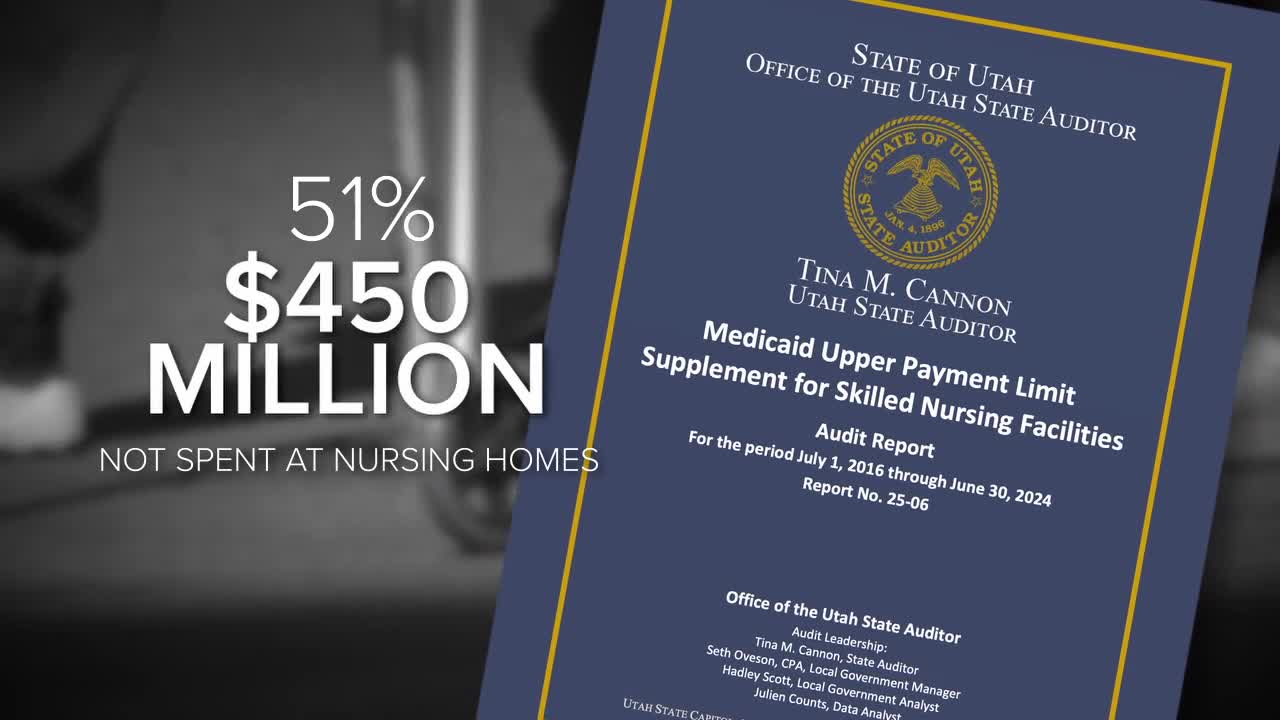
1. Utah’s government-owned nursing homes have received hundreds of millions of dollars through a program meant to improve care. But about half that money wasn't spent at these nursing homes, and metrics raise concerns about their quality of care.
Under a federal funding program known as the Upper Payment Limit, nursing homes owned by Utah cities and counties are eligible for additional federal money meant to improve the quality of their care.
Three rural communities are among the state’s biggest participants under the program: Beaver Valley Hospital owns 44 nursing homes, Gunnison Valley Hospital owns 15 and Kane County Hospital owns five.
But a recent state audit found nursing homes in the program spent just 49% of nearly $1 billion in federal Medicaid funds that flowed to them through the Upper Payment Limit from 2016 to 2024. The hospitals kept the rest – 51%, or about $472 million – “for a combination of owner compensation, administrative costs, and hospital operating expenses,” according to the report.
“It’s outrageous by anyone’s definition of a ‘reasonable’ administrative fee,” State Auditor Tina Cannon said in an interview with FOX 13 News. “Fifty-one percent is not reasonable.”
These Utah nursing homes received millions through a program meant to improve care:
The hospitals say the funds were used in compliance with state and federal law.
But Barry Toone, an attorney with the Elder Care Injury Group, believes the audit validates fears that money in the program is not always “going where we wanted it to go."
He shared an analysis with FOX 13 News last year showing that the quality of care at Upper Payment Limit nursing homes is worse than at facilities that aren’t part of the program and haven’t received extra federal dollars. The group provided FOX 13 News with its underlying analysis, which the station reviewed and spot checked against public data.
"We’re seeing all of the problems, all of the injuries, all of the death,” Toone added, referencing several medical malpractice complaints the group is pursuing against nursing homes in the program. “That likely and probably would have prevented those injuries and those deaths if that money had been used.”
2. About a third of Utah’s nursing homes are understaffed.
Federal data show about a third of the state's nursing homes currently have “below average” or “much below average” staffing ratings from the Centers for Medicare and Medicaid Services (CMS).
Experts say staffing is one of the best indicators of quality of care at a facility, while understaffing puts residents at higher risk of neglect and abuse.
After the recent repeal of a federal rule that sought to improve staffing in nursing homes, some advocates say they would like to see Utah lawmakers implement a minimum staffing standard.
“What would that look like? What impact would that have on facilities’ ability to function, and what impact would that have on the quality of care and life of the residents?” asked Alianne Sipes, the state of Utah’s Long-Term Care Ombudsman, in an interview with FOX 13 News. “Those are all really good questions worth exploring.”
‘A question of life or death’: How understaffing affects care in Utah’s nursing homes:
Utah currently requires only that facilities have “sufficient” staffing – a vague standard some experts argue leaves a lot of room for discretion.
3. Hundreds of older adults have wandered away from long-term care facilities in recent years.
We identified nearly 230 cases of older adults – often with cognitive deficits, like dementia – wandering away from the assisted living facilities and nursing homes entrusted with their care since 2019.
That number is based on a combination of federal nursing home inspection reports; police reports and call logs obtained through public records requests to more than a dozen departments; Silver Alerts; and news coverage of vulnerable people wandering.
Records show some residents who wandered away sustained frostbite in the winter or suffered burns from falls on the pavement in the summer. At least one nursing home resident died after he fell into a nearby body of water and drowned.
“This is a very, very serious issue,” noted Eilon Caspi, a gerontologist and elder mistreatment researcher.
To prevent wandering, experts suggest facilities invest in better staffing and in their recreation departments, to ensure residents are meaningfully engaged and don’t go searching for the door out of boredom. Improved training for staff and administrators can also help, Caspi said, as can a commitment to learning from all wandering events, regardless of their severity.
4. Deaths of older adults in long-term care facilities often aren’t reviewed by the state’s Fatality Review Committees.
When someone dies in a state-owned or operated facility — or if they were receiving services from a division of the Utah Department of Health and Human Services (DHHS) at the time — their death often prompts a deeper investigation by one of the state’s Fatality Review Committees.
The goal of these reviews is to evaluate deaths and identify systemic changes — whether “to procedures, policies, law or training” — that can help improve services and “prevent future client deaths,” according to a spokeswoman with the department.
But when someone dies in a nursing home or assisted living facility, “nobody is really doing that,” notes Nate Crippes, an attorney with Utah's nonprofit Disability Law Center.
Deaths of older adults in long-term care often underexamined, advocates say:
DHHS does review deaths of older adults in these facilities if the person had an open case with Adult Protective Services at the time of their death or in the year before — but only if their death was deemed a homicide, suicide or undetermined cause.
“I’m not going to disagree that when you’re talking about an aging population, a lot of people probably are going to pass away in facilities,” Crippes said. “But again, I don’t think it’s too much to ask to then really take a look at what were the circumstances? Why are we just saying, ‘Oh, these are all just fine?’”
Without a more comprehensive look at the factors that contribute to deaths in nursing homes and assisted living facilities, Crippes fears preventable issues may continue to occur.
“I think the state really should conduct these reviews system-wide,” he said.
5. Mental health is a growing concern among older adults. But long-term care facilities struggle to address their needs.
A 2010 study published by the National Institutes of Health estimated that between 65% and 91% of nursing home residents have some type of mental disorder — and other research indicates that the number with serious mental illness has been increasing.
But experts say these facilities were never designed to handle mental health at this scale, despite federal regulations requiring nursing homes to provide behavioral health services to patients who need them.
FOX 13 News found at least 18 incidents in federal inspection reports since 2019 where Utah facilities were cited for failing to provide such support to residents. Some attempted suicide, expressed thoughts of suicidal ideation or engaged in self-harm.
“I gave up hope,” one resident told regulators, who found that her nursing home had failed to offer outside behavioral health services before she attempted suicide. “There was no one here to talk to.”
'More psych than we can handle': Utah nursing homes struggle to address residents' mental health needs:
Sipes said the Ombudsman’s Office is having ongoing conversations at local and state levels to figure out how to help facilities find additional resources. Several nursing homes have also begun contracting with private therapy companies.
“We have a few early-adopter facilities who are recognizing ‘we need to adapt,’” she said. “Naturally, we’re going to have facilities that lag behind a little bit as well.”
6. Amid high caseloads for investigators, Utah’s Adult Protective Services substantiates a far smaller percentage of allegations of abuse, neglect and exploitation than the national average.
Nationally, adult protective services agencies uphold about 29% of the cases they investigate, according to a 2021 report prepared for the U.S. Department of Health and Human Services that covered 36 states.
Data shows Utah’s Adult Protective Services (APS), on the other hand, is substantiating an average of just 5% of all allegations of abuse, neglect and exploitation it investigates each year. That’s raised concerns among some advocates about the quality of those investigations as staff face high caseloads.
“I think we’re clearly missing something,” argues Crippes, with the Disability Law Center. “If we’re not investigating, we’re not looking at serious allegations, some really bad things can happen. And some people can really be put in some really difficult and horrific situations.”
DHHS records show that in the first half of last year, APS investigators in some positions handled more than 40 cases a month on average — almost triple the “ideal caseload” of 12 to 15 per month.
Nels Holmgren, director of the Division of Aging and Adult Services, said the agency is working to address high caseloads. But he said he isn’t concerned about low substantiation rates in Utah, pointing to differences in state laws around elder abuse investigations that can make it difficult to draw comparisons between states.
He acknowledged that the bar for investigating and substantiating cases “is high” in Utah and that investigators are subject to a “fairly narrow set of statutes.”
So “there are probably things that other states may consider a substantiated case that we don’t,” he added.
7. Sexual abuse is an underreported reality in long-term care facilities.
Federal regulators have cited nursing homes across the state at least 25 times since 2019 for failing to protect residents from sexual abuse. They also cited some facilities for failing to "respond appropriately" to the allegations.
In some instances, the perpetrators — whether staff or other residents — explicitly targeted those with cognitive deficits. Among them was an employee who assaulted two women with dementia and later told investigators he believed he could get away with it “because they can’t do much about it.”
Sexual abuse allegations are commonly underreported, so it’s difficult to understand the true prevalence of these cases.
In other instances, residents aren’t believed when they do make a report. For example, several Utahns with dementia said recently that they had been sexually abused in a facility but weren’t taken seriously “until it was caught on camera,” noted Sipes, with the Long-Term Care Ombudsman’s Office.
“They had voiced their concerns,” she said. “They had said that this had happened. But because of their diagnosis, they weren’t believed.”
Sipes said her office is working to educate facilities in the state “on how to take every allegation of abuse seriously, regardless of diagnosis.”
Experts say improved staffing, training and awareness can also help reduce and in some cases prevent incidents of sexual abuse within facilities.
"The more eyes that are available in a nursing home to monitor, to check in on residents, can ensure that residents are protected,” said Lori Smetanka, executive director of the National Consumer Voice for Quality Long-Term Care. “And that’s really an important piece of what we need to be focused on.”
8. There are no criminal and few lasting professional consequences for unlicensed care workers who enter consensual sexual relationships with their patients.
If a licensed care worker – like a doctor or registered nurse – began a consensual sexual relationship with a patient, the employee could face consequences under the professional conduct rules of their license.
But if an unlicensed care worker – such as a Certified Nursing Assistant (CNA) – did the same thing, there's no board to discipline them. And because the relationship was consensual, there are no criminal penalties either.
“There really isn't a lever to have the ability one to potentially pursue any sort of consequences or justice from it or to have any traceability from it,” noted Sen. Jen Plumb, D-Salt Lake City, in an interview with FOX 13 News.
The Utah Attorney General’s Office told lawmakers it’s been seeing these types of cases more frequently, prompting Plumb to sponsor a bill during last year’s legislative session to criminalize such relationships.
Because there’s no way to track employees with past concerns, the lawmaker said she heard stories while running the bill about “individuals who had jumped from one facility to another facility to another facility to another facility.”
But the legislation ultimately failed, as some felt the state shouldn’t criminalize consensual sex. Others wanted to see harsher penalties than those outlined in the bill.
Plumb said she may sponsor the legislation again in a future session. In the meantime, she hoped the bill would shine a light on these relationships.
“It may be that all we do ultimately get out of this is that awareness piece,” she said, “and people's maybe feeling that they can advocate for themselves or for their family members.”
9. Dozens of older or disabled adults have been discharged from long-term care facilities to homelessness.
Nursing homes are supposed to find a safe destination for residents to go when they discharge out of care. But data from Utah's Long-Term Care Ombudsman shows an increasing number of older adults in the state are being discharged out of these facilities and into homelessness — something experts say can lead to poor health outcomes and high hospital readmission rates.
Since March 2024, the office found 57 nursing home residents received a discharge notice with a shelter or hotel listed as their next destination, while 34 others were discharged to “unknown” destinations. The office identified a similar, though less prevalent, trend in assisted living facilities.
The discharges come as many older adults are feeling the pinch of rising costs and shrinking social safety nets. And as Utah’s affordable housing crunch has pushed some older adults into homelessness, it’s also made it harder to find places for them to go after they leave long-term care.
“We see a wide variety of facilities really trying to find solutions — there just isn’t any out there — to facilities who are just really putting them on the sidewalk and saying, ‘The rest is up to you or family,’” Sipes said.
Advocates say the discharges call for greater collaboration between homeless service providers and the long-term care industry.
Read the FOX 13 Investigates team's full coverage of Utah’s elder care systems:
- ‘A question of life or death’: How understaffing affects care in Utah’s nursing homes
- Deaths of older adults in long-term care often underexamined, advocates say
- These Utah nursing homes received millions through a program meant to improve care
- State audit: Millions meant to improve Utah nursing homes were never spent on care
- What are your discharge rights from a long-term care facility? It depends.
- Older adults are being discharged out of long-term care facilities — and into homelessness
- 'More psych than we can handle': Utah nursing homes struggle to address residents' mental health needs
- ‘It should never happen’: Vulnerable adults sexually assaulted inside Utah nursing homes
- Why FOX 13 News is reporting in-depth on gaps in Utah’s elder care systems
- Consensual sex between residents, employees in long-term care raises concerns
- Q&A: Utah’s Long-Term Care Ombudsman is ready to advocate for you and your loved ones
- Utah’s Adult Protective Services is substantiating few cases of elder abuse
- What you should know before choosing a nursing home
- Older adults are wandering away from Utah care facilities, sometimes with tragic outcomes
- Critics say taxpayer dollars for nursing homes should be spent on care, not new buildings
Nursing homes receiving millions in extra taxpayer funds face allegations of poor patient care